


Those of us who spend some of our lives defending Israel in the public discourse are accustomed to being told, even mocked, that we are incapable of finding any fault in the Jewish state at all—that we instinctively hear criticism of Israel and cry "anti-Semitism!"
I would like to put an end to this calumny by offering a strident criticism of Israel. To the so-called critics' dismay, it will not imply that Israel must cease to defend itself against its annihilationist neighbors or disavow the millennia-old connection between the Jewish people and the Holy Land. In other words, it is a criticism, not a thinly veiled call for the elimination of a sovereign state. But (and surely this will curry favor with those principled critics) it is a criticism amply backed up by painstaking research and comprehensive legal and historical analysis, courtesy of scholar Yonatan Green.
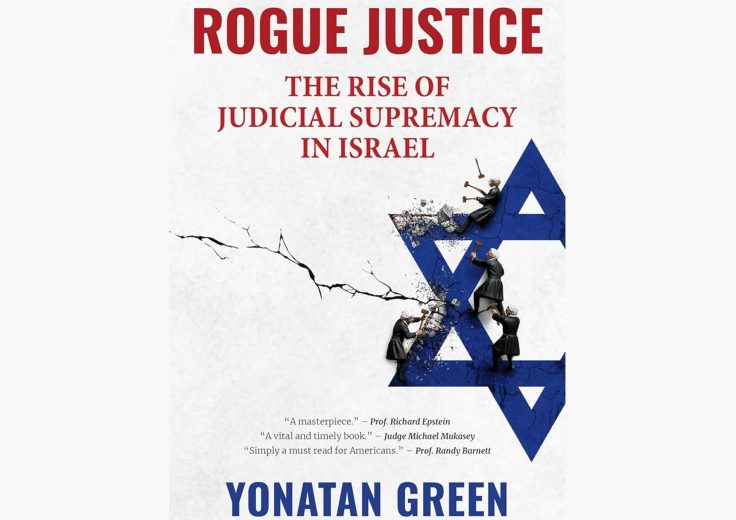
Here goes: Israel's judicial system is insane. It is bat-guano crazy. Green's recently released magnum opus, Rogue Justice, permits no conclusion other than that the current structure, powers, and methodologies of the Israeli Supreme Court render the state a juristocracy, rule by judges, at best. At worst, there is a colorable argument that the Supreme Court operates as an enlightened monarchy, selecting its heirs, arrogating powers, and ruling according to its own unimpeachable sense of benevolence.
Rogue Justice is a long book set in small typeface, and every single page contains a scandal. It usually takes the form of showing how Israel's judiciary behaved reasonably until the 1980s, when activist judges incepted some revolutionary concept out of nowhere, before the concept took on a life of its own and revealed itself to be completely out of control. Readers who have studied judicial structure or constitutional theory could be forgiven for gasping audibly throughout.
A good entry point for understanding the extent of Israel's journey from judicial activism to judicial supremacy is legal interpretation, a debate somewhat familiar to American audiences. In the United States, textualism is the prevailing interpretive theory: Legal texts should be interpreted according to the public meaning of their words at the time of enactment. Some competing theories emphasize the broader aims or intentions behind legislation, while others view legal meaning as evolving with changing societal values and norms.
The Israeli analog would be comical if it did not flout the rule of law so flagrantly. Israeli judges generally adopted normal methodologies until the 1980s. But as Green details, legendary chief justice Aharon Barak—the source of so much mischief, to whom Green's book's title could easily refer—invented the whimsical "objective purposive interpretation," a license for judicial aggrandizement unparalleled in the world.
The theory behind OPI is that every law bespeaks two sets of legislative purposes: a "subjective" intent indicated by the law's text and an "objective" purpose the legislature, per Barak, "would have had if it had thought about the matter." If the law and its "objective" purpose are at odds, "greater weight should be accorded to the objective purposes," argues Barak. The Court should ignore the "subjective" meaning and rule in line with their sense of "equality, justice, morality … human dignity, judicial integrity … the democratic values of the state … good faith, natural justice, fairness, and reasonableness." Good thing those ideals have easily distilled and undisputed meanings.
This scheme not only has the distinction of doing to "objective" what millennials did to the word "literally," but also insults legislatures, completely disregarding all democratic will in the name of democracy, and using "interpretation" to hijack all lawmaking. Green calls OPI a method of conferring an "extraordinary degree of judicial discretion and ultimate power." What's extraordinary is Green's restraint in pointing out how facile, how incompatible with democracy, how susceptible to crumbling under the scrutinizing eye of the average 1L is this embarrassing excuse for an interpretive methodology. To borrow from an American master of legal interpretation, if I ever joined an opinion that deployed OPI unironically, "I would hide my head in a bag."
It gets worse. In the early 1980s, Barak articulated a new standard for judicial review of the Israeli government's executive actions. He called it "reasonableness," which seems to parallel Anglo-American standards such as arbitrary-and-capricious review—the government can't take absurd or pretextual actions, or abuse its discretion. Usually, American courts defer to the government's decisions, recognizing that even foolish exercises of discretion are usually not quite illegal and must be resolved through politics.
Not so in Israel. Green shows that Barak's reasonableness is something quite different: "The government must correctly balance the relative and competing interests affected and involved by any decision." If the Court decides that even a reasoned and justified executive decision did not do the calculations the Court would have done, it will deem the action illegal and void.
In one prominent case, a foreign student active in the global boycott, divestment, and sanction movement against Israel was denied entry into the country under a statute that explicitly granted the minister of the interior the power to deny visas to noncitizens involved in BDS. The Court required the government to admit her, finding that the minister's decision "clearly deviates from the range of reasonableness." Why? Did the minister circumvent the proper procedures? Did he deny this woman entry because she had a certain hair color? No. He did not adequately account for the harm the denial would do to Israeli academia. As Green points out, the Court itself did an incomplete cost-benefit analysis, ignoring important security and incentive effects of the law as written and not even bothering to admit or analyze evidence about those alleged academic harms. It is the Court that acted arbitrarily in deeming the minister's actions unreasonable—not the government.
Somehow, it gets even worse. The Court's meddling in Israel's political affairs—and the difficult judgment calls that constantly arise in a nation always under attack—should at least be limited by the doctrines of standing and justiciability. Standing requires that plaintiffs demonstrate a direct, concrete injury to bring a case, rather than allowing anyone to challenge government actions on principle alone. Justiciability restricts courts to resolving actual legal disputes rather than weighing in on political questions. And neither concept has meaningfully existed in Israel since 1988, when Barak declared "there is no action to which the law does not apply. … any action, be it political or a policy matter," has "a legal norm which adopts a position towards it." Anyone can bring a lawsuit to the Supreme Court; the Court can decide which law applies, construe its "objective" meaning however it wishes, and declare it "unreasonable" by its own whimsy.
Against all odds, it gets even worse. The Israeli Supreme Court effectively selects its own successors through a nine-member Judicial Selection Committee in which sitting justices hold three seats, and the Israeli Bar Association—heavily influenced by the legal establishment—holds two more. An appointment to the Court requires seven votes out of nine, giving the judiciary and its allies a de facto veto over appointments. "If they so choose," writes Green, "this unelected majority can appoint and promote judges throughout the legal system almost at will." Even without the IBA's input, "the Justices voting in unison can block any Supreme Court candidate."
The Court's interpretive adventures are licensed by these structural and profoundly antidemocratic problems (among others, such as the Court authorizing itself to serve as a trial court in some cases, though it has no rules of evidence and leaves no room for appeal).
Only massive changes to Israel's constitutional structure—how power is delegated, shared, and balanced—can begin to dismantle the shadow constitution Barak and his fellow judicial activists have built. Eventually, an Israeli Supreme Court justice will deride OPI for the sham it is, reestablish the doctrines of standing and justiciability, and construe "reasonableness" reasonably. But much must happen in the interim, starting with the democratization of the appointments process.
It does not take a long memory to recall what happened last time such a reform was proposed. Driven mad by apocalyptic rhetoric about proposed judicial reforms—eminently sensible if necessarily dramatic changes to the Court's role in Israeli politics—Israelis took to the streets and nearly sparked a civil war. The atrocities of October 7, 2023, put an end to that. But reform will have to be revisited sometime, because Israel cannot go on with a judiciary that swallows the rest of the government whole. The Israeli public reflexively revolted against the judicial reform proposals out of a combination of ignorance and instinctive incrementalism; the campaign to tar the proposals as "antidemocratic" succeeded despite being a perfect inversion of the facts.
Perhaps within our lifetime the righteous and beleaguered people of Israel will be ready to pass some laws that will insist the people can govern themselves. If that is to happen, Yonatan Green must become a household name, and Rogue Justice must sit on every shelf from Kiryat Shemona to Eilat. Readers around the world will learn from Green's work what being ruled by men, rather than law, looks like—and how quickly a revolution promising to fight for democracy can instead flout it.
Rogue Justice: The Rise of Judicial Supremacy in Israel
by Yonatan Green
Academica Press, 698 pp., $40
Tal Fortgang is a legal policy fellow and adviser to the president at the Manhattan Institute.