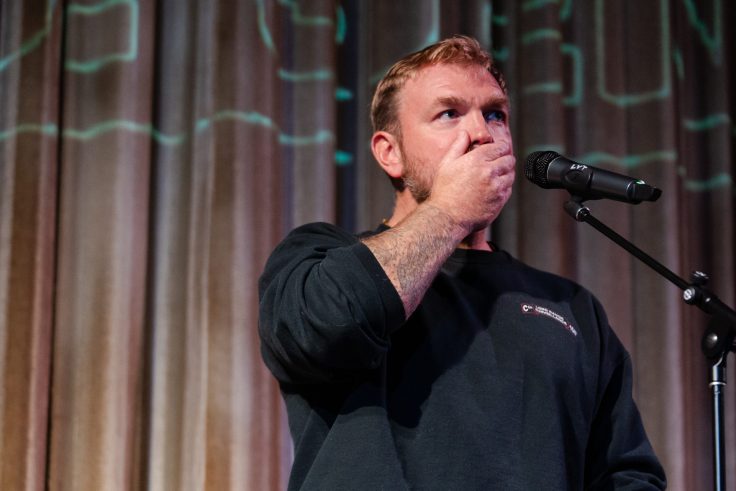


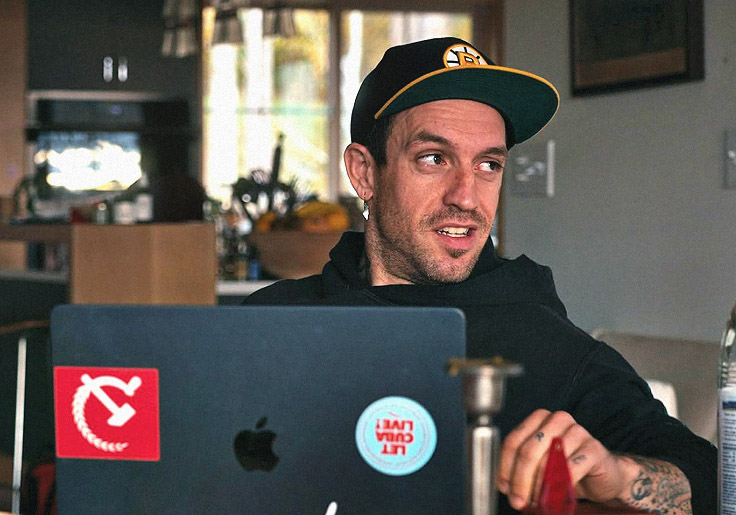
You've probably never heard of James Cox "Fergie" Chambers Jr., but that's OK. There isn't much to know that can't be gleaned from a cursory description or even photos of his "edgy" tattoos glorifying communist tyrants. Have you ever wondered what would happen if the most annoying person you know won the lottery? Fergie Chambers is what.
Chambers, 40, inherited a nine-figure fortune from his family's business empire, Cox Enterprises. He uses it to sustain a cushy lifestyle while he incessantly rails against the evils of bourgeois capitalism and (obviously) the Jews. He is constantly denouncing his own family—longtime patrons of the Democratic Party who want nothing to do with him. Each year he devotes a small fraction of his vast wealth to various left-wing projects—a Marxist commune for listless hipsters here, a gang of anti-Semitic vandals there.
For some reason, Chambers is the subject of a new documentary, All About the Money, by Irish filmmaker Sinéad O'Shea. It debuted last week at the Sundance Film Festival, where rich protesters and even richer celebrities joined forces to denounce ICE. In front of the camera, Chambers is exactly as expected. He's an ill-tempered nut job who loves to talk about himself. He rants nonsensically about politics with the confidence of a stoned college freshman. Think Hunter Biden, minus the charisma and zeal for a good time. He's a car crash you'd slow down to gawk at, but you wouldn't stop to help.
"All of the spaces in this country are totally dominated by reactionary culture," Chambers says at one point about his plan to start a martial arts studio exclusively for communist revolutionaries. When the documentary crew started following him, Chambers was in the process of launching this gym for the freeloading residents of his marijuana compound in rural Massachusetts. They hosted study sessions on urban guerrilla warfare in between jiu-jitsu classes. Some of them like watching football on TV, but feel guilty about supporting capitalism. The struggle is real.
The film opens years later on an entirely different scene. Chambers is holed up in a lavish hotel suite in Ireland. He smokes out the window and laments the state of his investment in a pro-Hamas soccer team in Tunisia, where he fled to escape criminal charges and converted to Islam. The commune has fizzled, the gym has shut down, and several of his comrades were jailed for vandalizing an Israeli defense contractor's offices after the Oct. 7 attack. He's even richer than he was before—thanks to his capitalist investment portfolio—but just as bored.
All About the Money follows Chambers on his inevitable path to nowhere in particular. Hamas incites the action by slaughtering Jews and inspiring Western leftists to protest Israel. Chambers springs to life like a dog bounding after a tennis ball. To channel his support for the "glorious" terrorists, Chambers starts funding Palestine Action US, a radical activist group that condones murder. He plays a role in the group's attack on Elbit Systems, the Israel-based defense firm, then runs away to avoid the consequences. One of his female serfs was not so lucky, and the limits of Chambers's generosity are tested. She's packing a bag for jail; he's thinking about going back to school to study religion.
The film is not a fawning portrayal. That would be impossible. It is a portrait of a wayward scion, but not much else. O'Shea asks some sensible questions off camera, but rarely challenges Chambers's worldview from an interesting perspective. She shares his disdain for Israel, having pledged last year to boycott Israeli film companies "implicated in genocide & apartheid against the Palestinian people." At a Q&A following the Sundance screening, O'Shea said that Chambers, who openly supports terrorism, was "probably having less of a negative impact than an awful lot of billionaires."
O'Shea was clearly eager to convey a meaningful point about the all-corrupting influence of money—that even rich communists can be corrupted by capitalist privilege. The film's soundtrack is dark, ominous, and sinister. Evil must be lurking somewhere close. At the Q&A, O'Shea said she admired Chambers for his lack of discretion compared to other semi-billionaires, as though his willingness to appear in a documentary about himself was a bold political statement rather than a symptom of his grandiose self-regard. There are plenty of narcissists who don't have trust funds.
In what is supposed to be a powerful moment of self-reflection, O'Shea invites Chambers to agree with her premise—that people should fear him because he's rich. Chambers doesn't hesitate. Of course people should fear him, he says. He's an "extremely wealthy member of the white American bourgeoisie." How brave! How refreshing! Most normal viewers would agree he should be feared—because he's crazy.
The mystique wears thin in Ireland, where Chambers pretends to be embarrassed by the opulence of his hotel. He has called the film crew back because he "wanted to talk," and proceeds to recount his tormented childhood, being raped in an insane asylum, whoring himself out for drugs. "I have wondered if maybe [this] could be seen to distract from things you've said and done," she tells him, disappointed.
What's left is the story of a disturbed man with pallets of cash that keep him from ever hitting rock bottom hard enough to seek help. Does it give us any broad insight into the failings of capitalism? Not really. O'Shea was kind enough to let Chambers watch the film before its debut at Sundance. He wasn't a fan. The film concludes with an end card explaining that Chambers "offered to cover the film's production budget plus a cash payment to the film's director to prevent it being screened."
Clearly, she wasn't afraid to say no.