

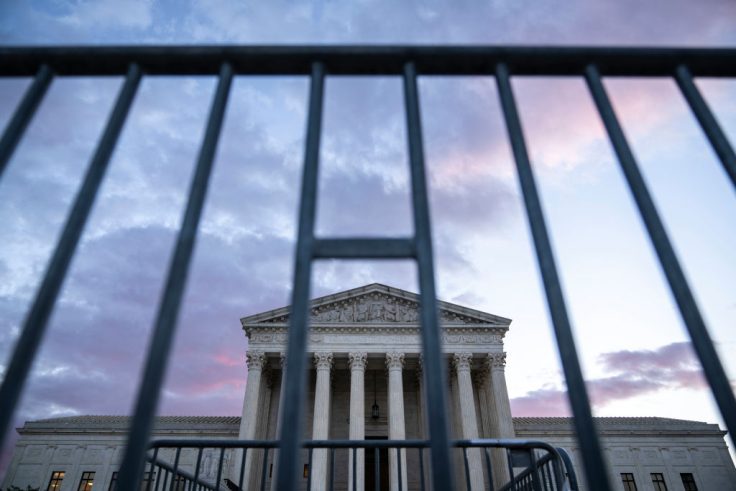
For much of the past year and a half you couldn’t open the New York Times or approach an elite university campus without hearing a panic about how President Donald Trump was becoming a dictator with "no guardrails" to curb him. After today’s 6-3 opinion from the Supreme Court striking down Trump’s tariffs, that complaint looks more foolish than ever. Trump called the opinion "terrible," "a shame," "ridiculous," and "totally defective."
The New York Times, in a 12-part Halloween 2025 editorial headlined "Are We Losing Our Democracy?" faulted the Supreme Court: "[T]he justices have too often played into his strategy … [T]he court’s reluctance to restrain him appears to have emboldened him to sidestep lower court orders he does not like."
"Why does the Supreme Court keep bending the knee to Trump?" a former New York Times reporter, Steven Greenhouse, asked in October 2025, in a Guardian column that observed, "[T]he court’s conservative supermajority has ruled time after time in favor of Trump since he returned to office. … [M]any Americans are dismayed that the conservative justices have been so submissive to Trump, the most authoritarian-minded president in US history. ... [T]he justices have utterly failed to provide the checks on Trump that many legal scholars had expected."
The Greenhouse column quoted Harvard professor Steven Levitsky, who likened Chief Justice John Roberts to Neville Chamberlain, the British prime minister who ceded territory to Hitler in the Munich Agreement. "John Roberts has been Chamberlain," Levitsky said.
"The Supreme Court and all other federal courts now appear to both halves of the polarized political spectrum to be weaker, more political, easier to manipulate, less bound to the Constitution," Anne Applebaum wrote in the October 2024 issue of the Atlantic under the hyperbolic headline "The End of Judicial Independence." She warned of "the real possibility of ‘an imperial judiciary walking arm in arm with an imperial executive’: a new political order, one in which the laws and norms that have insulated America from dictatorship slowly degrade." The phrase about the imperial judiciary comes from Laurence Tribe, Carl M. Loeb University Professor of Constitutional Law Emeritus at Harvard University.
Well it’s a fine line between vigilance of our constitutional liberties and alarmism that stokes unwarranted, paranoid panic.
As it is, the six justices who struck down the Trump tariffs included not only Roberts but also two justices that Trump himself nominated to the High Court—Neil Gorsuch and Amy Coney Barrett. He called those two "an embarrassment to their families" and suggested that they’d been swayed by foreign influence from China. The plaintiff in the tariff case, Learning Resources, Inc., is a family-owned U.S.-based company that imports toys manufactured in China. Its public face, Rick Woldenberg, donated a total of $15,000 to the Republican National Committee in 2011 and 2012 and $7,200 to the Harris campaign in 2024.
Gorsuch, in a concurring opinion, provided the additional service of explaining, in modern language, why the Constitution gave Congress, not the president, the taxing power. "[M]ost major decisions affecting the rights and responsibilities of the American people (including the duty to pay taxes and tariffs) are funneled through the legislative process for a reason," the justice wrote. "Yes, legislating can be hard and take time. And, yes, it can be tempting to bypass Congress when some pressing problem arises. But the deliberative nature of the legislative process was the whole point of its design. Through that process, the Nation can tap the combined wisdom of the people’s elected representatives, not just that of one faction or man. There, deliberation tempers impulse, and compromise hammers disagreements into workable solutions. And because laws must earn such broad support to survive the legislative process, they tend to endure, allowing ordinary people to plan their lives in ways they cannot when the rules shift from day to day. In all, the legislative process helps ensure each of us has a stake in the laws that govern us and in the Nation’s future. For some today, the weight of those virtues is apparent. For others, it may not seem so obvious. But if history is any guide, the tables will turn and the day will come when those disappointed by today’s result will appreciate the legislative process for the bulwark of liberty it is."
The three justices who dissented—Kavanaugh, Thomas, and Alito—pointed out that Trump may yet try to impose the tariffs using laws other than the International Emergency Economic Powers Act of 1977, which Trump had used to impose the tariffs. He could try Section 122 of the Trade Act of 1974, or Section 201 of the Trade Act of 1974, or Section 301 of the Trade Act of 1974, or Section 338 of the Tariff Act of 1930, or Section 232 of the Trade Expansion Act of 1962.
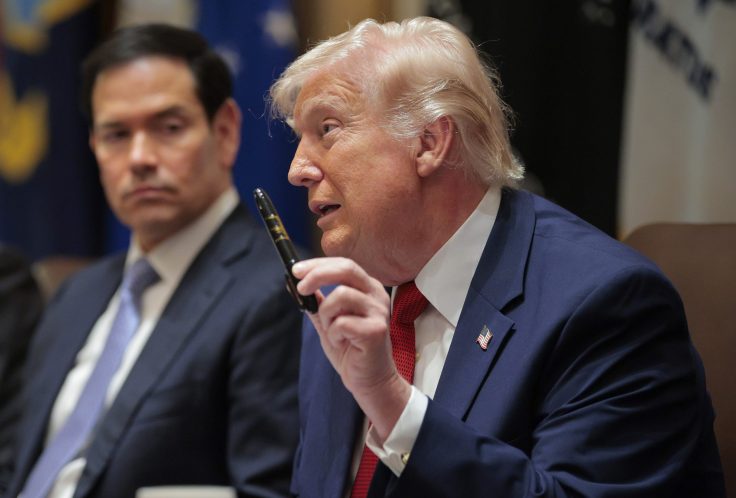
As Trump put it in a press conference this afternoon, "We have alternatives. ... We have ways, numerous other ways." The president said he’d go forward with a 10 percent global, "across the board," tariff under Section 122 of the Trade Act of 1974. "In the end, I think we’ll take in more money," Trump said.
The Treasury secretary, Scott Bessent, said in remarks at the Economic Club of Dallas that "Treasury’s estimates show that the use of Section 122 authority, combined with potentially enhanced Section 232 and Section 301 tariffs will result in virtually unchanged tariff revenue in 2026."
If the courts don’t ultimately wind up permitting that route, or if Trump prefers, he can go directly to Congress. At least a few members of the legislative branch expressed enthusiasm for, or at least openness to, that approach.
Senator Bernie Moreno, Republican of Ohio, posted to social media, "SCOTUS’s outrageous ruling handcuffs our fight against unfair trade that has devastated American workers for decades. These tariffs protected jobs, revived manufacturing, and forced cheaters like China to pay up. Now globalists win, factories investments may reverse, and American workers lose again. This betrayal must be reversed and Republicans must get to work immediately on a reconciliation bill to codify the tariffs that had made our country the hottest country on earth!"
And the chairman of the House Select Committee on Strategic Competition between the United States and the Chinese Communist Party, John Moolenaar, Republican of Michigan, called for immediate action to pass the Restoring Trade Fairness Act, which Moolenaar introduced with Tom Suozzi, a Democrat of New York. That legislation would repeal permanent normal trade relations with China and impose tariffs of 35 to 100 percent depending on whether a product is critical to national security.
"China continues to engage in predatory trade practices that hurt American workers, hollow out our manufacturing base, and threaten our national security," Moolenaar said in a statement. "Tariffs on China level the playing field for Americans, and President Trump has demonstrated, since his first administration, that tariffs are one of the few meaningful tools in the U.S. economic security toolkit for confronting China. That's why I led the first ever bipartisan effort to repeal China’s privileged trade status. Congress should quickly pass this legislation to put American workers first, rebuild our nation’s manufacturing capacity, and establish a consistent trade policy towards China."
I’m not on Capitol Hill counting votes, and Trump managed to get himself resoundingly ("too big to rig," as Trump put it this afternoon) elected in 2024 with tariffs as part of his platform. That said, as the opinion notes, "The Government points to projections that the tariffs will reduce the national deficit by $4 trillion." The idea that Congress would approve a $4 trillion tax increase in a midterm election year seems far-fetched; Republicans are Trump loyalists but they aren’t suicidal.
Trump initially sent a mixed signal on the point this afternoon, first saying he didn’t need additional congressional authority, then saying, "I would ask Congress and probably get it."
"I don’t have to ... and it’s all already been approved by Congress so there’s no reason to do it," Trump said in response to a follow-up on the topic.
Congress did vote, narrowly, to dial back the tariffs on Canada, with a few Republicans—Senators Rand Paul, Susan Collins, Mitch McConnell, and Lisa Murkowski, and House members Thomas Massie, Don Bacon, Kevin Kiley, Dan Newhouse, Brian Fitzpatrick, and Jeff Hurd—joining Democrats for the votes.
Though Trump was critical of the outcome of the Supreme Court opinion, he said a positive is that it would provide "certainty."
"This country is booming," Trump said. "It’s booming because of tariffs."