





A dark money group of left-wing environmental activists has been quietly "training" judges overseeing climate-related lawsuits, hosting them at multi-day, all-expenses-paid seminars in locales like Napa Valley and Palm Beach. Judges who attend these luxury retreats—where they are subject to indoctrination—are not required to report them in ethics disclosures.
At the "Judicial Leaders in Climate Science" seminars, representatives of the activist group, the Climate Judiciary Project, present to the judges contested claims on climate and other environmental issues as settled, scientific fact. Judges who attend the seminars are also expected to make a year-long commitment to participate in CJP events, take online classes, and, perhaps most importantly, help identify and recruit other judges who have influence over environmental law. The secretive program is designed to function like a judicial Tupperware party, with an ever widening circle of judges recruited to normalize controversial and often unsubstantiated climate theories.
A trove of previously unseen documents obtained by the Washington Free Beacon, including dozens of internal emails, provides a new window into the otherwise opaque operations of the CJP, a subsidiary of the nonprofit Environmental Law Institute, which claims to be "nonpartisan" but has deep ties to the climate movement’s far left.
While neither the Environmental Law Institute (ELI) nor the Climate Judiciary Project (CJP) are required to disclose their donors, the IRS filings of other nonprofit organizations show they include left-wing charities like the Picower Foundation—recently renamed the Freedom Together Foundation—which has recently focused on "democracy, gender, and racial justice." The late Jeffry Picower, whose massive fortune now funds the Freedom Together Foundation, was the single largest beneficiary of Bernard Madoff’s Ponzi scheme.
While judicial ethics rules in the state and federal judiciaries typically require judges to disclose their attendance at privately funded seminars—and when they receive free travel and lodging—seminars hosted by the CJP like "Judicial Leaders in Climate Science" are not subject to those rules because the organization has managed to partner with "educational groups" like the Federal Judicial Center, thus masking its initiatives as continuous education and lifelong learning for modestly paid judges, who are often going to be in the same job until retirement. The Federal Judicial Center pulled a chapter on "climate science" from its reference manual for judges earlier this year after over two dozen Republican attorneys general sent a letter noting that the authors of the chapter have cheered litigation as a means of addressing the harms of fossil fuels.
The new documents, obtained through an open records request by the Patriots Foundation and other nonprofits and shared exclusively with the Free Beacon, show CJP leaders strategizing about how to target judges overseeing climate litigation cases, how to promote the so-called clean energy interests of their donors, and how to conceal their ties to unsavory activist groups.
The group’s founder, Paul Hanle, a former Obama adviser who’s a major proponent of theories tying hurricanes and typhoons to climate change, said in a February 2022 email that he was "very pleased that all but one of our target states (where cases were being brought) opted in" to participate in the program. Another email included a list of judges in "states that are a priority for us (in bold)," which included Florida, Maine, and Colorado. Hanle has written that fossil fuels are the "main driver" of climate change, which, he said, is "assaulting humanity and Earth’s natural systems."
A spokesman for CJP, Nick Collins, told the Free Beacon the group's "continuing education" is meant to ensure judges who are "legal generalists" can "competently evaluate the evidence presented by all parties" in climate-related cases.
"CJP meets this need by providing evidence-based judicial education about widely-accepted climate science and how it arises in the law," Collins said. "CJP does not advise judges on how they should rule on any issue or in any case. In every case, it is up to the judge to consider the specific evidence presented by the parties and make particularized rulings grounded in the factual record before them."
Collins continued: "In collaboration with the National Judicial College (NJC), ELI developed a program to teach state court judges both climate science and leadership skills. NJC recruited the judge participants by offering each state's Chief Justice the opportunity to nominate a judge in their state to serve as a ‘judicial leader’ who would then decide how to educate their colleagues about climate science. It was up to those Chief Justices to decide whether to participate and who to nominate."
Judges who participated in CJP programs were invited on all-expenses-paid trips to vacation destinations. In 2020, ELI paid for multiple judges to attend a climate-focused conference that the group was sponsoring in Honolulu.
One of these judges was Oregon district judge Ann Aiken, according to the records, which include a list of judicial attendees. The emails indicate that ELI agreed to pay $645 for Aiken’s stay at the Holiday Inn Express Waikiki.
At the time of the conference, Aiken was serving as a judge in a key climate case, Juliana v. United States, which dragged on from 2015 to 2024. The Honolulu conference featured a presentation by Julia Olson, the lead counsel for plaintiffs in Juliana.
Aiken repeatedly ruled in Olson’s favor during the unusual lawsuit, brought by climate activists against the U.S. government on behalf of children who purportedly faced harm from climate change. The plaintiffs wanted the court to order the government to concoct a plan to phase out fossil fuels. The Ninth Circuit dismissed the case in 2020 and a district court formally ended the litigation in 2024.
Attendance at CJP seminars come with strings attached. Judges participating in the "Judicial Leaders in Climate Science" seminar are required to make a year-long commitment to participate in CJP programming, including two in-person conferences, attend the group’s online courses, "sharing updates on state-specific activities," and take steps to "apply the course curriculum" within their state judiciaries.
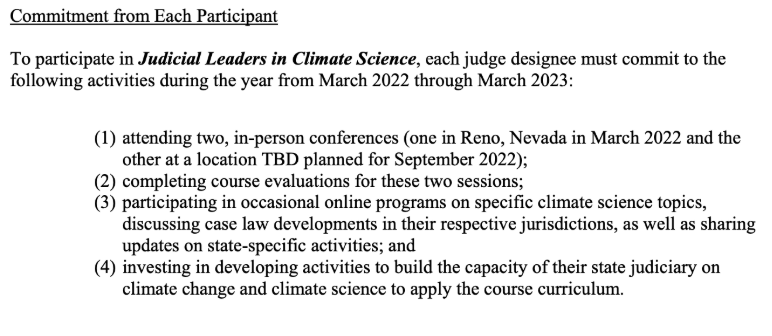
Participants were given all-expenses-paid trips to Reno, Nevada, and Woods Hole, Massachusetts, to attend conferences. In emails reviewed by the Free Beacon, the CJP and participating judges discussed methods of "recruiting allies" to the program, and the organizers pressed the jurists to act as "mentors" and "ambassadors" to their colleagues.
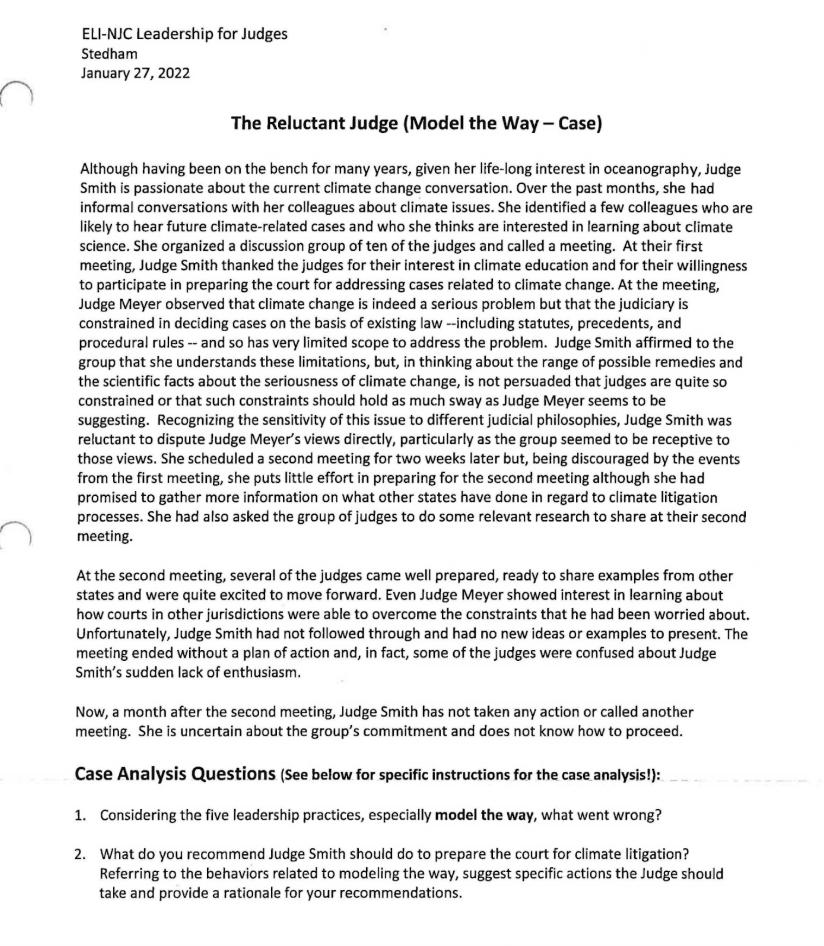
Materials for a 2022 seminar show that judges were broken into small groups, one of which was instructed to analyze a fictitious "case study" in which a judge backs away from confronting a colleague who believes that "the judiciary is constrained in deciding cases on the basis of existing law – including statues, precedents and procedural rules – and so has very limited scope to address" climate change. The judges are instructed to discuss "what went wrong."
CJP also encouraged participants to host local events for other judges so that CJP could gather attendee names as a recruitment tool. The group quietly tracked visitors to its website, according to a slideshow presentation in the documents.
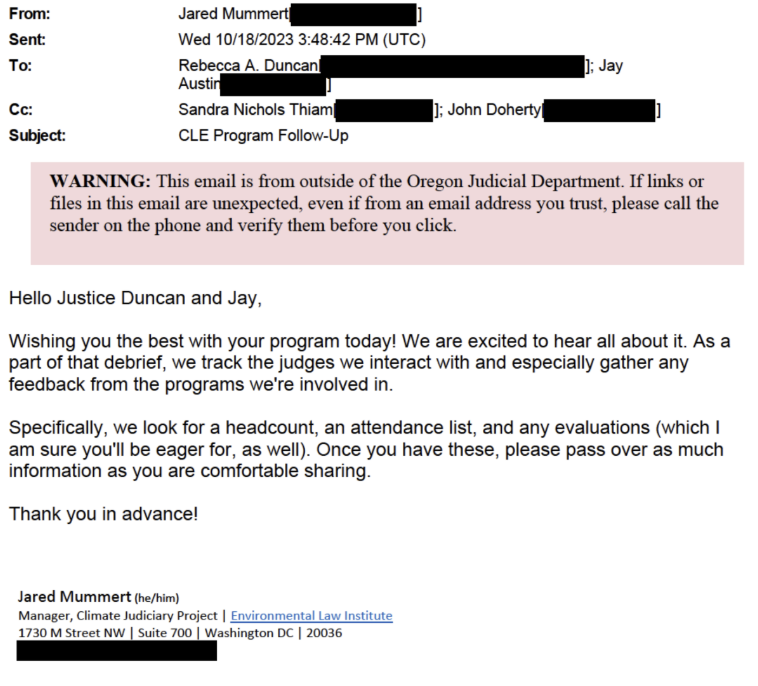
In one email, CJP Manager Jared Mummert told Oregon judge Rebecca A. Duncan that she would need to "debrief" him and send him an "attendance list" after an event she was hosting. "[A]s part of that debrief, we track the judges we interact with and especially gather any feedback from the programs we're involved in," wrote Mummert. "Specifically, we look for a headcount, an attendance list, and any evaluations (which I am sure you'll be eager for, as well). Once you have these, please pass over as much information as you are comfortable sharing."
The CJP's claims that it provides "Objective, neutral seminars, courses, and educational programs for the judiciary" are provably false. Curriculum documents and emails show that the group’s leaders lean uniformly left on climate change and take clear positions on controversial, unresolved issues.
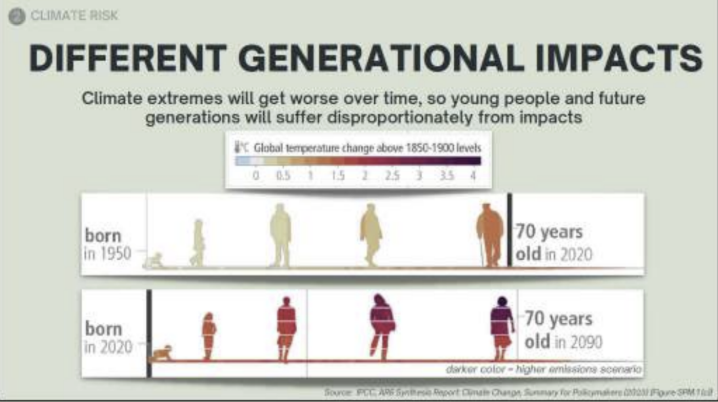
Internal curriculum materials show how the program seeks to influence how judges handle climate cases. One CJP slideshow instructed judges to use disputed "Attribution Science" to find "Legal Causation" for climate change impacts, including—controversially—how to attribute climate change to specific fossil fuel companies.
In one email, CJP senior fellow John Doherty sent a copy of a Biden-era National Climate Assessment to the judges participating in the CJP Judicial Leaders in Climate Science program, encouraging them to "act" on climate change.
"The bad news is that the impacts of climate change are being felt throughout all regions of the United States," wrote Doherty. "The good news is that the report also notes that it isn't too late for us to act."
The president of CJP’s parent group, ELI, Scott Fulton, also urged a colleague to downplay the involvement of the China office of ClientEarth at a Hawaii conference that was sponsored by ELI in 2020. ClientEarth is an activist group that is controversial for working closely with the Chinese government on environmental regulations, eschewing pro-democracy efforts.
"I see [ClientEarth’s China director] Dimitri DeBoer on the list [of guests]. Will Client Earth be shown as a sponsor? I’m kind of hoping not, given their advocacy profile," Fulton wrote in an email, adding that there "may be some issues for us if we are seen as financing an event that serves as a platform for Client Earth."
Fulton’s colleague responded that ClientEarth was "not listed in the Programme anywhere" but said DeBoer "has been vital to securing the participation of the [delegation of] Chinese judges" attending the conference.
Fulton said they could give a "verbal acknowledgement of Dimitri and Client Earth" at the conference, but to keep their involvement "a bit under the radar."