



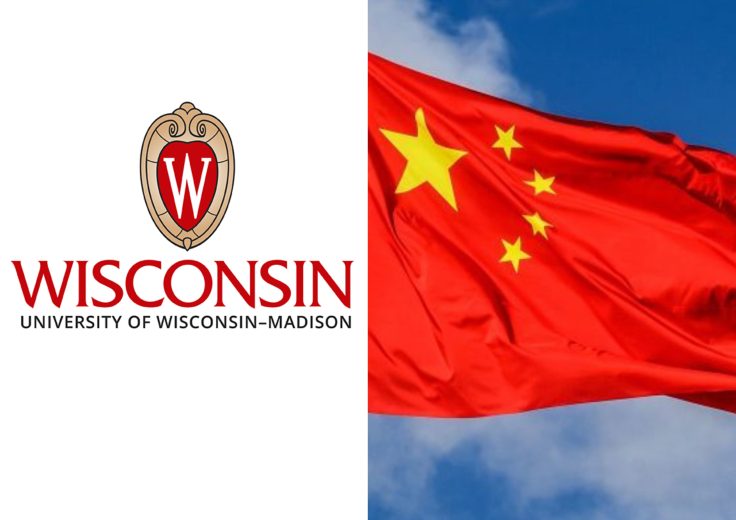
Researchers from the University of Wisconsin worked for nearly a decade with partners in China on sensitive technology projects that likely helped China build its notorious domestic surveillance apparatus, including in Xinjiang province, where the Chinese are accused of brutal repression of the ethnic Uyghur population, a new report has found.
The quiet partnership between Wisconsin's flagship Madison campus and multiple Chinese entities developed technologies "that further entrench China's surveillance state — and that also have significant dual-use implications" for the Chinese military, according to the investigation by the global intelligence firm Strategy Risks.
In some cases, these research projects benefited from U.S. federal grant funding, underscoring how American taxpayers can end up unwittingly supporting research projects linked to the build-out of Beijing's security apparatus. Wisconsin academics "conducted joint research with a sanctioned Chinese defense conglomerate, and participated in Tianlai, a radio-astronomy project centered on a telescope array in Xinjiang, a region fraught with sanctions compliance risks due to the Chinese government’s campaign of ethnic cleansing there," according to Strategy Risks' findings.
The 20-page report, "How a U.S. University Helped China Tighten Its Surveillance Machine," documents how UW-Madison established a "Joint Research Institute" in 2017 with China's Southeast University, which has been identified as a key cog in the CCP's notorious civil-military fusion strategy. Together, researchers from both schools engaged in sensitive work on autonomous vehicles and technology that can monitor cars on the road. This work has significant surveillance applications. It also has military uses. In 2024, the U.S. Bureau of Industry and Security issued a 2024 order restricting "transactions involving vehicle connectivity hardware and software linked to China or Russia, citing the potential risks posed to the U.S. economy and national security."
While Tianlai centers on space exploration, the technologies "overlap substantially with those used in early-warning radar, signals intelligence, and satellite communications." Tianlai's importance to China is evidenced by its broader collaborations with the 54th Research Institute of the China Electronics Technology Group, a major defense conglomerate. Known as CETC 54, the entity has been identified by the United States as the "principal contractor building communications equipment for the [People's Liberation Army], and it and its parent company CETC have long been under U.S. sanctions."
While Strategy Risks makes clear that there is no evidence to conclude UW-Madison's partnerships were subjected to "espionage or intellectual property theft," the firm's findings clearly "illustrate how longstanding academic partnerships established during an earlier era of scientific engagement could now present elevated national security risks in an era of intense strategic competition and rising authoritarianism."
"This report is significant because it shows how a major American public university became involved in a U.S.-funded research project in Xinjiang alongside institutions with deep ties to China's defense sector," Sam Shulman, Strategy Risks' research director, told the Washington Free Beacon. "When American universities are working in one of the world's most heavily securitized regions with defense-linked partners, they need to be asking much harder questions about who they are working with and where that expertise can ultimately flow."
Students from mainland China comprise nearly half of UW-Madison's 7,600 or so international students, a proportion on the high end for large, midwestern campuses. The university first entered into partnerships with China as far back as 1907 and had grown to encompass more than "60 agreements with Chinese universities by the fall of 2019," according to Strategy Risks. "Its China-facing footprint includes numerous faculty and student exchanges, joint conferences, and research collaborations across law, medicine, geoscience, and other fields."
When the Joint Research Institute, or JRI, was established around 2017, it was touted in agreements and university materials as a vehicle "to support joint research, faculty exchanges, graduate education, laboratory collaboration, academic conferences, and the development of shared research initiatives." The JRI's research on intelligent transportation systems and autonomous vehicles is one of its chief projects. UW-Madison researchers affiliated with JRI have also "conducted U.S.-supported research" in similar fields, highlighting how American gains in this research space can trickle back to China even with the existing federal restrictions in place.
"These technologies," Strategy Risks explained, "have implications for surveillance, military use, and human rights and deserve more attention than they presently receive."
Southeast University, meanwhile, the Chinese school involved in the JRI, plays a key role in Beijing's defense research. It operates at least two laboratories designed to perform sensitive defense work and "maintains secret-level security credentials, which means it can work on classified defense projects," according to the report. The House Select Committee on China flagged the university in a September 2025 report exposing the Chinese universities with direct ties to the People's Liberation Army.
These ties make the research partnership between UW-Madison and Southeast University particularly troubling, particularly at a time when China is ramping up efforts to monitor citizens, according to Strategy Risks.
"Vehicle-road-cloud systems are a dual-use technology operating on multiple levels," the report explains. "At the base level, roadside sensors extend what a car's own sensors can see. At the next level, a cloud-connected network analyzes traffic system-wide and recommends actions to drivers. At the top level, the road-and-cloud infrastructure can send direct commands to connected vehicles, taking over specific driving functions."
The military and security applications are clear: "The same system that improves traffic flow and safety gives whoever controls it real-time visibility into and command over participating vehicles." This is also why the Commerce Department moved in January 2025 to prohibit the import and sale of this technology by China inside the United States.
The report additionally discovered that, in March 2022, the JRI signed a "strategic cooperation agreement" with China's Tencent Cloud to research these technologies and build them. Tencent Holdings Limited, the parent company, was designated by the Pentagon in 2025 as one of several Chinese military companies operating in the United States.
The JRI is also connected "with two entities that have documented ties to China's security apparatus": the China Information Communication Technologies Group Corporation and its subsidiary, CICT Connected and Intelligent Technologies Ltd., according to the report.
UW-Madison's work with the Tianlai telescope in Xinjiang raises similar concerns for Strategy Risks. In this case, some of the UW-Madison physicists have received federal funding for the work, according to the report.
But "the Chinese side of that collaboration includes a company under active U.S. sanctions for supporting China's military modernization and activities that threaten U.S. national security," Strategy Risks found. "It also includes universities operating under the direct oversight of China's defense-industrial regulator."
The project's placement in Xinjiang—where China has been suppressing the native Uyghur population, keeping them under constant surveillance and locking them up in vast internment camps—raises substantial questions about how this research could be enhancing China's police state.
"Xinjiang is also a region characterized by an extensive state security presence and significant military infrastructure, meaning that any major scientific installation built there operates within the region’s broader political and security context," Strategy Risks wrote. "While these facts do not establish any connection between Tianlai and forced labor, detention, or military activity, they do situate the project within one of the world's most heavily securitized regions."
UW-Madison did not respond to a Free Beacon request for comment on the report's findings by press time. Strategy Risks, however, noted that "counsel for a UW-Madison professor" disputed the findings, claiming that JRI "was never operational, funded, or staffed by UW-Madison." Strategy Risks says that UW-Madison also did not respond to its own request for comment.