

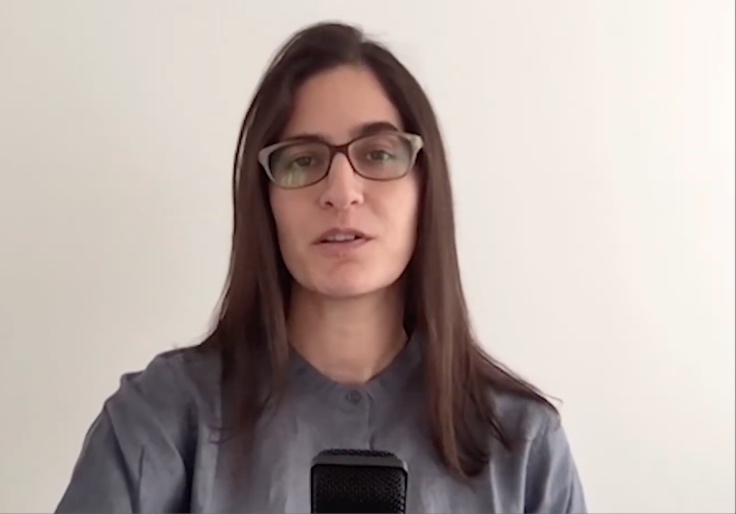
A professor removed from her leadership post at Harvard University after bringing in a raft of anti-Israel guest speakers and panelists and few, if any, dissenting voices is among four finalists to become the Edward Said chair in Arab Studies at Columbia University, internal communications reviewed by the Washington Free Beacon show.
Columbia on January 22 informed graduate students and faculty members in its history department that Rosie Bsheer, an associate professor of history at Harvard and formerly the associate director of the university's Center for Middle Eastern Studies, is a finalist for the position and will give a presentation as part of the selection process, according to a copy of the message. Bsheer's presentation is scheduled for February 16, the communications indicate. Associate professors do not have tenure at Harvard, while the Said chair at Columbia is a tenured position.
Bsheer's appointment would be controversial, coming just seven months after Columbia, which became the epicenter of anti-Israel and anti-Semitic campus protest in the wake of Oct. 7, 2023, reached an agreement with the Trump administration to restore the federal grant funding that had been put on pause in part due to the university's failures to adequately protect Jewish students.
Bsheer, who has written just one book, has a long history of anti-Israel activism. On May 21, 2021, the last day of a nearly two-week war Hamas began by launching missiles into Israel, she and Harvard's former Center for Middle Eastern Studies director, Cemal Kafadar, shared roughly 60 digital resources centering on topics like "occupation" and "settler colonialism." They included a book, Hamas Contained: The Rise and Pacification of Palestinian Resistance, which asserts that Hamas is not "a terrorist group" but "a multifaceted liberation organization." Hamas Contained was written by Tareq Baconi, who has described the October 7 Hamas terror attack as "anti-colonial violence" that was "inevitable" and motivated by "oppression." Harvard's Center for Middle Eastern Studies hosted Baconi at an April 2024 event. It did not host pro-Israel speakers in the wake of the Hamas attack.
Bsheer, a Columbia PhD, served as the center's associate director from 2022 to 2025. Harvard administrators were reportedly concerned by two panels she organized, one on "Israel's War on Lebanon" and another on the Jewish state's alleged "attacks on children in Gaza." Former Harvard president Lawrence Summers said the Lebanon event was "very likely" anti-Semitic under the International Holocaust Remembrance Alliance's (IHRA) definition, which Harvard adopted last year as part of a settlement with Jewish students who alleged discrimination.
The Center for Middle Eastern Studies also faced criticism from the Harvard Jewish Alumni Alliance, which said the center perpetuated the false narrative that Israel "is the last remaining colonial settler power embodying the world's worst evils: racism, apartheid, and genocide." When the Trump administration sent Harvard a list of demanded reforms in April 2025, it cited the center for fueling "antisemitic harassment" and reflecting "ideological capture." And Harvard's own anti-Semitism report dinged the center for hosting speakers who "appeared to justify Hamas' actions" on October 7.
If Bsheer gets the Columbia job, she will replace Rashid Khalidi, who held the position from 2003 until his 2024 retirement. A former Palestine Liberation Organization spokesman, according to the New York Times, Khalidi blamed October 7 on Israeli "settler colonialism" and "apartheid" and said Columbia's adoption of the IHRA anti-Semitism definition made it "impossible with any honesty to teach about topics such as the history of the creation of Israel" and "the genocide being perpetrated by Israel in Gaza."
Bsheer, a vocal advocate of the students who erected an illegal anti-Israel encampment in Harvard Yard, hosted Khalidi in November 2020 for a Harvard Divinity School discussion on his book, The Hundred Years' War on Palestine: A History of Settler Colonialism and Resistance, 1917-2017. She described Khalidi as her "mentor, colleague, and friend" and lauded his "remarkable" and "powerful" book. Bsheer has written one book, Archive Wars: The Politics of History in Saudi Arabia.
In addition to Bsheer, two other candidates under consideration for the role—Princeton University historian Max Weiss and University of California, Santa Barbara, history professor Sherene Seikaly—have defended Hamas terrorists.
In January, Weiss published a lengthy defense of Hussam Abu Safyia, a Gazan doctor who doubled as a Hamas colonel. Seikaly offered support for Hamas during its 2021 conflict with Israel, writing, "The #Nakba is ongoing. Our struggle is ongoing. We will remain. We will return." Months later, she lamented that four of six Palestinian terrorists who escaped an Israeli prison were recaptured, saying she was "heartbroken" and "in awe" of their bravery.
Four birds captured, praying, heartbroken, in awe of this bravery #prisonbreak #Palestine
— Sherene Seikaly (@shereneseikaly) September 11, 2021
A Columbia spokesman said that "no offers of employment have been extended, and the views of individual candidates do not represent the University."
Bsheer kept her position as an associate history professor at Harvard after the school removed her from her role at the Center for Middle Eastern Studies. She is on leave for the 2025-2026 academic year.
While Columbia, unlike Harvard, reached a deal to settle alleged civil rights violations and restore its relationship with the federal government, cracks have emerged in its enforcement of the deal.
The agreement, for example, subjects Columbia to independent monitoring by a third party. The school has reportedly refused to turn over data to the monitor that would allow him to determine whether it is complying. Columbia also filled a committee meant to conduct a Trump-mandated review of its Middle East programs with anti-Israel faculty members who have justified Hamas's October 7 massacre and defended notorious anti-Semites.