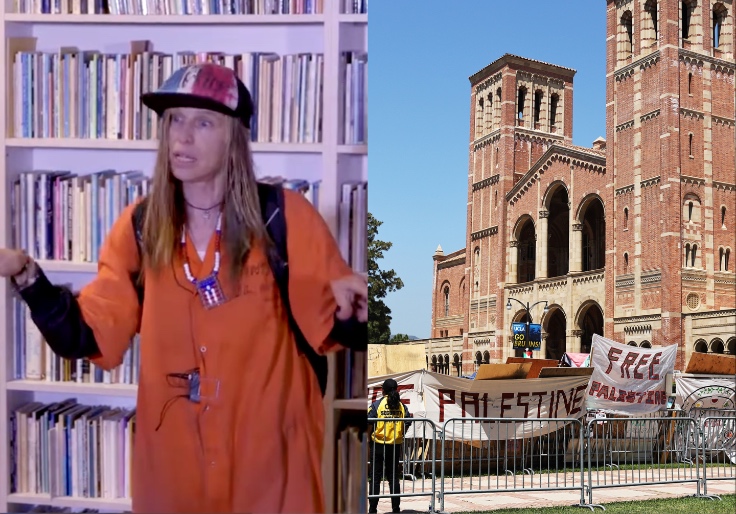






A Harvard Business School professor who participated in a library protest in favor of student anti-Israel protesters is planning to teach a "case" in her class on Friday about divesting from Israeli and other companies because of "their possible complicity in the crisis in Gaza."
A copy of the 26-page "case" obtained by the Washington Free Beacon puts the decision in the context of responding to "the apartheid regime in South Africa." The Free Beacon is not printing the case in its entirety because Harvard Business copyrights the materials. The case makes gestures at even-handedness, noting that the movement to boycott, divest, and sanction Israel "faced criticism of antisemitism in its singling out of Israel, as opposed to the numerous other states engaged in human rights violations globally, for divestment." Yet on careful analysis, the case as drafted is slanted against Israel from the very first sentence, which describes the October 7, 2023, attack as one by "Palestinian armed groups" rather than by terrorists. The word "terrorists" doesn’t appear in the whole case, including in an extensive discussion of what the case calls a "separation barrier" or "wall"—actually a security fence that Israel built to prevent terrorist attacks.
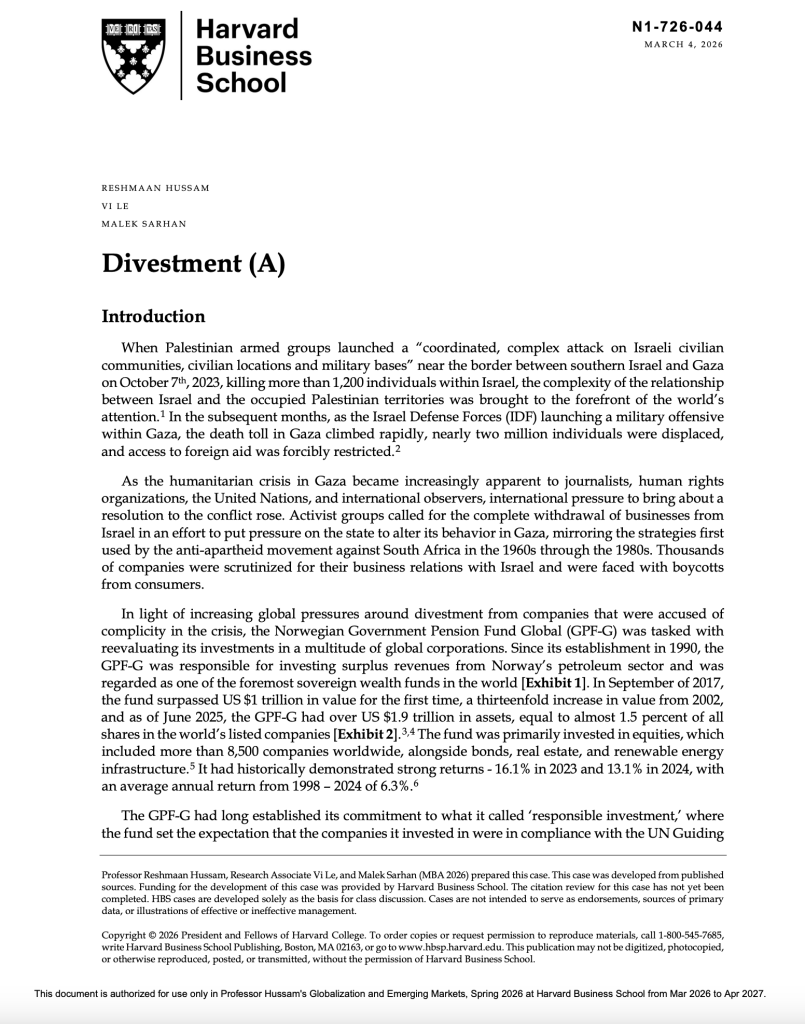
The case is about whether the Norwegian Government Pension Fund Global—at $2.1 trillion, one of the world’s largest—should divest from Caterpillar, IBM, Microsoft, and Ben & Jerry’s Homemade Holdings Inc. and Unilever on account of being "‘too’ complicit in unethical activity to justify investment."
The lead author of the case and the teacher of the business school class is Reshmaan Hussam. Hussam co-wrote an October 2024 Harvard Crimson article about participating in a library protest wearing a black scarf as a variation on "traditional Palestinian keffiyehs" worn by students. "Our students’ suspensions from the library come amid a wave of new, excessively restrictive rules governing campus speech that have been codified in direct response to student protests about the devastation in Gaza," she wrote. She was also quoted in Harvard Magazine coverage of the faculty in-library protests, which the participants described as "study-ins."
Harvard "case study" pedagogy sometimes features a two-part presentation in which students get part of the story, discuss what they’d do, and then get the second part of the case reporting what the decisionmakers actually did and how the decision turned out. The case version that was obtained by the Free Beacon is titled Divestment (A), suggesting that a part (B) may be next. The case carries a boilerplate disclaimer that cases "are developed solely as the basis of class discussion" and "not intended to serve as endorsements, sources of primary data, or illustrations of effective or ineffective management." The fine print also says "Funding for the development of this case was provided by Harvard Business School. The citation review for this case has not yet been completed." A Free Beacon article last month about the Norwegian fund’s divestment from Bezeq, an Israeli telecommunications firm, reported that at that point, it was "up more than 50 percent in the 14 months since the Norwegians decided to sell." That story also addressed Caterpillar: "On Aug. 25, 2025, the Norges Bank Executive Board decided to dump its $2.1 billion worth of shares in Caterpillar Inc., the Texas-based construction giant. The ethics board reportedly declared that ‘bulldozers manufactured by Caterpillar are being used by Israeli authorities in the widespread unlawful destruction of Palestinian property.’ Caterpillar stock closed at $702.89 a share on Feb. 3, 2026, up from its $432.30 close on the day of the divestment announcement, according to Yahoo Finance. That’s a 62.6-percent gain, handily outperforming the 8.3-percent return of the S&P 500 index."
Hussam did not reply to an email seeking comment. An HBS spokesman did not respond to an email seeking comment. Harvard says generally that it "cares deeply about members of our Jewish and Israeli community and remains committed to ensuring they are embraced, respected, and can thrive on our campus," and that the university "has taken substantive, proactive steps to address the root causes of antisemitism."
Hussam’s doctoral adviser at MIT was economist Esther Duflo and her thesis director was Duflo’s husband Abhijit Banerjee. Duflo and Banerjee won the 2019 Nobel Prize in economics; the pair also both signed a 2025 letter to Prime Minister Benjamin Netanyahu describing Israel’s treatment of Gaza as "unconscionable."
The U.S. government sued Harvard on Friday, March 20 over what the suit called the university’s "toothless non-response to the ongoing relentless antisemitic on-campus discrimination." On Sunday, March 22, Harvard co-sponsored an event with a boycott-Israel advocacy group in which a Harvard researcher accused Israel of "genocide" in Gaza. On March 23, the federal Department of Education announced it was opening a new investigation into anti-Semitism at Harvard.
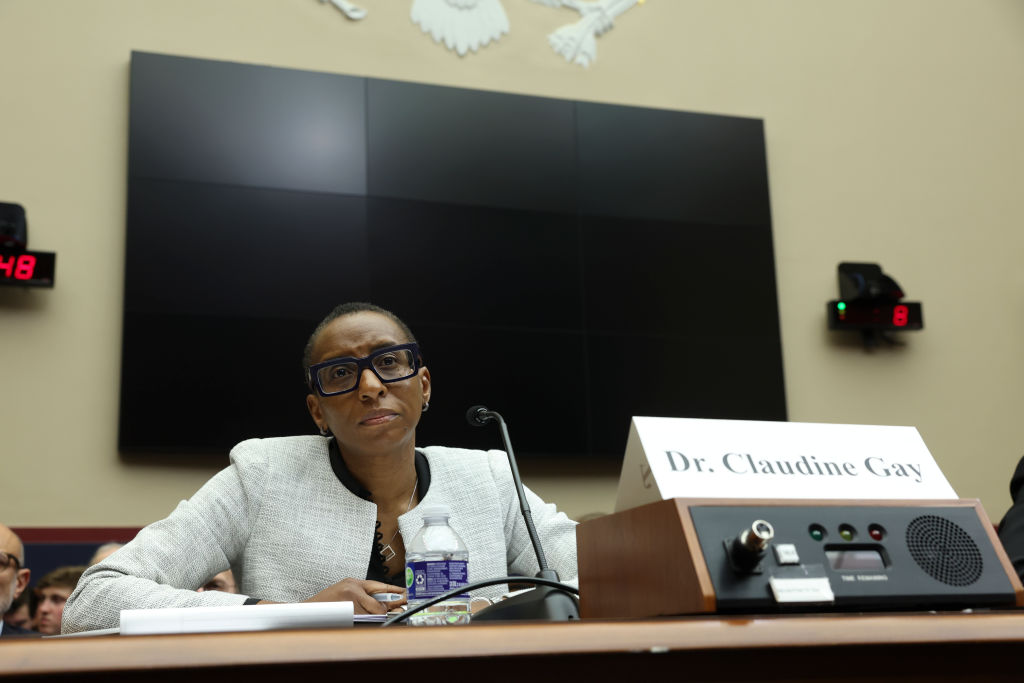
The controversy comes as the House Committee on Education and the Workforce, which has played a key role in investigating campus antisemitism and whose hearings led to the resignations of Harvard president Claudine Gay and of presidents Liz Magill of Penn, Michael Schill of Northwestern, and Baroness Minouche Shafik of Columbia, released pages from a confidential draft report of Harvard Business School’s anti-Semitism working group.
Among the disclosures that the draft report labeled as "key findings" were that Jewish business school faculty "were shocked by the hatred."
"Several said they used to feel pride to work at Harvard, but now felt embarrassed," the draft report said.
Among the "themes" that the report said emerged from interviews with Jewish students, staff and faculty at Harvard Business School were "a palpable experience of feeling unwelcomed, abandoned, fearful, and silenced," "a surprising level of ignorance, insensitivity, and arrogance," and "a School culture of silence and anti-intellectual tendencies."
One staffer quoted in the report said, "An all-staff meeting was scheduled on Yom Kippur." The staffer reported being told, "If we have to schedule meetings around all religions, we’ll never be able to meet." The meeting eventually was rescheduled.
The disclosures also come as some of Harvard’s Jewish faculty, led by a professor who wrote in 2015 that he was boycotting Israel, publicly claim that the description of Harvard fostering a climate of anti-Semitism "paints a portrait of Harvard that we do not recognize." They claimed the Trump administration "cynically exploits concerns about antisemitism to justify what can only be called an authoritarian assault on institutions of higher education."
This is an example of the anti-Semitism at Harvard rather than evidence that it doesn’t exist; to win social approval and avoid shunning there is pressure to come out publicly against externally enforcing accountability for Harvard’s problems. The anti-Trump politics are so pervasive that there’s pressure to prove you are a clubbable Jew. In legendary Harvard leader Henry Rosovsky’s words about the Jews of the 1930s: "Jewish scholars who managed to become professors frequently became ‘closet Jews,’ anxious to dissociate themselves from their background." The Havard closet Jews of the 1930s have become the Harvard as-a-Jews of 2026.
Sure, there’s a case that competition and choice are better enforcement mechanisms than heavy-handed litigation from Washington, though anti-Semitism is literally the only area in which left-wing Harvard Jews believe this to be so. But events on the campus—as well as the documents from the House committee—undercut the narrative that this is all fully repaired or some imaginary pretext by the Trump administration to seize control of Harvard. President Claudine Gay, after all, resigned during the Biden administration. Many of the same professors now blaming anti-Semitism enforcement on Trump authoritarianism were among Gay’s most vehement defenders.