



You are probably familiar with the Chinese curse, "May you live in interesting times."
Such was the course of life of the Marquis de Lafayette. As Americans, we are likely not to understand that the French nobleman's life involved far more misfortune than good luck.
A volunteer in the American Revolution, Lafayette rose to the rank of major general and became a surrogate son to George Washington. Injured at the Battle of Brandywine, he demonstrated his facility as a commander, along with his valor, throughout the war. Returned to France, he played a central role in the early and less radical phase of the French Revolution. Then, a quarter century later, he emerged as an influential foe of the restored Bourbon monarchy. Later still, as his life was drawing to its close, Lafayette was the leader standing on the balcony who brought forth the July Revolution of 1830 from which Louis-Phillipe and the House of Orléans came to rule in France.
In between, the Marquis's sister-in-law and his mother-in-law were executed during the Reign of Terror, and he spent five years as a prisoner in foreign dungeons. A portion of that was in solitary confinement. While Lafayette was born into vast wealth, moreover, the bulk of his property was taken from him, and, had it not been for a huge congressional dispensation given to him in 1825, he might have died in destitution.
He had, indeed, arrived in the world during interesting times.
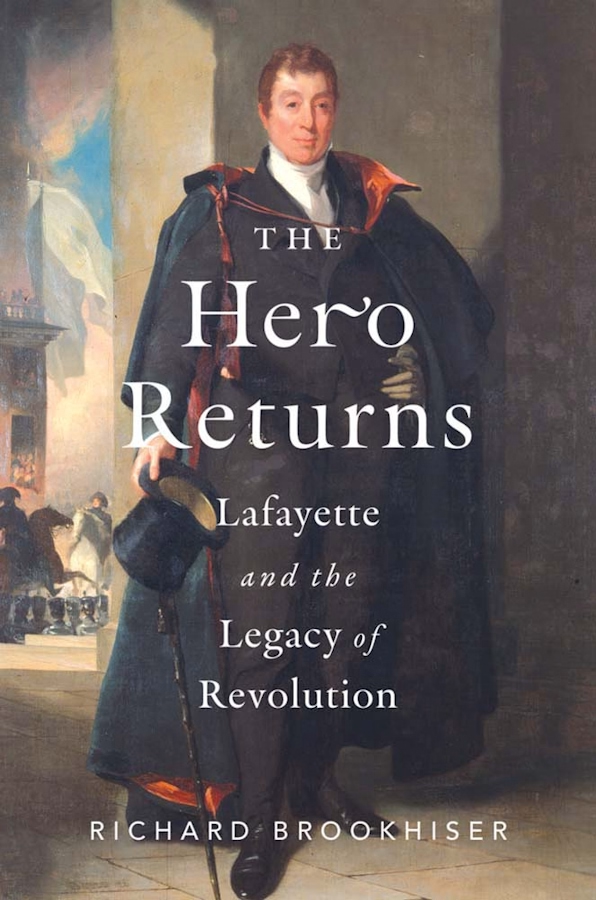
That is not, however, the focus of Richard Brookhiser's new book The Hero Returns: Lafayette and the Legacy of Revolution. Instead, Brookhiser's chronicle centers on a triumphant year when Lafayette toured the United States as the last great surviving figure of our War of Independence. Fêted in nearly every town and city of consequence in the young republic, he was treated as the living embodiment of revolutionary bravery and sacrifice. That offered Lafayette and those who accompanied him an opportunity for observation and reflection, one anticipating that of Alexis de Tocqueville just a few years later.
Thus, only secondarily does The Hero Returns look at the abundant tragedy that Lafayette experienced. Nonetheless, it uses that pattern of recurrent calamity as a means to examine the disastrous record of the late 18th and early 19th century revolutions inspired by our own.
A senior editor at National Review, Brookhiser has authored a sequence of remarkable books about our country's founding and the central figures connected to it. Although not formally labeled as a series, the various titles he has composed are best understood as that, and this new work should properly be identified as the eighth in a chain that commenced with Founding Father, his extraordinary examination of the life of George Washington.
Patterned after Plutarch's Parallel Lives, they have the great virtue of brevity. The reader's eyes are directed to the most revealing and pertinent events, not oceans of minutiae. Brookhiser also has the rare gift that he is able to write in a fashion that is at once elegant, readable, and unaffected.
Brookhiser is admiring of Lafayette, but he is not uncritical. He sees the Frenchman as sometimes vain and uncomprehending but also an embodiment of noblesse oblige.
This was not such a common trait among the aristocrats of the ancien régime. The portrait that we get in Choderlos de Laclos's Les liaisons dangereuses of a landed nobility that was a dead weight upon society—and an immoral one at that—contains seeds of truth.
But also among the nobles were devoted sons of the Enlightenment, and Lafayette was foremost among them. Thus, in 1777, at just age 19, he boarded a ship for America intent on serving the joint causes of national liberation and republican egalitarianism. Appearing as a well-trained graduate of a prestigious military training academy and already a captain in the French Army, he was promptly given a privileged status and, soon afterwards, a command within the Continental Army. As Washington quickly came to realize that Lafayette fully merited this, by the end of the war, at the Battle of Yorktown, he gave Lafayette charge over of a wing of the Continental Army. In this way, Lafayette played a crucial role in securing our victory. He is justly ranked among the most courageous and the most capable of the military leaders on the American side.
The tragedy came both before and after the war. The product of a family with a long tradition of military service, Lafayette's own father was killed at the Battle of Minden in 1759. Lafayette was just two years old. As his mother preferred to live the life of a wealthy woman in Paris, he was left with his grandmother.
Ten years later when his mother passed on, he inherited his title, considerable wealth, and a large estate. But he had been orphaned. The 12-year-old was also in training to be a musketeer.
Among his classmates and rivals was the future reactionary king of France, Charles X. Though the two men had nearly opposite political views from adolescence onwards, they had notably amicable relations. This was a consequence of Lafayette's personality, which remained warm, positive, doggedly loyal, and generally optimistic. These traits would prove of value during the hard days of war, as at Valley Forge. At the same time, they may have caused him to underestimate the dangers posed in subsequent years by men like Maximilien Robespierre.
Lafayette's involvement in the French Revolution started two years before the Storming of the Bastille. In 1787, he was appointed to the Assembly of Notables. He used his position to fight for equality under the law and greater personal liberty. Two years later, Lafayette was front and center when the members of the National Assembly committed themselves to a French Constitution and a reformed government through the "Tennis Court Oath." Days later, with assistance from Jefferson, Lafayette composed the first version of the Declaration of the Rights of Man and of the Citizen.
At the same time, his devotion to the crown was consistent, and he very publicly acted to protect Marie Antoinette, unpopular though she was. That allegiance played its part in his appointment as the commander of the National Guard. In that post, he combined the red and blue colors of Paris with the white hue associated with the French royal family to produce the country's tricolor flag.
Ironically, although Lafayette had risked his life to protect the royal family and had sat in the National Assembly with the Girondins (literally on the right), when Austria and Prussia invaded France in the hope of restoring the monarchy, Lafayette was arrested and tried by a court arraigned by the two invading powers. Thus, for five years he was kept prisoner.
Pleading letters from Washington proved unpersuasive and did not win him his freedom, and unsuccessful rescue efforts undertaken by private Americans led to his being placed in solitary confinement. Thus, he only managed to gain his release through the intercession of Napoleon—and that, too, ended poorly as France's new government, the Directory, refused to let him return to France without an acknowledgment of its seizure of power, which he would not provide it. Nor would it let him go back to America. What it did, instead, was to seize nearly all his property, impoverishing him. Permitted by Napoleon to return at last in 1800, he then kept out of politics until Napoleon's capture in 1814.
Yet his continued dedication to "Liberté, Égalité, Fraternité" meant that while he served as an influential representative in Louis XVIII's Chamber of Deputies, it was in consistent opposition to the illiberal king's rule.
Brookhiser tells this story in incidental fashion as the first half of his narrative instead focuses on Lafayette's happy return to America in 1824-1825. That brought him to joyous reunions with his old friends, Adams and Jefferson, along with visits to Andrew Jackson at the Hermitage, John Quincy Adams in the White House, the Erie Canal, Niagara Falls, and literally thousands of toasts and hundreds of celebratory dinners. Accompanying him were his son and his secretary Auguste Levasseur.
Levasseur crafted a detailed account of their journeys, and Brookhiser's summaries offer a fascinating window on life during the early republic. Levasseur and Lafayette, like de Tocqueville, had great admiration for much of what they saw, but dread for what they observed in the treatment of black slaves and American Indians.
One question that greatly interested them—as it does Brookhiser—is why the American republic displayed such a capacity for renewal and such stability while the Bolivarian and French revolutions did not. Although there is not one answer, of course, the system of checks and balances proposed by Montesquieu and woven together by Madison at the Constitutional Convention cannot be underrated. That stands alongside a devotion to republicanism that was held by the first populist president, Andrew Jackson, his many faults notwithstanding.
The Hero Returns: Lafayette and the Legacy of Revolution
by Richard Brookhiser
Yale University Press, 248 pp., $30
Jonathan Leaf is a playwright and novelist who lives in New York.