


Down the generations, certain intellectuals have been attracted to opera. Nietzsche, outstandingly. Also Bernard Williams, the English philosopher (1929–2003). Williams wrote about opera throughout his life, and, three years after his death, a collection was published: On Opera. In 2017, Mitchell Cohen, the political scientist who was long an editor at Dissent, published The Politics of Opera: A History from Monteverdi to Mozart. It is a brilliant book, loaded with learning.
So is the latest from Martha C. Nussbaum, the philosopher, who works at the University of Chicago. Like Williams, who was one of her teachers, she has written about opera throughout her life. At age six, she was taken to the Metropolitan Opera by her grandmother. "We had close-up orchestra seats for Verdi's Rigoletto, which shocked and profoundly moved me," she writes.
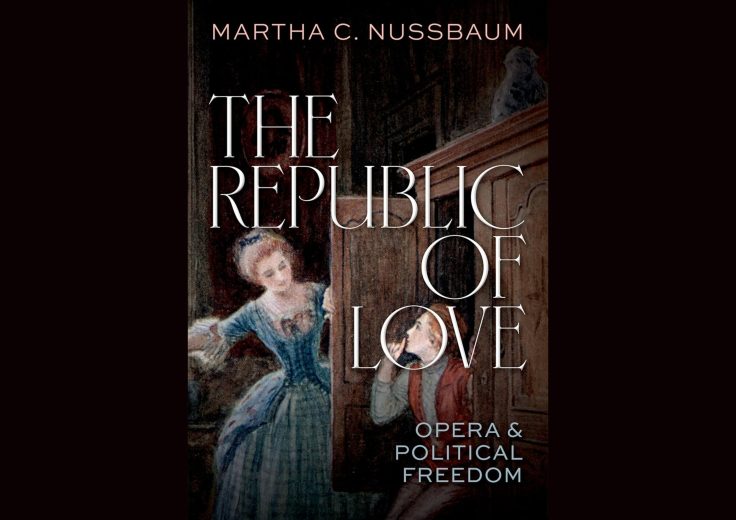
Those words come from this new book, The Republic of Love: Opera and Political Freedom. A republic of love, she tells us, is the opposite of a monarchy of fear. In 2018, she published The Monarchy of Fear: A Philosopher Looks at Our Political Crisis. The title of her new book, she says, "makes reference" to the earlier title.
Let me quibble that the new title alludes to the older one, if anything.
The Enlightenment, writes Nussbaum, gave birth to "a republican political community bound together by brotherhood and love." Gone were "feudal arrogance" from the upper strata and "groveling fear" below. In their places were "reciprocity, equality, and compassion."
This book has a hero, namely Mozart. (It also has a villain, about whom more in due course.) Mozart was "the deepest philosopher of the Enlightenment," writes Nussbaum. Can he really be called a philosopher? I defer to the philosopher.
It is undoubtedly true that Mozart accepts human beings as they are, as Nussbaum writes. He appreciates the variety and craziness of life. (This is a word on which Nussbaum relies: "craziness.") He welcomes difference. "The serious business of Mozartean comedy," writes Nussbaum, "is its ability to laugh at the absurd (including the absurd in oneself) while aiming for the sublime." Perfect.
Nussbaum devotes the first half of her book to Mozart, treating six of his operas. The first of them is The Marriage of Figaro. I think I can sum up her view of this opera in two sentences: The men exhibit the mentality of a shame-and-honor society. The women, to a degree, shame them out of it (honorably).
The subtitle of this book, remember, is Opera and Political Freedom, and any such book must include Beethoven's Fidelio—which this one does. Fidelio is one of the greatest paeans to political freedom in art. It is also one of the greatest paeans to marital love. Art gives short shrift to this kind of love; it prefers other kinds.
Nussbaum calls Fidelio "the opera of humanity, striving for the light." Again, perfect. Her pages about Fidelio stir and uplift the reader, as the opera itself does. In the relevant chapter, she pairs Fidelio with an opera by a living composer, the American Jake Heggie. That opera is Dead Man Walking, about a prisoner on death row. This pairing, writes Nussbaum, "will raise some eyebrows." It did mine.
The two operas "conduct a searing critique of the breath-denying penal institutions of their very different times." Okay. But would it be wrong, mean, or thickheaded to point out that Fidelio is about a heroic political prisoner while Dead Man Walking is about a rapist-murderer? Are we not in apples-and-oranges territory? In any case, Nussbaum has good arguments to make.
Inevitably, she gets to Verdi, a politics-minded composer, and indeed a figure in the Risorgimento. She fastens on one of his most political, and best, operas: Don Carlo. She is interesting on the role of the chorus, wherein we see how easily a mob, or a public, can be swayed.
The book has many an opinion, including this: "Verdi is opera's greatest master of choral writing." I myself am second to none in admiration of Verdi, or second to few. But, to borrow a phrase from social media, Wagner would like a word…
A chapter on Mozart's Don Giovanni and Così fan tutte is titled "Two Problem Operas." I regard Britten's Peter Grimes, which Nussbaum later discusses, as a problem opera. It is not such an opera for her, however.
"Peter Grimes is extremely painful to experience," she writes. On that we can agree. But her view of the opera is pretty straightforward, pretty black-and-white, if I have read her correctly. A man who is different, who does not fit in, who is misunderstood, is hounded to his death by a mob of a community.
I believe there is much more ambiguity in the opera. Is Grimes innocent? Would you entrust your child to him?
Back to the aforementioned Wagner—who is the villain of the piece, the villain of the book. Nussbaum is candid. While conceding the composer's talents, she is "not a fan." He is "the great antagonist of the Republic of Love." His operas are "totalitarian dramas of despair."
In a few lines of a brief review, I cannot rehearse "the Wagner question" (as this subject has been known for about 125 years). Suffice it to say that I find the last scene in Die Meistersinger, with its creepy nationalism, hard to take—and that Wagner wrote reams of music of a universal, transcendent nature.
How can a monstrous man make divine art? Maybe we can talk about that another day.
Nussbaum writes, as if it were too obvious to state, "Anyone who chooses to spend half of a book on opera talking about Mozart and much of the rest talking about Verdi is no Wagnerite." This assertion puzzles me. As the author knows as well as I, millions have loved all three composers over the years. Those millions include three American conductors who come immediately to mind: Leonard Bernstein, Lorin Maazel, and James Levine. We might throw in a formidable Italian, too: Arturo Toscanini.
But is Martha Nussbaum worth reading on Wagner? Talk about "too obvious to state."
I have some stylistic bones to pick. Is "Gypsy" now verboten, so that we must say "Roma" instead? Nussbaum uses this word repeatedly. I think of Brahms's Zigeunerlieder ("Gypsy Songs"). Romalieder? "Hunchback" is a cruel word, but it describes a cruel condition. Nussbaum writes that Rigoletto suffers from "a curvature of the spine."
She is a master of the footnote, and some of her best material is in the footnotes. Should it be up above, in bigger letters? In any event, relish those footnotes (as in Gibbon, that all-time footnoter).
Like Verdi, Nussbaum goes out with a "burst of hilarity." That famous phrase comes from Arrigo Boito, discussing Verdi's final opera, Falstaff—of which Boito is the librettist. Nussbaum's final chapter is about this opera.
Question: Is Falstaff a comedy? Yes. And no. The conductor Riccardo Muti argues, as he has with me in interviews, that Falstaff is laced with pain, and that it reflects Verdi's thinking on himself. Nussbaum is deep and delightful in this chapter.
Above, I said that Nussbaum's pen takes on something of the spirit of Fidelio when she writes about Fidelio. The same pen takes on the spirit of Falstaff when writing about that one. And so it is with the other operas.
I, for one, am not crazy about intellectuals on the subject of music, including opera. But Professor Nussbaum's book has many of the same effects on a reader that opera, at its best, has on an audience member. It is altogether stimulating.
The Republic of Love: Opera and Political Freedom
by Martha C. Nussbaum
Oxford University Press, 392 pp., $29.99
Jay Nordlinger is a resident senior fellow at the Renew Democracy Initiative and a contributor to its publication, The Next Move. He also writes on Substack at Onward and Upward and is the music critic of The New Criterion.