


The Declaration of Independence, signed and issued to the public 250 years ago this month, was the banner under which the American Revolution was fought. "We hold these truths to be self-evident, that all men are created equal, and are endowed by their Creator with certain inalienable rights." The Declaration, "the sheet anchor of American republicanism," as Lincoln called it, stated the ideals behind the revolution, but played little role either in starting or ending the conflict. The battles of Lexington and Concord, which ignited the war, had been fought more than a year earlier, in April 1775; the war would continue for another five years until it was settled in 1781 by the American victory at Yorktown. Without victory in the war for independence, the Declaration of Independence might have been relegated to a footnote in history.
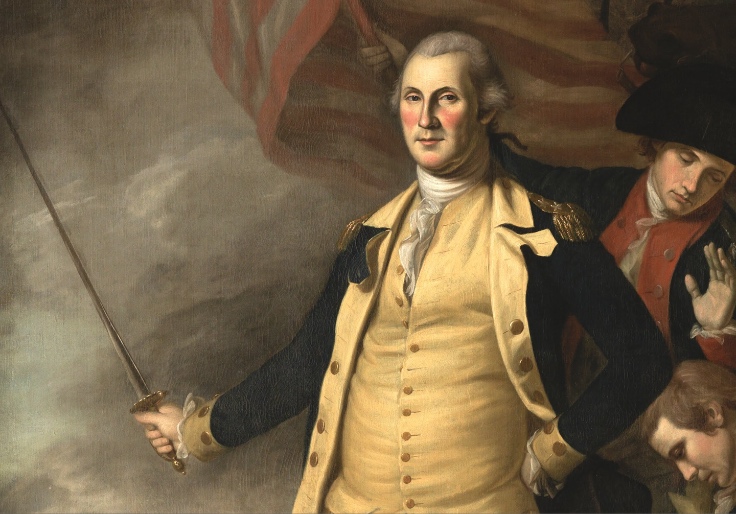
In American Patriarch: The Life of George Washington, H.W. Brands provides a highly readable single-volume biography of the architect of that victory, and the indispensable Founding Father of the American republic. Brands, professor of history at the University of Texas and author of previously published biographies of Benjamin Franklin, Andrew Jackson, and Franklin Delano Roosevelt, relies upon letters, diaries, speeches, and other original documents, to draw a fresh portrait of Washington that shows him to be less distant and elusive, and more human in both his virtues and vices, than he has been rendered in other biographies and popular histories.
Washington's aristocratic bearing along with his commanding presence were important ingredients in his success but, as this biography shows, Washington earned his lofty reputation by persevering through setbacks, defeats, and disappointments, all of which prepared the way for subsequent victories. Washington's life was one of action and experience: He participated in nearly every important event that roiled the American colonies and the new nation during the latter half of the 1700s. Brands succeeds admirably in compressing these events, and Washington's role in them, into a single volume that is at once accessible to most readers while remaining faithful to the rapidly unfolding history of the era.
It is a good question why this proprietor of a Virginia plantation with some 300 slaves decided to risk everything by leading revolution against the world's most powerful empire. Brands finds an answer, partly in Washington's character, but also in his unsettling experience as a young officer in the British armed forces.
In 1754, Washington, then just 22 years old, was authorized by the British governor of Virginia to lead a detachment of roughly 160 soldiers into the wilderness in western Pennsylvania to caution French troops against maintaining a fort in contested territory at the confluence of the Allegheny and Monongahela rivers (present-day Pittsburgh). Arriving in the area, his troops ambushed a small force of French troops sent in turn to warn him against encroaching upon French territory. The enterprise turned into a disaster as the French organized a counterattack, forcing Washington into an embarrassing surrender. That campaign, starting with Washington's ambush, provoked a wider war between the British and the French in North America that continued until 1763.
Washington's conduct in that campaign reinforced British doubts about the military abilities of the colonists in general, and of Washington in particular. British leaders dispatched their own experienced officers to lead the campaign against the French. Washington signed on as an aide-de-camp to assist British general Edward Braddock in a renewed campaign in the west. When Braddock was mortally wounded in one of those engagements, he passed his command to Washington, who braved intense musket fire to lead his troops in an organized retreat. Notwithstanding that achievement, British officers passed over Washington for a formal commission in the British Army, and ignored his advice for advancing on the French garrison at Fort Duquesne. After British and American troops captured the fort in 1758, Washington resigned his colonial commission in frustration with British military practices.
Washington learned important lessons in those early campaigns—first, that British leaders regarded Americans as second-class citizens, unworthy to serve as officers in their armed forces. In addition, he saw that British officers were not well prepared to fight wars on America's rugged and forested terrain. The British, he saw, were not as powerful as they seemed.
The end of the war brought a different kind of turmoil to the colonies as British leaders, mindful of accumulated debt built up from the costs of previous conflicts, moved to tax colonists for the costs of the recently concluded war. When Parliament adopted the Stamp Act in 1765, Washington judged that the British had blundered by exaggerating the colonists' ability to pay and underestimating their determination to resist. As the conflict escalated over the next several years, Washington changed his mind: The British meant to enslave the colonies in general and would do so as soon as Boston was brought into line. He understood from harsh experience how the British looked down upon the colonists.
The battles at Lexington and Concord changed the calculus of opposition from protest to outright warfare, and from proposals for conciliation to calls for independence. The Second Continental Congress, which convened in Philadelphia in May of that year, took charge of the war effort by voting to organize a Continental Army out of scattered militia units in Massachusetts. Washington attended the Congress, wearing his buff and blue military uniform, a sign that he was willing to serve as general. The gambit succeeded: Congress, on a motion from John Adams, appointed Washington as general of the Continental Army. He pledged to exert every effort in support of "the glorious cause."
Washington would spend the next eight years in command of the army and away from his wife and plantation in Virginia. He, along with his men, made enormous sacrifices for the cause of independence, enduring brutally cold winters, inadequate supplies, carping and criticism from members of the Continental Congress, long marches, and much more, before the conflict was settled in 1781. It was a close-run affair: There was scarcely a time in those years when it was clear to either side which one would prevail.
Washington settled quickly on an overall strategy for fighting the war. He could lose ground, cede it to the enemy as necessary, but he must not lose his army. "He could," Brands writes, "retreat and retreat, so long as he had an army to retreat with." He would strike British forces here and there when he had a tactical advantage, but would not risk a decisive defeat. He would win the war by refusing to lose it. When the Congress issued the Declaration of Independence on July 4, 1776, Washington was in New York City awaiting an expected return of British troops after he had driven them from Boston a few months earlier. The document inspired his troops, when it was read to them five days later, clarifying the cause for which they were fighting.
Over the next several weeks, some 30,000 British troops landed in Staten Island and Long Island under the command of General William Howe, who hoped to engage Washington's forces in a decisive battle. Washington, following his strategy, refused to accommodate him. Seeing his troops outnumbered and outmaneuvered, he led them in a series of retreats from Brooklyn to Manhattan, then north to White Plains, across the Hudson River into New Jersey, then into Pennsylvania, while under continuous pursuit from British forces. Then, when it was least expected, Washington led his troops across the icy Delaware River on Christmas night to stage a daring counterattack on Hessian and British troops at Princeton and Trenton, thereby reviving sagging American spirits.
Washington was not in all cases the master of the military situation during the revolution, as Brands points out. It was General Horatio Gates, not Washington, who in late 1777 engineered the defeat of British forces in the Battle of Saratoga, the most significant American victory in the war prior to Yorktown. That victory persuaded the French government to lend financial and military support to the American cause, and induced the British in turn to adjust its overall strategy to winning control of the southern states.
Later, in 1781, it was Count Rochambeau, commander of French forces in America, who advised Washington to abandon plans to attack British forces in New York City, and to focus instead on a siege of Yorktown where French naval forces would be available to pin down General Cornwallis's troops near that town on the Virginia peninsula. Washington agreed: He and Rochambeau combined forces outside New York City and proceeded on a long march to Yorktown. Their planned siege, carried out with a combined force of 17,000 French and American troops, assisted by a French naval blockade, forced Cornwallis to surrender and the British to call for an end to the war. The British might have fought on from there but decided to cut their losses.
When British officials signed the Treaty of Paris in 1783 in a final act of surrender and withdrawal from American shores, Washington resigned his commission as general of the Continental Army and returned to life as a private citizen. He had outclassed and outfought Britain's best generals and thereby won a towering reputation among his countrymen, and especially among the soldiers under his command. King George III, hearing of his voluntary retirement, said he was "the greatest man in the world," as he may have been.
It marked the pinnacle of his career, but far from the end of it. He watched in those years as the federal government, rudderless under the Articles of Confederation, listed from crisis to crisis, unable to win the respect either of European powers or its own citizens. It was nothing new to Washington: He had endured the same during the crisis of the Revolution.
He had always been in favor of a stronger national government, and so it came as no surprise when, on request from a young James Madison, he agreed to serve as chairman of the convention in Philadelphia that would design a Constitution for the American union. He said little during the proceedings. He did not have to: His presence lent needed legitimacy to the enterprise.
There was never any doubt as to who would be the first president under the new Constitution; indeed, the provisions in Article II may have been drawn up on the assumption that Washington would be the first occupant of the presidential office. He was elected unanimously in 1789, with John Adams as his vice president. He had no particular agenda to pursue, other than to establish the legitimacy of the new government, and to make it visible among citizens by his travels and public appearances.
As president, Washington inadvertently helped to establish the party system by appointing a team of rivals to his cabinet, led by Alexander Hamilton, his aide-de-camp during the war, and Thomas Jefferson, author of the Declaration of Independence, two ambitious figures who disagreed over every major issue. He sided with Hamilton, and against Jefferson (and Madison), in debates over the national bank, funding public debt, neutrality in the new war between Britain and France, and the Jay Treaty. Jefferson, frustrated with those decisions, resigned from the cabinet and, with Madison, created a new political party to oppose those policies, claiming they were "monarchist" in design. Yet Washington's decisions were consistent with views he had expressed for decades about the necessary powers of government.
Washington, as Brands writes, never forgave Jefferson for injecting partisanship into the new system, and for implying that he had designs to be a king. That was hyperbole: Washington wanted most to throw off the cloak of power and return to private life, which he did after two terms in office, but not before warning Americans about the corrupting dangers of partisanship and entanglements with European powers. In his final act as a private citizen, he directed in his last will and testament that his slaves should be emancipated on his wife's death.
Washington was America's first and only patriot president, elected without regard to party or ideology, and solely on the basis of devotion to his country. There could be only one Washington, born in an age of aristocracy but living through an age of popular revolution that he helped to shape but in which he was out of place. He was in all things the indispensable American, America's patriarch, the image that shines through this splendid new biography.
American Patriarch: The Life of George Washington
by H.W. Brands
Doubleday, 640 pp., $40
James Piereson is a senior fellow at the Manhattan Institute.