

There's an old story about the four generations of the American Jewish experience: The first generation was a peddler, the second generation was a successful businessman, the third generation was a doctor- or lawyer-style professional, and the fourth generation was an artist or activist, or both. A funnier, more biting summary of this has appeared on X as going from "garment factory worker" to "pharmacist" to "Chair of the Federal Reserve" to "feminist freelance journalist with hairy armpits."
In earlier times, John Adams captured a similar dynamic in his own Massachusetts Puritan cohort with his famous quote, "I must study politics and war, that my sons may have liberty to study mathematics and philosophy, geography, natural history, naval architecture, navigation, commerce, and agriculture, in order to give their children a right to study painting, poetry, music, architecture, statuary, tapestry, and porcelain." These similar sentiments capture not just the Jewish experience but also the American experience.
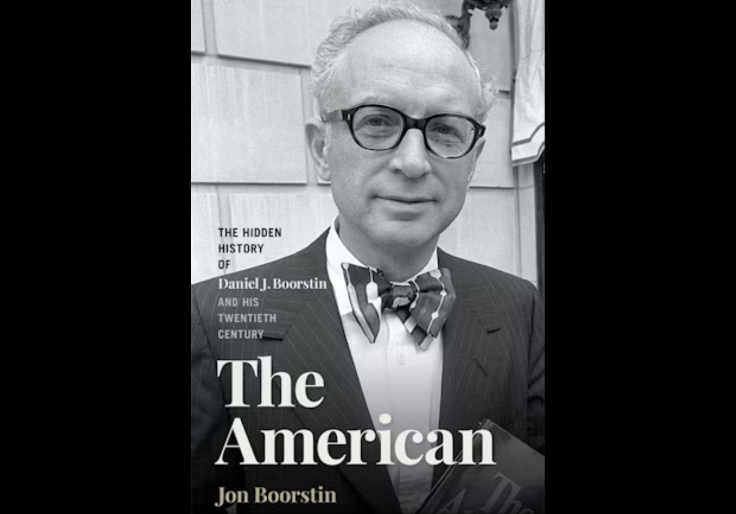
In the new book, The American: The Hidden History of Daniel J. Boorstin and His Twentieth Century, Jon Boorstin describes this very American but also American Jewish evolution (devolution?) in the Boorstin family. The Boorstin family is notable largely because it included the famous historian Daniel Boorstin, who embodies the third generation in the Boorstins' rise. As Jon describes it, Benjamin Boorstin came to America penniless. He did not speak English, but made his way as a peddler and then store owner in the South. Benjamin groomed his son Samuel to take over the family store but Samuel instead became a successful lawyer. Samuel's son Daniel became the famed historian, and now Jon is a filmmaker and writer. (Jon's children, not covered in the book, are a lawyer and a marketing executive, and his cousin Bob was chief speechwriter to President Clinton and head of public policy at Google, for those who are curious.)
The book jacket describes it as part biography, part family history. As such it is not a standard look into Daniel Boorstin's illustrious career but more a picture of the American Jewish experience over the 20th century. The book is divided into set pieces that capture some of the family experiences, starting with the peddler Benjamin and a vivid if imagined description of how he must have made his way in the late 19th century South. Benjamin did not leave much of a written record behind, so Jon has clearly mined accounts of other Jewish peddlers to describe how they lived their lives and sold their wares.
Particularly interesting is Jon's descriptions of the gentiles Benjamin must have met—friendly and not threatening, unlike those he encountered in Europe; the African Americans he sold to—wary but surprised to find a white man who treated them as equals; and the American view of law enforcement—the Jewish peddlers as a whole are surprised but pleased to see that a man who killed a peddler was pursued and hanged by the local gentile population. These experiences showed Benjamin that America was very different from the Europe he had left behind, in a good way, something that did not always need to be said but should be repeated now in these woke times.
Benjamin's son Samuel was not very interested in running the family store. He wanted to be a lawyer, which was beyond the family's budget at the time. The scrappy Samuel bought himself a camera and presented himself at the University of Georgia as staff photographer, a position that allowed him to pay for his legal education. Samuel finished law school at 19, young but wise beyond his years. When he presented his credentials to a Georgia Superior Court judge for swearing in, the judge told Samuel that lawyers had to be 21 in Georgia. In response, Sam recalled, he showed the judge "the 1843 session laws establishing the Franklin College of Law at the University. It said graduates of the law school would be admitted upon presentation of their certificates. So he swore me in."
Sam moved to Atlanta, where he befriended a smart Cornell graduate named Leo Frank, who managed a pencil factory. Many readers will recognize the name of the man wrongly convicted in 1915 of killing Mary Phagan, a young girl from the factory. Sam worked desperately to save his friend, even being instrumental in the governor's commutation of his death sentence, but he was ultimately unsuccessful: A mob lynched Frank after the commutation.
Shortly afterwards, Sam moved to Tulsa. This was a surprising transition as Tulsa was a smaller city with also a smaller Jewish community, but Tulsa was a boomtown around then. Unfortunately, it was also the home of the 1920 Tulsa race massacre. Sam and his young son Daniel recalled watching from their home the flames that destroyed the black neighborhood. Daniel begins to emerge in Tulsa, a top student who gets into Harvard during a period of anti-Jewish quotas because he did not appear Jewish from his application. The last name was nondescript, and Tulsa was not known for having a large Jewish community.
Daniel is largely unknown today, but he was a hugely successful historian in his time. His Pulitzer Prize-winning trilogy The Americans remains a brilliant cultural and political history of the United States; in The Image he created and popularized the term "pseudo-event" to characterize a staged rather than an actual event; and I still recommend his short book The Genius of American Politics as the best single volume to give someone if they want to understand what America is all about. He was named librarian of Congress in the Gerald Ford administration.
Of course, young Jon saw his father when Daniel was still striving for success and not the famous historian he later became. Jon tells readers the family knew that should there ever be a fire in the Boorstin house, the top priority was to "save the manuscript first," before even the children or any other family possessions.
Jon also shares why Daniel fell out of favor. First, he testified to the House Un-American Activities Committee about his former time as a communist, earning him enmity on the Left. In addition, he was an advocate of merit and an opponent of racial quotas.
Boorstin also celebrated and advanced the career of the African-American historian John Hope Franklin. Franklin was also from Tulsa, where Sam and Franklin's father were friends. When Franklin came north to Harvard, he was not surprised to experience some casual racism, but he was very surprised with the widespread antisemitism he found there. As Jon quotes Franklin, "Growing up, I had never heard any educated white person speak of another in such terms, and I lost respect not only for the individual who made the statement but for the entire group that tolerated such views."
In The American, Jon Boorstin has helped re-create the world of American Jewish immigrants from Europe and the pathway to success they took to get here. He also provides insight into his father Daniel and the fact that Daniel's good work is now sadly forgotten. This eminently readable book provides a window into the opportunities that America has given to both citizens and newcomers and why it remains a country that deserves more credit than it gets these days.
The American: The Hidden History of Daniel J. Boorstin and His Twentieth Century
by Jon Boorstin
University of Georgia Press, 384 pp., $34.95
Tevi Troy is a senior fellow at the Ronald Reagan Institute and a senior scholar at Yeshiva University's Straus Center. He is the author of five books on the presidency.