


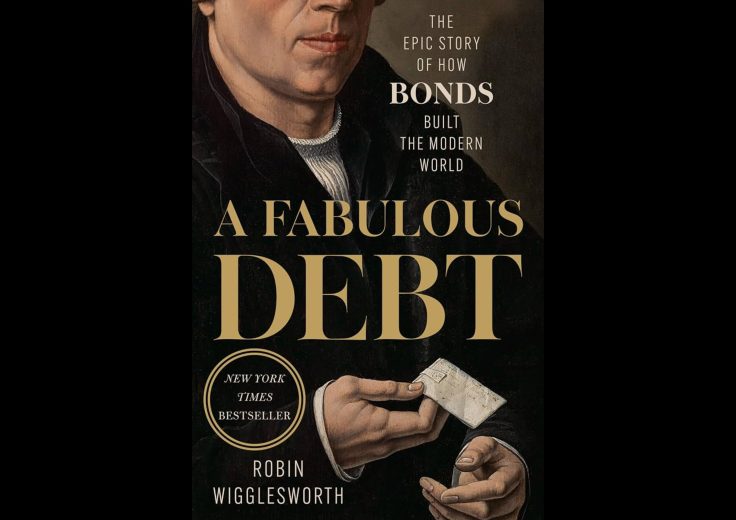
Ian Fleming called his secret agent James Bond because the name was dull. But there is nothing dull about Robin Wigglesworth's history of the bond market's relentless innovation toward efficiency, liquidity (and crashes) from the Middle Ages to the present. Wigglesworth, the editor of the Financial Times's witty Alphaville column, offers essential insight into the gargantuan market in U.S. Treasury securities that underpins world finance—and the hazards of increasing leverage.
A bond is conventionally defined as publicly traded debt with a maturity of at least two years. This gives bond issuers (borrowers) stable sources of financing and provides buyers (lenders) with predictable streams of principal and interest repayment. The lines between bonds, the money market (short-term debt), and the larger world of debt (which can be privately held rather than publicly traded) are never rigid, and their interactions have become increasingly important.
Like the strolling players in the musical Kiss Me, Kate, the bond market opened in Venice, which requisitioned loans from its citizens to pay for a medieval naval war with Byzantium. As a sweetener, La Serenissima promised to pay 5 percent interest, and the monte (mountain of debt) was born. Like U.S. Treasuries today, the bonds became the basis for a fractional reserve banking system, which allowed the expansion of credit and savings.
Wigglesworth's tale is consistent with Charles Tilly's famous thesis that Europe's development was driven by competing fiscal-warfare states. He emphasizes the financial advantage of republics such as Venice, with their distributed political power and creditor representation, which was reflected in lower interest rates. Where monarchies could repudiate debt based on a single ruler's decision, bond-issuing republics could more credibly limit the expansion of debt and commit to repayment.
The next innovation took place a century later in what are today's Netherlands, where renten (bonds backed by local taxes) funded public works, a precursor of the municipal bond market. Wigglesworth attended a 400th anniversary ceremony celebrating a payment on the oldest known active bond, issued in 1624 by a Utrecht-area water authority to repair a dike breach. Renten later financed the revolt against Spain and turned the Dutch Republic into a financial hegemon.
In 1694, the privately controlled Bank of England was founded by Parliament to back government bonds financing the Nine Years' War, while a century later, Alexander Hamilton's First Bank of the United States backed bonds funding the repayment of defaulted Revolutionary War bonds. Again, bonds issued by representative governments led to a relatively stable currency, lower interest rates, and expanded credit. By the 19th century, bonds were the primary way of financing canal and railroad infrastructure. The resulting transportation revolution turbocharged the Industrial Revolution—at the cost of booms and busts.
The book's bond market focus is narrower than financial history surveys by academics Niall Ferguson, David Graeber, and William Goetzmann, which are now over a decade old. Wigglesworth humanizes the story through capsule biographies of the personalities who strut across the bond market stage, synthesizing popular histories. They rarely end well. Venetian Doge Vitale II Michiel and Golden Age Holland’s Grand Pensionary Johan de Witt were killed after military disasters. (De Witt had just completed the first mathematical text on bond valuation.)
By the 19th century, failure no longer resulted in execution, but bondholders still wanted assurance they would be repaid. The author doesn't cite bond underwriter J.P. Morgan's 1912 statement that "a man I do not trust could not get money from me on all the bonds in Christendom." But Morgan's principles—incentivized by bankers' unlimited personal liability for the debts of their banks—made the bond market an old boys' network that constrained access to capital.
Sixty years after Morgan, unlimited personal liability, the post-World War II Bretton Woods system, and information technology costs were all in steep decline, and with them the old boys' network. Eccentric geniuses, many Jewish, Italian-American, or Irish-American, laid the groundwork for freer credit markets and accelerating innovation. Their idiosyncrasies and bets were often allowed to compound until the point of no return, most famously Salomon Brothers securitization pioneer Lew Ranieri and his "food frenzy" mortgage desk of Liar's Poker fame. The same was true, less bizarrely, of junk bond king Michael Milken, Long-Term Capital Management hedge funder John Meriwether, and "buy side" investment manager Bill Gross.
While many post-1970 innovations had antecedents, the speed and complexity of their interconnection was new. The final chapters, mostly based on Wigglesworth's decades of reporting, spread out like a river delta. Government bond guarantees expand and bonds become collateral for new tools such as financial futures, credit default swaps, and collateralized debt obligations. The breadth of coverage can occasionally turn cryptic, even for this reviewer, who has a financial services background. Readers seeking additional detail, however, can find it in sources such as Investopedia.
The bond market's interconnections contributed to a secular decline in interest rates over the decades—and incentivized even more leverage, leading to the Global Financial Crisis (GFC). In response, central banks spurred a massive global debt buildup via another innovation, quantitative easing. The Federal Reserve (whose historical role was to manage short-term interest rates through the banking system) bought trillions of dollars of long-term Treasuries to hold down long-term interest rates and spur recovery.
As Wigglesworth observes, regulation causes transactions to move to less regulated markets. Post-GFC bank restrictions pushed overnight lending into the less regulated repo market, with lenders such as money market funds replacing banks. (For non-cognoscenti, repos are Treasury repurchase agreements, in which one party agrees to sell Treasuries to a counterparty and then buy them back the next day for a slightly higher price. The Treasuries are effectively collateral and the higher buyback price is effectively an interest payment. The parties often roll over into a new repo each day, so the seller has the continuing use of the buyer's cash.) When 2020's COVID shutdown triggered a sudden calling in of Treasury collateral (buyers refused to roll over repos, and had the right to keep the Treasuries unless sellers paid off in cash), a liquidity crunch threatened a financial meltdown. The Fed then created a backstop for the repo market. By the end of 2024, there was more money in bonds (approximately $174 trillion) than in the banking system.
The author doesn't explicitly cite economist Hyman Minsky's model that market participants who perceive low risk will increase leverage to bid up valuations until, like Wile E. Coyote, they suddenly realize there is nothing underneath. But consistent with Minsky, Wigglesworth observes that the expectation of bailouts creates moral hazard for market participants, who take more risk, which generates ballooning bailouts that can lead to economic decline for the sovereign. He reviews failed academic attempts to predict the threshold of doom, but warns that some debt level will trigger a crisis.
The book ends before the current artificial intelligence boom, which has loaded on even more debt. In recent weeks, the U.S. national debt passed $40 trillion, the Trump administration expanded its tariff and Strait of Hormuz threats, and Treasury Secretary Scott Bessent launched sudden market interventions that failed to prevent the 10-year Treasury rate from rising above 5 percent. Wigglesworth's former Financial Times colleague John Authers (now of Bloomberg) argues that today's rising Treasury interest rates include an "insanity premium" due to policy uncertainty.
In a recent Alphaville post, Wigglesworth warns of codependency: Hedge fund purchases of Treasuries have increasingly funded (and enabled expansion of) federal deficits. These holdings, estimated at 8.5 percent of outstanding Treasuries, are collateral for highly leveraged, opaque short-term trading that can generate huge profits. Insanity premiums are easy to misprice, and as in 2008 and 2020, incorrect bets somewhere in the baroque financial plumbing could cause massive Treasury collateral calls overnight. The next bust could be even scarier than the last.
A Fabulous Debt: The Epic Story of How Bonds Built the Modern World
by Robin Wigglesworth
Portfolio, 416 pp., $35
Jay Weiser is associate professor of law emeritus at Baruch College and has written for the Wall Street Journal, Reason, the Weekly Standard, National Review, City Journal, and American Purpose, among other publications.