

A ghost story should start with a time reference, according to the man who may be the master of the form. "A slight haze of distance is desirable," wrote M.R. James. "'Thirty years ago,' 'Not long before the war,' are very proper openings."
So let's begin: Ninety-six years ago, James learned that King George V had selected him to receive the Order of Merit, which recognizes outstanding achievement. Only 24 living people can hold the honor at once. Current members, as they are called, include the naturalist David Attenborough, the computer scientist Tim Berners-Lee, and the inventor James Dyson. The painter David Hockney was in the club until his death in June.
Back in 1930, the letter James received from Buckingham Palace praised him for his scholarship: "your pre-eminent position as a medievalist, your unique knowledge of illuminated manuscripts, medieval literature, ecclesiastical architecture, and stained glass windows, and also your contribution as a specialist on the Apocryphal literature of the Bible."
It said nothing about ghost stories. Yet they are "his most lasting legacy," writes Darryl Jones. "He is, I firmly believe, the greatest ghost-story writer there has ever been, and the single most frightening writer I have ever read."
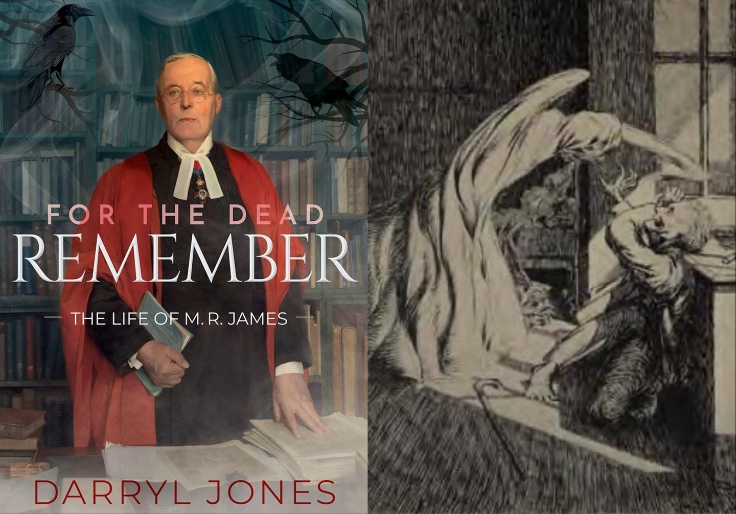
Jones ought to know. A professor of literature at Trinity College Dublin, he has written widely on horror fiction. Now he is the author of a fine biography of James that combines deep insights with a light touch. It makes for thoughtful reading that goes down easily. For the Dead Remember: A Life of M.R. James is at least the equal of 1983's M.R. James: An Informal Portrait, by Michael Cox, who was himself a distinguished critic of ghost stories as well as a good novelist.
James wrote only 33 ghost stories. That's the number gathered in Collected Ghost Stories, a volume Jones edited for Oxford University Press in 2011. Several rank among the best in the genre: "Canon Alberic's Scrap-book," "Count Magnus," and "'Oh, Whistle, and I'll Come to You, My Lad.'" Their author produced about one per year, mostly for an annual reading by candlelight to colleagues on Christmas Eve. They are the main reason a reader today would have any interest in James.
Yet there was much more to the man. James was a top administrator at elite institutions, and Jones arranges his biography by chapters with job titles. It's quite a résumé: "Fellow of King's," "Director of the Fitzwilliam Museum," "Provost of King's," "Vice-Chancellor of Cambridge University," and "Provost of Eton." Jones chronicles this progression without getting bogged down by the bureaucratic intricacies of James's daily life. His wry synopsis will satisfy most readers: James "attended a lot of boring meetings."
James was more than an office holder. He was "the most eminent anglophone codicologist of his day," which is to say he studied codices, or ancient manuscripts. His best-known work that isn't a ghost story is The Apocryphal New Testament, a 1924 compendium of early Christian writings that failed to make it into the Bible. James also published a book on apocalyptic art, a guide to English abbeys, and more than 30 catalogs of library holdings. As Jones confesses in his introduction, "writing a biography of M.R. James requires a range of expertise that no one person could possibly have." A compounding challenge is that James and his expertise often veered into the obscure. "The lure of the marginal, the apocryphal, the irrelevant, the forgotten—or indeed the forbidden, the rejected, and the occult—would always be irresistible." James "always knew more than anyone else about his subjects," writes Jones, who then adds: "In fairness, he was the only person interested enough to find out about many of them."
Jones describes the arcana without becoming arcane himself. Along the way, he enlivens his biography with anecdotes. James, for example, dreaded spiders. Jones traces the fear and loathing back to James's early years and the eight-legged inhabitants of a washbasin. James also displayed a scholarly bent as a boy, and Jones illustrates the point with a glimpse of the young student "reading a copy of Aristophanes during a game of cricket, chuckling away, oblivious to the match." As he grew, James came to love cats, jigsaw puzzles, and the London appearances of Buffalo Bill's Wild West Show.
James picked up languages with small effort. At the age of 16, he taught himself Ancient Ethiopic. Later, he "relaxed … by learning a new language, Coptic." He also knew Hebrew, Aramaic, Greek, Latin, French, German, Danish, and Swedish. One skill he couldn't conquer was handwriting: Jones describes his scribblings as "almost unreadable," "illegible," and "horrible." James also suffered from "chronic bad teeth." Dental troubles punctuate his life's story. At one point, Jones blurts an exasperated question: "What must the inside of his mouth have looked like?"
A minor annoyance is that Jones is eager to portray James as "a profoundly repressed and closeted homosexual man." James may in fact have been gay. His closest friend thought he was. Many others have speculated. Yet it's impossible to prove. As Jones admits, "there is no direct evidence of any sexual relationship" between James and anybody, male or female. James is perhaps best described by a phrase Jones uses once: "celibate bachelor don." All else is guesswork or wishful thinking. It's both prurient and preposterous to call For the Dead Remember "a valuable biographical addition to the history of queer studies," but that's how the publicity materials from Oxford University Press promote it, in a statement that reveals more about OUP publicists than it does about James.
It's true that James rarely revealed his interior life, at least not in his publications or his surviving letters. Yet he could express himself with eloquence, as he did in 1916, when he was vice-chancellor at Cambridge and gave a speech about the young men who had marched off to war and slaughter. He had known many of them personally, when they were students. "To us Christians," he said, "the sum of our thought about the dead is that they are alive." His remarks were widely published. "Grieving friends and relatives," reports Jones, "often drew great comfort from its sentiments."
The dead who are alive, of course, is a way to define ghosts. It must be said that James rarely depicted his ghosts as the wispy apparitions of cliché. They were more often monstrous manifestations, often shaggy with hair: "Imagine one of the awful bird-catching spiders of South America translated into human form," he wrote in "Canon Alberic's Scrap-book." In this sense, he didn't compose ghost stories as much as horror stories. Whatever the label, they drew from his well of knowledge as a scholar. Authentic documents fueled his nightmare visions. Jones makes several compelling connections between specific manuscripts from James's intellectual life and the demons, vampires, and other fiends who haunt his fiction.
This leads to an irony. In the tales, curiosity often leads to calamity. Characters inadvertently summon sinister entities because they open books that are best left shut or play with artifacts that should have stayed buried. One story is titled "A Warning to the Curious." Another, "The Rose Garden," concludes with advice: "quieta non movere," which is Latin for "do not disturb quiet things." As a scholar, however, James appreciated the value of snooping around. "Be inquisitive," he once advised his fellow academics. "See books for yourself."
If you've gotten this far without having read a ghost story by James, perhaps the time has come to see one of his books for yourself. What could go wrong?
For the Dead Remember: The Life of M.R. James
by Darryl Jones
Oxford University Press, 464 pp., $34.99
John J. Miller is director of the Dow Journalism Program at Hillsdale College and a Free Expression columnist for the Wall Street Journal.