


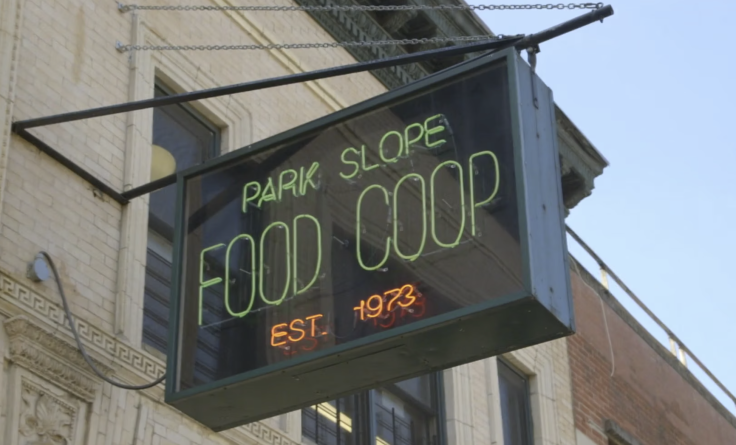
The Park Slope Food Coop in Brooklyn was slapped with a lawsuit on Tuesday that alleged an antisemitic intimidation campaign by its leadership to silence Jews who objected to its boycott of Israeli food, according to a copy of the lawsuit first obtained exclusively by the Washington Free Beacon.
The members-only food cooperative—an institution in left-wing Park Slope—voted in late May to boycott all Israeli goods, capping a pitched battle by co-op's anti-Israel "Members for Palestine" to see Jewish foods stripped from the shelves. Feuding at the co-op over whether to stock Israeli goods has simmered for many years—dating back at least to a contretemps over Sabra hummus in 2009—but anti-Israel sentiment hardened after Oct .7
Tuesday's lawsuit—filed by the National Jewish Advocacy Center on behalf of five Jewish co-op members—maintains the co-op's leadership wrongly altered longstanding practices to facilitate the boycott's passage and that Jewish members who spoke out against the process were met with antisemitic harassment.
"The Boycott's proponents," the lawsuit reveals through text messages and other communications, "repeatedly singled out 'Zionists,' Jewish Members, and persons with ties to Israel for criticism and exclusion." A secure chat on the encrypted messaging app Signal, for instance, included calls by the "Members for Palestine," or M4P, to oppose "the co-op Zionists" and push for "the demolition of the zionist entity's invincibility." The suit was filed in the state's Kings County Supreme Court and requests "declaratory, injunctive, equitable, and monetary relief" of at least $150,000 for both the harassment campaign and unjust changes to the co-op's voting process.
The lawsuit carries national implications as anti-Israel activists work on the state and local level to introduce Israel boycotts into many facets of the economy and daily life. The Park Slope Food Coop—which delivers to its membership a literal feast of organic meat and produce direct from area farms, along with gourmet options such as 100 varieties of cheese—generated $63.17 million in revenue this past year. It's at the heart—or the stomach—of the "Commie Corridor" of Brooklyn neighborhoods that fueled winning campaigns by far-left candidates such as New York City mayor Zohran Mamdani and Democratic and socialist congressional candidates such as Brad Lander and Claire Valdez. The current boycott itself has been percolating for years, driven primarily by M4P, and its passage earlier this year was celebrated across anti-Israel spaces online and in the Western media.
The M4P Signal chat was active as far back as 2024, with members discussing tactics to intimidate co-op members, take over leadership posts, and strongarm the co-op into altering its longstanding voting processes to ensure the boycott motion passed. In one June 2025 message included in the lawsuit, M4P members referred to then-co-op general manager Joe Holtz as "a rabid Zionist" and as "Genocide Joe."
Other messages "included calls for discipline or censure of Members who opposed the campaign's tactics" to formalize the Israel boycott and, in other cases, bizarrely offered praise for Yahya Sinwar, the late Hamas leader who orchestrated the Oct. 7 terror attacks.
"Long live Yahya Al-Sinwar," wrote activist Damien Neva to the Signal group in November 2024, as M4P members were planning strategies to push the Israel boycott through the co-op. "At least one other participant reacted with approval. Immediately before praising Sinwar, Neva messaged, 'that lot does not have the votes to block our campaign,'" the lawsuit reveals.
The antisemitic intimidation campaign continued into last year, when a co-opmember wearing a "Peace, Love, Israel" shirt was told by a person—whose role was not identified in the lawsuit—that the outfit is "disgusting" and that the wearer is "a racist and a genocide supporter" who should leave the co-op. Following the warning, the co-op suspended the pro-Israel member from their "shift" (a required, unpaid work period). "The harasser," the lawsuit alleges, "was not disciplined."
Members of the co-op work volunteer shifts stocking shelves or operating cash registers in exchange for cheaper-than-retail groceries, with elaborate rules governing shopping eligibility and work-shift requirements.
In some cases, the lawsuit alleges, complaints of discrimination by Jewish members were swept under the rug.
In April of 2025, a boycott activist "referred to 'right wing Jewish extremists' as interfering in Coop affairs." When the co-op's Dispute Resolution Committee later held a mediation session related to the complaint, the same activist called it an exercise of "Jewish privilege."
By Sept. 16 of last year, the co-op's "official publication" included a letter branding a prominent Jewish co-op member as being affiliated with an "extremist Zionist faction and IDF [Israel Defense Forces] apologist." The letter went on to accuse the Jewish member of "intellectual depravity," being "morally abhorrent," and "spiritually disfigured."
Alongside the campaign to silence Jewish co-op members who opposed the Israeli boycott, the M4P faction slowly assumed more power within the co-op's leadership architecture.
The multi-year campaign included efforts to change the co-op's longstanding voting practices to the boycott measure passed under any circumstances. As the process played out, the co-op was "repeatedly placed on notice of the legal and financial risks" a boycott would carry.
A survey from May 2026 projected that around 37 percent of the co-op's members opposed the boycott measure and would resign from the co-op, taking with them membership dues and deposits. It also found that around 1,300 members would stop shopping at the co-op and that sales could decrease by up to 16 or 20 percent. co-op's treasurer reported around the same time that if 10 percent of the members left, the co-op could lose $6.5 million in revenue and $1.3 million in gross margin.
The plaintiffs maintain that these findings prove the co-op shirked its fiduciary responsibilities in a bid to accommodate anti-Israel members and see the boycott passed.
When the co-op voted in late May to approve the boycott, approximately 67 percent voted in favor, far short of the 75 percent supermajority typically needed. That, however, did not matter due to a yearslong campaign by M4P and its backers to alter the co-op'sbylaws and operating procedures, the lawsuit says.
"The Boycott was adopted after Defendants disregarded co-op's Governing Documents, altered voting procedures and thresholds without the required bylaw amendments, suppressed debate, and treated an advisory General Meeting vote as binding," the lawsuit charges. This deprived those opposed to the boycott a rightful say and constitutes "substantial legal, financial, operational, and reputational risk."
Alan Scheiner, a senior litigation counsel with NJAC, told the Free Beacon that "Israelis and Jews should not be subjected to this hatred or forced to surrender their Jewish identity in order to be welcome in places of public accommodation."
"Most Jews feel called by the ancient core of their identity to deeply identify with Israelis and the State of Israel, where nearly half of the world's Jews live," Scheiner said. "Anti-Israel activism uses pretextual human rights claims that are only a thin veil over unlawful antisemitic animus that focuses on Israel—to the exclusion of all other nations—because Israel is the only Jewish state."