



So much for Seth.
Rep. Seth Moulton's bid for U.S. Senate in Massachusetts ended Tuesday in an inglorious defeat in the Democratic primary at the hands of the incumbent, Senator Ed Markey, 80.
At 10 and a half months, Moulton's Senate bid lasted longer than his 2020 presidential campaign, which expired in August 2019 after 4 months. He managed to win the endorsement of the Boston Globe, the state's largest newspaper. But Moulton, a 47-year-old ex-Marine with three degrees from Harvard, didn't win enough votes in the primary to proceed, leaving his Senate race with the same outcome as his presidential campaign: a loss. With 96 percent of the vote in, he was trailing by 30 points.
The significance goes beyond Moulton's political career. It points to the difficulty of dislodging an incumbent senator—news that will come as no solace to John Cornyn, Republican of Texas, but that may help reassure Susan Collins, Republican of Maine. It points to the tenuous road for moderate candidates in Democratic primary politics. Most of all, though, it is a demonstration that totally abandoning whatever principles you had, or were pretending to have, is no recipe for victory.
Malleability is sometimes counted as a political plus, as in the hoary joke about the politician who says, "those are my principles, and if you don't like them… well, I have others." But Moulton managed to take that approach so far in his 2026 campaign—running away from any of his own moderate positions that might conceivably differentiate him from Markey—that the overall effect was less self-deprecating than it was abjectly pathetic. Instead of pragmatic, Moulton seemed inauthentic.
Among the areas where Moulton flip-flopped:
Business, taxes, and class warfare. One of his three degrees from Harvard is an MBA, and Moulton kicked off his presidential campaign in 2019 by pointedly declaring, "I'm not a socialist." He denounced tax increases on the rich as "class warfare." As a member of Congress, he has not signed on as a cosponsor to two pieces of tax-the-rich legislation.
Yet as a Senate candidate, he's promising a $3.5 trillion tax increase based on "a national wealth tax on mega-millionaires."
Israel. Moulton started out pro-Israel. On October 7, 2023, he said, "I stand firmly with Israel and unequivocally affirm its right to defend itself and its people." He called the Harvard student organization letter holding Israel "entirely responsible" for the violence "intellectually weak and morally repugnant," declaring, "I cannot recall a moment when I've been more embarrassed by my alma mater." In December 2023, he criticized Harvard's then-president, Claudine Gay: "Moral leadership rarely comes in the form of defensive explanations. People are 'confused' because you refused to unequivocally state that advocating genocide has no place in the Harvard community. ... Wouldn't it have been powerful to see university leaders join together in committing to combat the shocking rise of antisemitism in America, rather than uniting to avoid answering a simple question."
Yet Moulton kicked off his Senate campaign with an attack on the main pro-Israel lobby, the American Israel Public Affairs Committee, performatively refusing to accept donations from it. He also pledged to return all the money he had accepted from AIPAC, which he failed to do. Instead, he returned the funds he'd received from the group in the 2026 cycle.
Cultural issues. In a November 2024 post-election interview with the New York Times, Moulton suggested that the Democrats could benefit from being less doctrinaire on the issue of men in women's sports: "I have two little girls, I don't want them getting run over on a playing field by a male or formerly male athlete, but as a Democrat I'm supposed to be afraid to say that." The remarks came after Trump soared to victory over Kamala Harris in part on the basis of a television commercial highlighting Harris's response to a 2019 ACLU questionnaire in which she said she supported taxpayer-funded sex-change operations for illegal aliens. "Kamala is for they/them. President Trump is for you," the ad said.
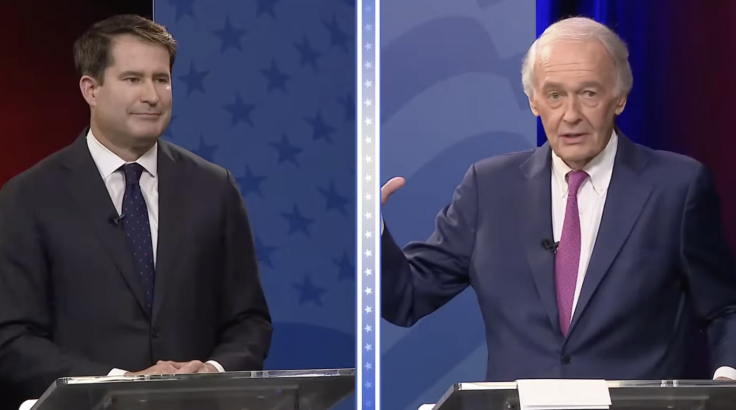
Yet in the Senate campaign, Moulton apologized for those comments. "To the trans community, feeling the weight and the pain of the Trump administration policies, I deeply recognize your trauma, and I'm sorry if my comments hurt you. That was not my intention," Moulton said during an August 3, 2026 debate. "I'm a proud sponsor of the transgender bill of rights, a proud repeat cosponsor of the Equality Act, and I have a 100 percent record with the Human Rights Campaign. If you're in the trans community, or you're a trans kid feeling the weight of the Trump administration and the Supreme Court, you matter, you're valued, and I will always have your back."
The cumulative effect of it all was to leave Massachusetts voters confused about what Moulton stood for other than his own ambition for higher office. The evolutions seemed awfully convenient for appealing to the left-leaning Massachusetts Democratic primary electorate, but they wound up turning off voters by appearing calculated rather than conviction-based. Maybe Moulton will be considered for the role of Secretary of Veterans Affairs in the next Democratic administration, or some transportation-related job—he's a high-speed rail enthusiast. Until then perhaps he will seek employment in the private sector, equipped with the painfully earned newfound knowledge that the public—even a segment of it as skewed as the Massachusetts Democratic primary electorate—can easily detect a phony.