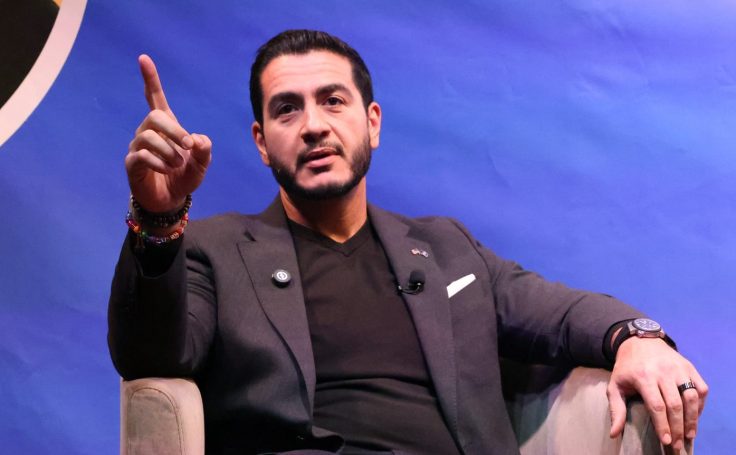
At least six men who joined Abdul El-Sayed in signing a notorious 2012 letter calling for a Muslim Brotherhood "purge" of the media and police have also donated handsomely to his two runs for office, mostly to his current Senate campaign, records reviewed by the Washington Free Beacon show.
The total haul from his fellow brotherhood backers was at least $25,850, according to the records.
The 2012 letter, signed by El-Sayed and other "leaders of the Egyptian community," voiced support for Egypt's struggling Muslim Brotherhood government and called on newly elected president Mohamed Morsi, a longtime Muslim Brotherhood leader, to "purge the media and the police as quickly as possible."
Dr. Hany Saqr, who signed the letter as part of the "Egyptian Association in America," has given at least $1,000 to El-Sayed's Senate campaign, Federal Election Commission records show.
Saqr has a long history with the Muslim Brotherhood—an Islamist group with longstanding ties to terrorism that birthed al Qaeda and ISIS—the Free Beacon previously reported.
The doctor was listed in a 1992 phone directory of U.S.-based Muslim Brotherhood leaders submitted by federal prosecutors as part of the terror financing case against the Holy Land Foundation in 2008. The directory was seized from the Virginia home of an alleged Hamas operative. In 2018, Saqr used a Muslim Brotherhood logo as his Facebook profile photo and blasted Egyptian president Abdel el-Sisi—a foe of the Muslim Brotherhood—as a "dog of the Jews."
While El-Sayed has denied any ties to the brotherhood, his own mother spent time working for a charity which was later shut down over its association with al Qaeda. His half-sister Eman Abdelhadi has said the family has deep ties to the Muslim Brotherhood, according to now-deleted social media posts. She specifically pointed to her and El-Sayed's mother's role as a Muslim Brotherhood activist as a college student in Egypt in the 1970s.
On Wednesday evening, El-Sayed dismissed the scrutiny into his family during a debate against Republican opponent Mike Rogers, who referenced the 2012 letter by accusing El-Sayed of calling to "defund the police there" in Egypt.
"He keeps raising this question about this association with an organization I've never been a part of because of my mom who's a nurse in Missouri?" El-Sayed said, omitting her work for the charity shut down over terror fundraising. "To bring into question my commitment to the Constitution is really beneath you."
Abdul's fellow signatories to the 2012 letter, however, had no shame about injecting themselves directly into Egypt's messy affairs. Dr. Khaled Elsayes, for instance, signed the letter as a representative of "Rebuilding Egypt." He remains in charge of the organization, a tax-exempt nonprofit in Pearland, Texas, to this day.
Though its website has been deleted, archives of the page from 2011 and 2012 showed the group actively backing the Muslim Brotherhood revolution in Egypt, which brought Morsi briefly to power.
Hyperlinked pages for Elsayes's group include "Fundraising to help the revolution," "How to present the revolution; click here to upload powerpoint presentation" and "KEY TALKING POINTS FOR EDUCATING MEDIA NEIGHBORS & FRIENDS."
"Do you support boycotting the Egyptian TV channels for illegitimate support of the government by broadcasting wrong news and reports about the revolution?" another page asks prospective members.
In another archived page, Khaled Elsayes takes ownership of the effort and notes his work as an "Associate professor of Radiology at the University of Texas MD Anderson Cancer Center"—an affiliation he still holds today.
Elsayes has donated at least $2,750 to Abdul El-Sayed's Senate campaign, records show.
Reached by the Free Beacon, Elsayes says he donated to El-Sayed but did not sign the 2012 letter. "I didn’t sign anything to support Morsi and didn’t even like his policies," he said. "The only explanation was that Morsi supporters were including some names who are known as successful Egyptian expats to support his policies."
Another letter signer, Ahmed Shehata, was irate when Morsi's crackdown on the press and police—as urged by El-Sayed and his comrades—failed and the brotherhood was ousted, writing an opinion piece for Roll Call in December 2013 calling on the United States to reinstate Morsi. A year later, in December 2013, he attacked efforts to brand the Muslim Brotherhood a terrorist organization.
Morsi, who was overthrown and imprisoned in 2013, died six years later when he collapsed in the courtroom defendant's cage during his espionage trial.
Today, Shehata serves as CEO of Islamic Relief USA. In that capacity, he donated $500 to El-Sayed's Senate campaign, records show. Shehata threw in another $500 for El-Sayed's 2018 gubernatorial campaign as well.
Dr. Azmy Allam of Michigan also signed the letter. Today he works as a doctor of pulmonology at Memorial Healthcare in Owosso, Mich. His employee page notes his education as "Cairo University."
"I wished I was there," he said of the Muslim Brotherhood-backed revolution to the local Argus Press in February 2011.
Allam threw $1,000 into El-Sayed's Senate race last year with another $1,000 for his 2018 gubernatorial race, records show.
By far the largest donor to El-Sayed from those who signed the letter is Dr. Hesham Gayar—who today works quietly in Michigan's Barbara Ann Karmanos Cancer Institute, specializing in oncology and proton therapy, according to his employer page.
But in 2012 he joined El-Sayed's call for an Islamist crackdown as a representative of the "Egyptian Foundation," according to his signature on the letter. More than a dozen years later, he has donated at least $7,000 to El-Sayed campaign for Senate in Michigan, Federal Election Commission records show.
El-Sayedalso accepted $6,600 more from El-Gayar during his 2018 gubernatorial campaign—a figure which included $1,600 for catering services, records show.
Dr. Amr Abbas, also of the "Egyptian Foundation" in Michigan, donated $5,500 to El-Sayed’s gubernatorial campaign, records show. Today he works as a cardiologist in Berkley, Mich., at Corewell Health. Like Allam, he was also educated in Cairo.
El-Sayed was one of 46 "leaders of the Egyptian community" in the United States who signed the letter, which originally appeared in Arabic.
"Statement by Morsi Supporters in America Backs His Decisions and Calls on Him to 'Purge the Media and Police,'" blares the headline published on Nov. 25, 2012.
"We, leaders of the Egyptian community, support the revolutionary decisions taken by the president, and we call on him to purge the media and the police as quickly as possible," the letter reads.
El-Sayed has never addressed why he decided to sign the 2012 letter making the ask of Egypt’s then-Muslim Brotherhood leader Mohammad Morsi and has repeatedly ignored Free Beacon inquiries about the matter. His campaign even refused to discuss the letter for a sympathetic New York Times piece published Wednesday that discussed El-Sayed's Muslim Brotherhood ties.
The United States formally classified large branches of the brotherhood as terrorist groups in 2025 and 2026.
Five of the six letter signers did not immediately respond to requests for comment from the Free Beacon.