



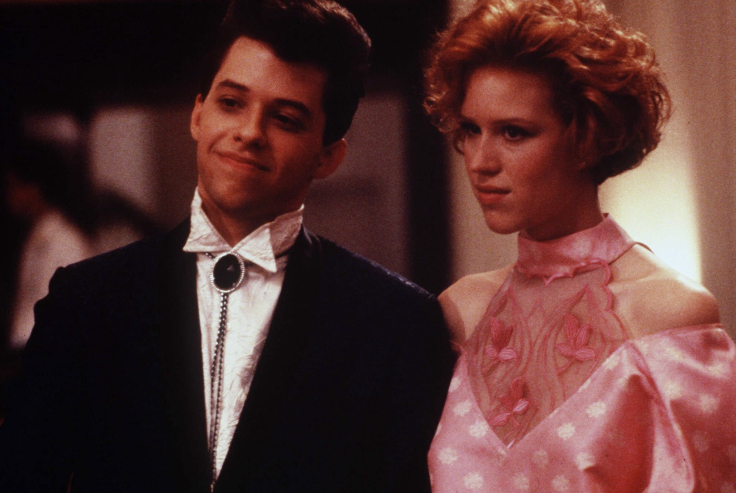
Pretty in Pink is a fairy tale set in a suburban Chicago high school in the weeks before senior prom. Andie Walsh (Molly Ringwald) grows up on the wrong side of the tracks and doesn't have a stitch to wear. Her date lets her down at first, but she goes to the ball and gets her prince in the end. Her frog, a wealthy beta in a white tux called Blane McDonough, is played by Andrew McCarthy.
Pretty in Pink is not the best "Brat Pack" movie. That would be the previous year's The Breakfast Club, in which Ringwald played the pink-clad, sushi-eating rich girl Claire Standish. Nor does Pretty in Pink have a moment of dumb genius to compare with the detainees dancing around the library in The Breakfast Club. This is a John Hughes "Brat Pack" movie on paper: Hughes, the Orson Welles of the SAT set, only wrote the script.
The director, Howard Deutch, had lately made pop videos for Billy Joel ("Keeping the Faith") and Billy Idol ("Flesh for Fantasy") and now made his first feature-length movie. This was the dawn of MTV, and Deutch's quick-cutting zip and English indie soundtrack offset the drag of Hughes's maudlin tendencies and Balzacian obsession with sociological nuance. It is a period piece, bouncing up to the edge of adulthood on the Psychedelic Furs' track that supplied Hughes's title, but a piece of which period?
The prettiness and pinkness of the movie's title refer to Andie's dress, which is altered not by singing mice but by Andie herself. The dress, created by the movie's costume designer Marilyn Vance, followed the then-fashionable style (think Madonna 1.0) for combining vintage pieces with modern underwear. When Ringwald tried on the "puffy sleeves and inverted-triangle, sacklike silhouette" of Vance's design, she did not think herself pretty in pink. She burst into tears. She did like the Victorian-style halter neck, though. The dress is now alleged to be iconic, like many things from the 1980s whose charm at the time lay in their shoddiness.
At the time, this was the least mystifying of the many mysteries of Pretty in Pink. I was a little less than 16 when I watched it in a suburban London movie house after its delayed release in the U.K. (April 25, 1986, two months after the U.S. launch, because America was ahead in everything). The characters in the movie were a year or two older than we were, and they too lived in the suburbs and listened to English pop, but all of them possessed plutocratic quantities of consumer electronics, not forgetting a driver's license. Even the poor characters looked rich. This is a film that signals an unbridgeable Romeo and Juliet-like divide by assigning one of the star-cross'd lovers a new BMW and the other an old Karmann Ghia. You could see who was going to win the Cold War.
We were accustomed to material humiliation by Hollywood. We were aware that the high-school prom possessed the metaphysical power to make or break you for life. What foxed us is that despite possessing the keys to the kingdom of teenage liberty, our American peers lived under class codes more exacting than those of Brideshead Revisited. The tyranny of the rich and sporty, spoofed in Back to the Future, which we'd seen a few months earlier, is presented here as a social fact. The wealthy kids ("the Richies") ridicule cool kids such as Andie and her friend Duckie Dale (Jon Cryer) as low-status, and the cool kids, inexplicably, consent to this and embrace their indignity like the Yahoos in Gulliver's Travels or the penurious writers in Gissing’s New Grub Street.
The high school class war survives into Lindsay Lohan's Mean Girls (2004), in which the mean boys of Pretty in Pink are now mean girls who say, "On Wednesdays we wear pink." Regina George's grip on the Plastics resembles "Steff" McKee's grip on the Richies. McKee is played by James Spader. Pretty in Pink launched Spader in the clammy pervert line that he would make his own three years later in Steven Soderbergh's debut, Sex, Lies and Videotape. As Steff, Spader's dominance of Andrew McCarthy's Blane hints at a class-tinged homoerotic sadism: the Waugh of the sexes.
McCarthy clearly feels it and reciprocates but, like Charles Ryder in Brideshead, Blane knows he must straighten out in order to graduate into adulthood. Andie getting Blane, and Blane escaping Steff, were not in John Hughes's original script or Deutch’s first cut. In the original version, Andie rejects Blane and leaves the prom with Duckie. But test-screening audiences did not like this. Duckie is an irritant, like all men who wear ironic hats. Ringwald says Hughes based Duckie on her gay best friend. Jon Cryer insists that he did not play Duckie as gay, only as irritating. Perhaps Hughes and Deutch, in the habit of manipulative adults, withheld the obvious from Cryer.
Anyway, what audiences wanted is for Andie to end up in handsome Blane's arms and BMW. So Deutch reshot a new final scene and Andrew McCarthy, who had already shaved his head for his next role, wore a hairpiece. In the new ending, Duckie squires Andie when Blane lets her down, but then tells Andie to go to him. They kiss in the car park to the tremulous but cold synth-padding of Orchestral Maneuvers in the Dark. But is Duckie's crush on Andie or Blane?
There are too few winners and too many losers in this rigged market of high-school romance. This explains the rage that drove Revenge of the Nerds (1984). It would also partly explain the rage of the computer geeks who were then starting to plot their vengeance in the garages where rock bands used to play and would, like the Mathletes in Mean Girls, march triumphantly into the middle of the party in the early 2000s and change the passwords of cool.
The Breakfast Club is an ensemble rivalry, but Pretty in Pink is built around Molly Ringwald. None of her fellow protagonists has the superbly stupid energy of the leads in The Breakfast Club. None of them gets a line as good as "I taped Larry Lester's buns together." But then, few do. Pretty in Pink is Andie's fairy tale. Forty years on, it is impossible to watch it without wondering what will happen when she wakes from the dream of adolescence.
Andie makes her own clothes and dreams of becoming a designer. She gets top grades, despite her absent mother and sinister, boozy father (Harry Dean Stanton, who appears to have remained in character from his previous movie, Wim Wenders's Paris, Texas). Will Andie stay in the burbs forever and join her substitute mother Iona in the record store? With those grades, she could get a scholarship to a liberal arts college. There, she will learn about a new thing called "Political Correctness," just in time for the '90s.
Will Andie tire of Blane and his boring friends? Or, as Duckie fears, will Blane's inner conformist lead him to drop Andie before he heads off to Princeton or Yale? As Richard Butler's lyric for the theme song says, "The one who insists he was first in the line / Is the last to remember her name."
That song belies the happy ending on the screen. Like the movie, it is balanced between dream and disillusion. Andie is pretty in pink at the end of the movie, but her character bears no resemblance to the "Caroline" in the song. This is because it's not really Andie's song. Like Harry Dean Stanton's menace and failure, it seems to come from another story, the adult future of the morning-after that Duckie avoids and the movie forestalls. Andie would not say "And wasn't she easy? Isn't she Pretty in Pink?" But Steff would.
The characters in Pretty in Pink are forever in 1986, forever on the edge of adulthood. They are already nostalgic, as young people often were in the 1980s, for the 1950s. They are living in the age of transistors, CDs, and clunky computers that preceded the dissolution of everything in the digital shift; tomorrow's detritus, vinyl records and unspooled tape, already decorates the interior of Trax Records. But there is no way forward for Andie, Blane, and Duckie, and no way back for us.
In 1987, Deutch returned to high school to direct Hughes's script for Some Kind of Wonderful, which reverses the sex roles of Pretty in Pink, as Shakespeare did in Twelfth Night, only for prom night. Ringwald turned down playing the female lead, Amanda Jones, because she felt Jones was too close to Claire Standish in The Breakfast Club. Hughes had inverted Claire's class standing for Andie Walsh in Pretty in Pink, and was now inverting Andie into the queen-bee Amanda Jones.
Hughes gave the role to Lea Thompson, who had lately played Marty McFly's mother in Back to the Future. He did not appreciate Ringwald's contumely, and they never worked together again. Like anyone who remembers what adolescence was really like, Ringwald knew better than to go back.
Editor’s note: This retrospective review is one in a series celebrating 1986, arguably the greatest year in movies—inarguably if you’re Gen X.
Dominic Green is a Wall Street Journal columnist and a fellow of the Royal Historical Society.