


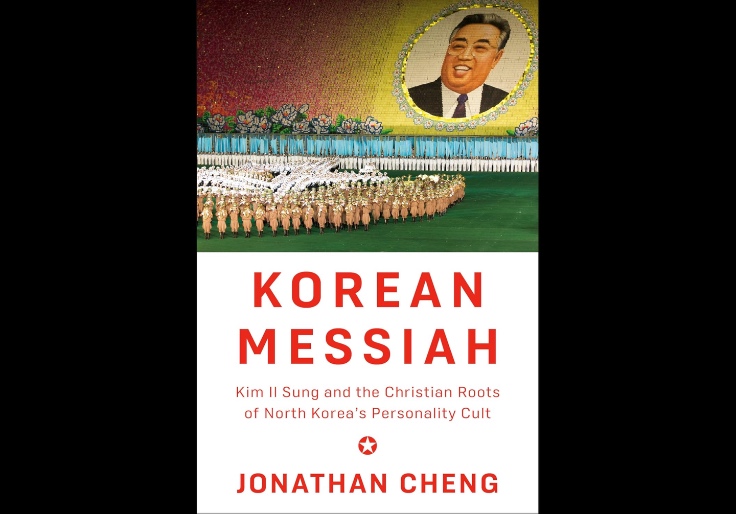
Even before I plunged into reading Korean Messiah—with its 550-odd pages of narrative text and another 150 pages of endnotes—I was riveted by a map at the very beginning of the book. It depicted Central Pyongyang in 1912, two years into the brutal Japanese colonial occupation of Korea.
What is striking about the map is the profusion of Christian churches, seminaries, schools, Bible institutes, and hospitals, particularly in Pyongyang's Inner City. I paused to count them, and totted up 28 such institutions, mostly Methodist and Presbyterian, many established by American missionaries.
On the facing page is another map, this time of Central Pyongyang in 1994, the year of the death of Kim Il Sung, leader of North Korea from 1948 until his demise. There isn't a single church or other Christian institution on the Inner City's grid. Where churches once stood, there are, instead, schools and monuments and stadiums named after Kim Il Sung, as well as museums and palaces commemorating the Korean Revolution, the Workers' Party of Korea, and the Liberation War. Once-Christian Pyongyang had become a bleak communist propagandopolis.
The book's author, Jonathan Cheng, is a former Korea bureau chief for the Wall Street Journal, currently that newspaper's man in Beijing. He tells us that Pyongyang was once so Christian that it was known as the Jerusalem of the East. The map from 1912 confirms the devoutness. In the years since World War II ended, the city has been scrubbed of its Christianity, replaced instead by a cult of worship no less fervent, though far less benign.
That cult is called "Kimilsungism," and its reigning gospel is Juche (which Cheng spells as Chuch'e)—loosely translated as "self-reliance." The author quotes a top North Korean official—identified in the endnotes as Hwang Jang-yop, former chairman of the Standing Committee of the Supreme People's Assembly of North Korea—who describes Juche as an exercise in "idolizing the Great Leader, turning his ideology into a faith … and swearing unconditional loyalty to him." Cheng writes that Kimilsungism is "an all-encompassing ideology unlike any that had been seen in the annals of history," which also conferred divine status, after Kim Il Sung's death, on his son Kim Jong Il, and after the latter's death on his son Kim Jong Un.
What is novel about Korean Messiah is its illuminating thesis, which sets it apart from the rest of the literature on North Korea—including Accidental Tyrant (2025), by Fyodor Tertitskiy, Kim Il Sung's most recent biographer. Cheng contends that the "motivations and pathologies" of Kimilsungism can be traced back not just to Bolshevism (which Kim Il Sung imbibed from the Soviet Union) but to "another foreign source: Protestant Christianity, and in particular, postbellum American Presbyterianism."
Reviewing Korean Messiah in the New York Times, Bruce Cumings—professor emeritus at the University of Chicago and an acknowledged heavyweight on the subject of Korean history—writes: "I have been a scholar of Korea for decades, but I learned so much from this book." Specifically, he (and this less erudite reviewer) learned how the Presbyterianism preached by American missionaries and their Korean acolytes morphed into a schema of reverence and iconography that swapped out Christ for Kim Il Sung, who came of age (Cheng tells us) "in what can be described as a Christian bubble."
Kim Il Sung's entire life, the author writes, was "mythologized" after his ascent to power, the mythmaking being a powerful element in the consolidation of his supreme (and ineradicable) authority. Some examples: As a teenager, Kim Il Sung was "said to be able to cure people of disease with the mere touch of his hand, while his hagiographers spoke of his ability to teleport through space and read minds." On a visit to Pyongyang in 1994 to meet Kim Il Sung, Jimmy Carter, former U.S. president and a longtime Sunday school teacher, concluded that Kim's North Korea resembled the Branch Davidians, a millenarian Christian group in Waco, Texas.
The author quotes North Korean dissidents who escaped to the south, recalling the confusion—and even consternation—they felt when they first encountered Christianity. One North Korean commando, captured in 1968 on a raid inside South Korea, said: "When they talked about God, it kept reminding me of Kim Il Sung. We worshipped Kim Il Sung as God. When they mentioned Jesus, it reminded me of Kim Il Sung." The man later became a Christian pastor.
The book's sprawling narrative begins, in fact, with the story of a Christian pastor—one Samuel Moffett, a young man trained in the First Presbyterian Church of Madison, Indiana, for missionary work abroad in the penultimate decade of the 19th century. This was a time of "missionary explosion," and men like Moffett (and not a few women) poured forth from the Midwest to take the word of their Christian God to dark and distant—and in their eyes godless—parts of the world. While China was all the missionary rage, Korea—men like Moffett soon found—was particularly fertile ground. "My first impression here is that the Koreans very greatly need the Gospel," he wrote to a friend in 1890, after taking more than a month to travel the distance from Indiana to Seoul.
The teachings of Moffett and his ilk, which described an equality of all people before a merciful God, was both radical and attractive in Korea. Christianity (Cheng writes) was "embraced with unusual fervor by Koreans in the country's northwest, especially in and around Pyongyang." This was a godforsaken part of the Korean kingdom, far from the political center in the south. Northerners were regarded as uncouth and ungovernable rubes, and treated with disdain by the Korean establishment. It is no wonder they drank deeply of the missionary message, as it offered them not merely a form of spiritual redemption but also an earthly source of political uplift and dignity.
Moffett and his missionaries came to convert the forebears of Kim Il Sung, including his maternal grandfather Kang Ton-uk, whose daughter Kang Pan-sok (Kim's mother) served as a deaconess or "Bible-woman" in the Presbyterian church. Kim's father, Kim Hyong-jik, embraced Christianity too and "threw himself into the task of Christian nationalist education during the most wrenching period in modern Korean history"—the early years of the Japanese occupation. Under the Japanese, Christianity, in fact, offered Koreans a nationalist refuge, making the transition from Christianity to the ultranationalist postwar Kimilsungism all the more seamless.
It also enabled the conferring of divinity on Kim Il Sung. North Korean state teachings—compulsory for every child over generations since the war—portrays his birth as "the arrival of Korea's Messiah, a miraculous birth foretold on the very night that Korea was annexed by Japan on August 29, 1910." On the day of his birth, cranes were said to have flocked to his window, flying in a celestial pattern outside. Apricot, peach, and plum trees in the vicinity bloomed with unusual beauty. Hagiographers would write of the day he was born: "Like a morning star shining bright in the eastern firmament, he emerged with a distinct banner for the decisive overthrow of Japanese imperialism." The baby was named Song-ju, or "pillar of holiness." He adopted the new moniker, Kim Il Sung—"Becoming the sun"—after his release from a Japanese prison in 1930.
A footnote: On the day Kim Il Sung was born, the Titanic hit an iceberg in the North Atlantic, giving rise to one of the most enduring disaster stories in modern history. And yet, as disasters go, the Titanic pales when compared with the havoc wreaked on their land and people by Kim Il Sung and his two successors.
Korean Messiah: Kim Il Sung and the Christian Roots of North Korea's Personality Cult
by Jonathan Cheng
Knopf, 768 pp., $36
Tunku Varadarajan, a writer with the editorial page of the Wall Street Journal, is a fellow at the American Enterprise Institute and at New York University Law School's Classical Liberal Institute.