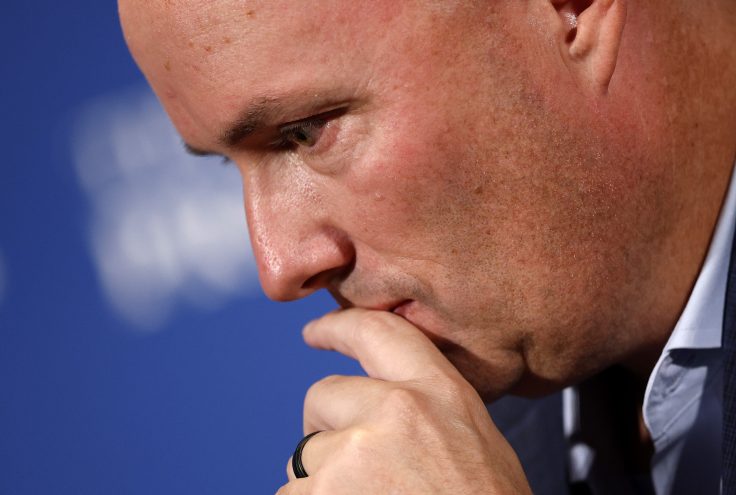


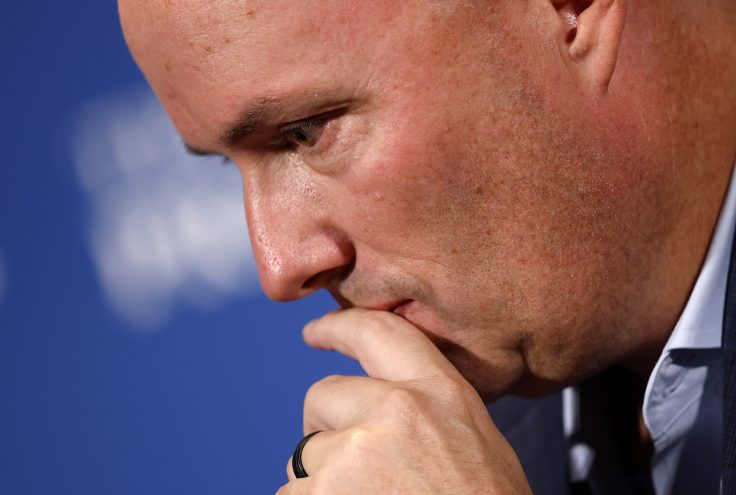
Spencer Cox would like you to know he is not running for president. "No, really," the Utah governor insists at the beginning of Off Ramp, a book introducing readers to his upbringing, governing philosophy, and vision for the nation's future. Sure, dude.
Cox also promises he has no interesting stories about "killing dogs or old people." The shots at Kristi Noem and Andrew Cuomo suggest that even America's leading evangelist for political civility enjoys getting a few punches in. Unfortunately, much of what follows is less lively. Cox's writing frequently lapses into platitudes and repetitive exhortations to recover our better selves. He seems like a good man who could use a more ruthless editor.
And yet Cox is consistently interesting. His book raises a question more consequential than whether Americans should be nicer to one another: Can a politician combine conservative convictions, a conciliatory temperament, and a willingness to confront industries that are making ordinary life worse? There may be a constituency for that combination, even if voters remain unmoved by generic appeals to civility. Whether Cox can build it is another matter.
Cox has a nose for emerging political debates and a willingness to enter them before the partisan battle lines have hardened. Beyond the book, he has become a forceful opponent of prediction markets, arguing that dressing up bets as financial instruments does not make them any less a form of gambling. He has supported age verification for online pornography and protections for children on social media. His administration's AI framework, meanwhile, encourages experimentation while imposing oversight and consumer protections.
These commitments suggest a potentially compelling combination of free market economics and social conservatism updated for the 21st century. Cox's Mormon faith clearly informs his outlook, but his case also draws on secular researchers across the political spectrum, including Jonathan Haidt on social media and childhood, Robert Putnam on civic decline, and Lilliana Mason on partisan identity. His concern is that the institutions and technologies shaping American life are weakening the relationships that make freedom worth having.
There is a compelling argument here that could resonate well beyond Mountain West Republicans. Parents worried about gambling, pornography, and their children's phones do not have to become hostile to business or technological progress. Cox understands the problem with social media companies is the impact of their products, not the wealth of their founders. The case for AI guardrails need not entail slowing innovation or surrendering the technological competition with China. The Utah governor articulates legitimate critiques of the technology sector while avoiding Elizabeth Warren-style hostility toward financial success as such. He could become an early voice in debates that reshape the country—or another Andrew Yang, who identified real problems without building a durable constituency.
Off Ramp, however, is chiefly concerned with Cox's effort to persuade Americans to "disagree better." As chairman of the National Governors Association in 2023-24, he made that phrase the name of a bipartisan initiative encouraging healthier political conflict. Its activities included joint service projects and advertisements featuring officials from opposing parties. Cox had modeled the approach on his 2020 campaign, appearing with Democratic opponent Chris Peterson to urge mutual respect and acceptance of the election's outcome.
Charlie Kirk's assassination at Utah Valley University gave the project a terrible urgency. Cox describes responding to the murder, helping oversee the manhunt, and condemning those who celebrated it. Searching Kirk's old posts for words that might discourage retaliatory hatred, he found quotations Kirk had shared over the years: "The only way out of the labyrinth of suffering is to forgive." "The weak can never forgive. Forgiveness is the attribute of the strong." And, most directly: "To be a Christian means to forgive the inexcusable because God has forgiven the inexcusable in you."
The political difficulty is that voters' stated preference for civility coexists with a strong demand for politicians who fight. A 2025 Pew survey found 71 percent of Republicans considered it very important for Democratic officials to compromise with them, while only 39 percent demanded the same of their own officials. Democrats exhibited a similar double standard. Americans like compromise considerably more when their opponents are doing it.
Donald Trump embodies this tension. He has been flexible on substantive questions, moving the GOP away from some of its previously more rigid positions on trade, entitlements, abortion, and more. Yet his disposition is radical: No one could credibly accuse him of being insufficiently combative. Cox is something like the opposite. His policy commitments are fairly conservative, but his willingness to compromise and find common ground across party lines is increasingly unconventional.
This raises a question that has received less attention than the prospect of ideological realignment: Could American politics undergo a temperamental realignment? Voters regularly turn against the people in power, looking for something different. Perhaps a politician could offer mutual rhetorical disarmament to Americans who dislike both MAGA's permanent state of gladiatorial combat and the ascendant socialists on the Islamist-sympathetic Left.
There are good reasons for skepticism. In a recent conversation, the New York Times's Ezra Klein, whom Cox cites frequently throughout the book, and my Manhattan Institute colleague Christopher Rufo agreed that the left is over-institutionalized and the right under-institutionalized. Democrats operate within a dense organizational network that enforces ideological expectations. Republicans have become increasingly organized around Trump's personal authority, with weaker institutions mediating between the leader and his supporters. Each structure creates obstacles for someone seeking to change his coalition's political habits. A Republican peacemaker must navigate Trump's demands for loyalty; a Democratic moderate must confront institutions that regularly treat ideological concessions as betrayal.
Cox's own endorsement of Trump in 2024 illustrates the difficulty of operating within that environment. Still, his survival is worth considering. Booed at Utah's Republican convention that year, he responded, "Maybe you hate that I don't hate enough." He later regretted returning contempt with contempt. He also won the primary. The activists demanding maximum hostility were not the entire electorate.
Milquetoast moderation from a friendly face is unlikely to sell. A tougher, more subversive centrism might: a project that picks fights with ideological activists and predatory industries while offering voters a way out of permanent partisan warfare. Ideological extremism and political passion are different things, and a candidate can reject the former without abandoning the latter. Cox understands this better than his reputation suggests: He explicitly rejects mushy civility and tells readers they do not hate social-media companies enough. His call for mandatory national service also gives his project a purpose beyond asking everyone to calm down.
Could a candidate in 2028 reject our familiar political dividing lines, remain pro-business and pro-AI, and instead pick fights over gambling, pornography, and social media? I think so. I am less certain Cox is the man to pull it off. He has lasted longer than many of Utah's nice-guy Republicans—RIP Mitt Romney and Evan McMullin—in an era that rewards a different temperament. His book suggests there may be more fertile ground for his politics than conventional wisdom allows. Having experienced the pain of political polarization in my own family, I hope he finds it.
Off Ramp: How to Be a Peacemaker in an Age of Contempt
by Spencer Cox
Penguin Press, 304 pp., $30
Jesse Arm is vice president of external affairs at the Manhattan Institute.