


The share of successful National Science Foundation grants containing DEI language has plummeted during the Trump administration, falling to 9 percent in 2025 from 34 percent in 2022, according to data obtained exclusively by the Washington Free Beacon.
The data, compiled by DeepAudit, a nonprofit specializing in AI-assisted research, shows that the percentage of awards with DEI terms is at its lowest point since 2001. It illustrates the extent to which the Trump administration has changed the norms around federal science funding, which for years advantaged applicants who pledged to advance "equity" and "inclusion."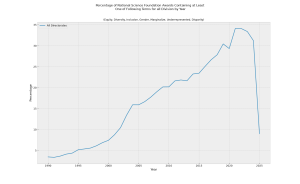
"The percent of grants with DEI terms being funded is now about the same as in 2001, before the great awokening," said DeepAudit director of research Jonah Davids. "This suggests that the second Trump administration is taking the problem of politicized and ideologically biased research seriously, and that having the right leaders in place can reverse some of the negative trends we've seen over the past few decades."
DeepAudit used AI to analyze the abstracts of successful NSF grant applications from 1990 to 2025. It found that the prevalence of DEI terminology had fallen across all grant categories, including education and human resources, areas where the language was pervasive. In fact, over 50 percent of awards dispersed in those areas between 2018 and 2024 included DEI language.
"Now that's down to below 15 percent, around the same percentage as computer science, math/physics, and most other STEM subjects," Davids said. "So both across and within divisions, scrutiny is being applied."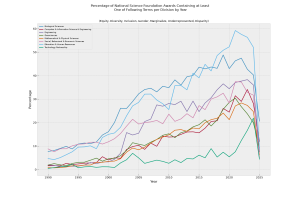
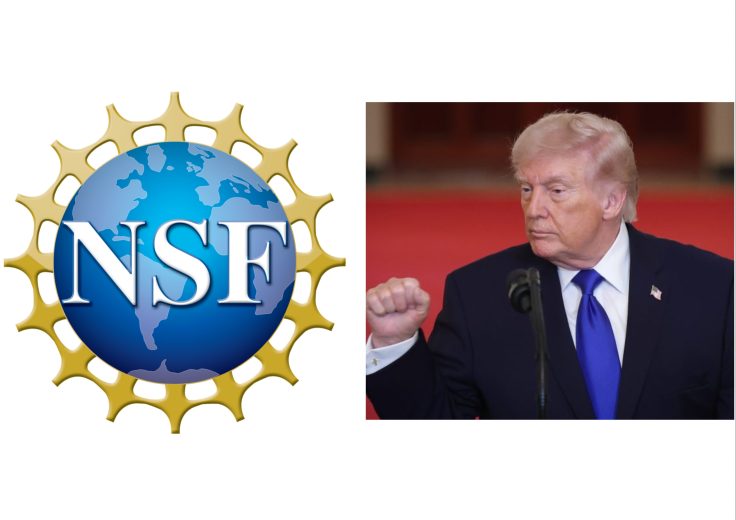
Established by Congress in 1950, the National Science Foundation accounts for about 25 percent of federal research grants to universities. The agency’s mission is to "promote the progress of science; to advance the national health, prosperity, and welfare; and to secure the national defense; and for other purposes."
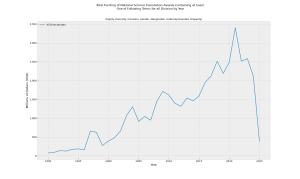
In time, those "other purposes" came to include social justice. The National Science Foundation in 2021 awarded $3.4 billion in grants that contained at least one of the following terms: "equity," "diversity," "inclusion," "gender," "marginalize," "underrepresented," or "disparity." By 2025, the number dropped to $400 million, an 88-percent decrease.
Though part of that decrease took place at the tail end of the Biden administration, the vast majority of it occurred under President Donald Trump, who has issued a spate of executive orders targeting DEI in federal grant-making.
The Office of Management and Budget has also proposed a rule that would require National Science Foundation grants to align with the Trump administration’s priorities, including the elimination of "woke" programs that do not "reflect the values of the vast majority of the American public."
"For example, Federal programs and funding opportunities were designed to advance unlawful identity-based ‘Diversity, Equity, and Inclusion’ (DEI) policies and preferences across the country," the rule reads. "These policies were inconsistent with basic American values and civil rights laws, including the equal protection principles of the U.S. Constitution."
It is not clear whether the decline in DEI language reflects a genuine change in emphasis or a terminological slight of hand. Leif Rasmussen, DeepAudit’s director of technology, said grant applicants could be using different language to describe the same research in an effort to skirt the Trump administration’s mandates.
"What we could be seeing is grant applicants changing the terms they’re using, or simply removing that language from the grants while still pursuing the same sorts of ideologically tilted research," said Rasmussen, who published a similar analysis of NSF grants in 2021. "We plan to investigate this further by following some of the scientists who were getting funding for DEI-related projects during the post-awokening era, and seeing whether they’re still being funded and if the language they’re using has changed."
A few terms have actually dropped below their 1990 baseline. "Women," for example, appeared in over 2 percent of grant abstracts in 1990, but fewer than 1 percent of abstracts in 2025, while "gender" appeared in 0.5 percent of abstracts in 1990 and dropped to under 0.25 percent in 2025.
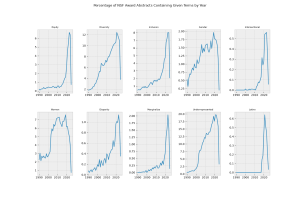
"Latinx," meanwhile, did not appear in any grants until 2018. The term increased exponentially over the next three years but had all but disappeared by 2025, showing up in under 0.05 percent of awards. "Intersectional" and "marginalize" have likewise dropped below 0.25 percent.
"These results look promising, and indicate that DEI is in decline relative to when I conducted the initial analysis," Rasmussen said. "However, it’s possible that the underlying DEI concepts are still there but have been hidden or rebranded."