


The New York Times has awarded what the paper says is its first-ever four star review of a restaurant outside of New York City—to what the review describes as "a Palestinian restaurant" in Washington, D.C., that has existed since 2020 but reopened in 2025 stressing the Palestinian aspect.
The restaurant, Albi, includes on its website a portion of a poem by Mahmoud Darwish, who resigned from the Palestine Liberation Organization executive committee in protest in 1993 in opposition to the Oslo Accords between the PLO and Israel.
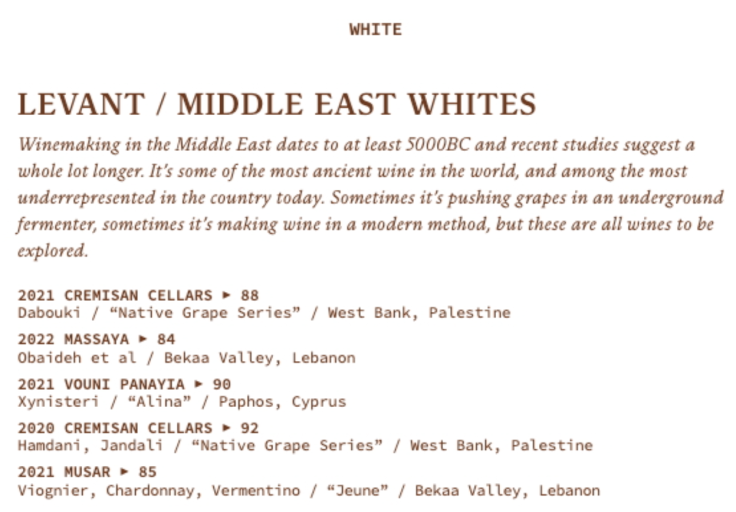
It has a 31-page wine list that includes dozens of options, priced up to $650, from Lebanon’s Bekaa Valley, as well as a $158 white from 2022 billed as offering unspecified "indigenous varieties … Grapes of Wrath" from "West Bank, Palestine." No wines identified as Israeli are on the list. A 2024 article in the New York Times identified the Bekaa Valley as "a Hezbollah bastion," "where Hezbollah holds immense sway and has a significant support base" and "one of Hezbollah’s most fertile recruiting grounds." Hezbollah is designated by the U.S. government as a foreign terrorist organization. The U.S. government says the group is responsible for the 1983 suicide truck bombings of the U.S. Embassy in Beirut and the U.S. Marine Corps Barracks in Beirut; the 1984 attack on the U.S. Embassy Beirut annex; and the 1985 hijacking of TWA Flight 847.
In a May 2026 interview with the Columbia Journalism Review, the Times restaurant critic who wrote the review, Ligaya Mishan, said she hoped her work would "undermine the current order and redistribute power."
Four-star restaurant reviews in the New York Times are extremely unusual—"as rare as the return of some comets," the newspaper said in December 2025, in an article about the five New York City-based restaurants to have earned the distinction. In that piece, Mishan declared that, "Maybe four stars should require love!" and the other chief Times restaurant critic, Tejal Rao, declared that "to earn four stars, it would have to be extraordinary, subversive or transcendent in some way." The Times has been reviewing restaurants since 1963.
One of our editors ate at Albi before it ramped up its Palestinian activism, and she reports that the experience was mediocre—modestly better than The Halal Guys chain but not as good as a falafel stand in a third-tier Israeli city.
But alas, the Times has been promoting its anti-Israel agenda through its food coverage for quite some time, with characteristic inaccuracies. A single cookbook by a boycott-Israel activist who also filmed a pro-Iran propaganda video was promoted with three articles by the Times. The newspaper also started referring to Yotam Ottolenghi as a "British chef," suppressing his Israeli heritage, and even dropped the term "Israeli couscous" from recipes.
The New York Times review of Albi gushes: "the target seems to be the soul. … overt, unabashed pleasure." The Times review appears with a photo of the chef, Michael Rafidi, wearing a black-and-white checkered scarf, a keffiyeh, of the sort sported by PLO terrorists, the current socialist mayor of New York City, and by activists violently disrupting university campuses. "Mr. Rafidi is interested not in some abstract, seamless perfection, but in building a wholly realized world, vivid in all its particulars, and making it yours," the Times reviewer writes, using the second person in a way that any remaining Times readers who aren’t PLO sympathizers may find othering, or at least less than fully inclusive.
The review says Rafidi "grew up in Maryland" and "his grandparents on both sides are from Ramallah." In an Instagram post in June 2024 after winning an award from the James Beard Foundation, Rafidi claimed, "We are seeing unspeakable horrors in my homeland, we are seeing food being used as a weapon of war, to starve people and deprive them of their human rights. The very land that for generations provided my family and millions with the ingredients and recipes that sustained life and made it possible for someone like me to stand on that stage is in danger and we must all speak out against it. In case I wasn’t clear on stage. This award is dedicated to the people of Palestine."
The restaurant website leans heavily into political geography. It also includes, in a somewhat obscure subsection, an explanation that "Albi includes a 3% employee wellness fee on all orders to provide a benefits package for our staff. This fee is not a gratuity tip." It also specifies that "Select proteins at Albi, such as our Shenandoah lamb and Soujek sausage, are halal."
This latest restaurant review, though, was a bit much for some Times readers, who saw political or religious bias flavoring the food coverage—which left a bad taste.
"Malka on the UWS is an excellent candidate. Wonder why it doesn't even get reviewed … never mind. There is no mystery there," one reader writes, referring to the Times not reviewing a kosher restaurant operated by Israeli chef Eyal Shani on Manhattan’s Upper West Side.
Another reader observed, "If you've been around the scene long enough, you know that critical tastes are heavily infused with personal and political tastes. Is Albi an outstanding restaurant? Yes. Is it having a particular moment for reasons other than the food, drink, and service? Absolutely."
Mishan, the Times food critic, has been on a campaign to champion Palestinian food—which actually is really not that different from Syrian or Jordanian or for that matter Israeli food. In a 2024 piece, "The Secret Behind a Beloved Palestinian Dessert," she went on about a London-based chef’s "childhood in Bethlehem, in the Israeli-occupied West Bank." In a 2020 piece, "The Rise of Palestinian Food," she ponders, "How to speak of the cuisine, given the political context? Alongside recipes, must there be testimony to the daily tolls of life under Israel’s occupation of the West Bank and its blockade of Gaza, the bulldozing of Palestinian homes and the uprooting of hundreds of thousands of local olive trees over the past half century?" Among that piece’s conclusions: "Food may be the most effective form of propaganda."