




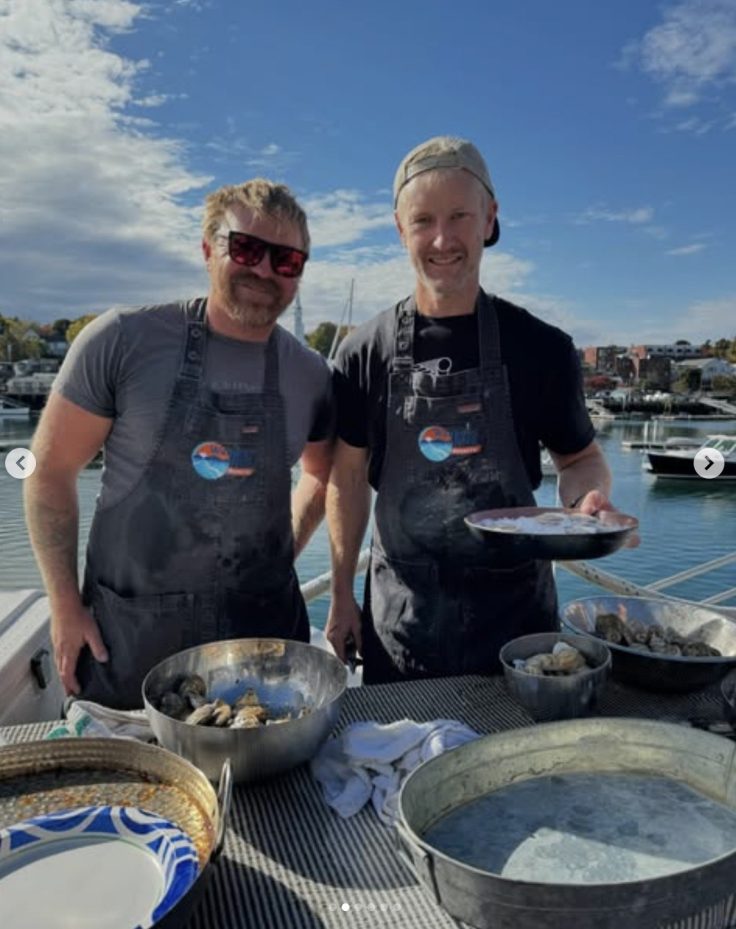
Maine's far-left Democratic Senate nominee, Graham Platner, has leaned on his career as a "working-class" oyster farmer to cast himself as a blue-collar everyman. His Ivy League business partner—who owns the secluded island where the farm is based—is, well, anything but.
Robert Cushman III is an elite New England boarding school graduate who has described his habit of drinking "foraged spring water with Redmond sea salt." He got into the oyster farming business, he has said, after having had a "liminal seafood experience" at the age of four.
The website for the Platner-Cushman farm—which is officially called the Frenchman Bay Oyster Company but does business under the name of Waukeag Neck Oyster Co.—describes Cushman as a "local food" advocate with "long-time family ties" to Maine. But Cushman was born in Africa and raised in Canada, according to an interview he gave to CKTH, short for Can't Knock the Hustle, an online wetsuit store that sells $25 wooden hangers and counts Cushman as a "founding member." He has spoken of spending summers in Maine with his family, and his "liminal seafood experience in Maine," he said in 2010, came when he "was about four and it involved fresh mussels collected a hundred feet from the table."
"I crave that rich, savory rush of amino acids that it has in such abundance," Cushman said, describing his love of seafood in an interview with Greenhorns, an organization focused on "food justice" and creating a "welcoming cultural space."
After attending the St. Paul's School in New Hampshire—an ultra-elite boarding school that costs upwards of $80,000 a year and is the subject of the 2012 book Privilege: The Making of an Adolescent Elite at St. Paul's School—Cushman went to Dartmouth College, where he studied religion and "cultural anthropology," and then received a master's degree in agriculture, food, and environment from Tufts University. He moved to Maine around 2011, according to his LinkedIn, working as an "aquaculture research assistant" and as a "dorm parent" at a private academy on the coast. In 2018, he joined Platner as a partner in the Frenchman Bay Oyster Company.
Cushman provides more to the farm than his advanced degree. His family owns Ingalls Island, located about 10 minutes southwest of Platner's home in the town of Sullivan. Cushman's island is effectively home to Platner's oyster farm. Platner's 2021 aquaculture lease application, obtained by the Washington Free Beacon, shows three small farming sites located just off of the island's shores. Platner testified during the application process that he "has a relationship" with the island's owners and "has communicated his proposed plans with them." Another member of the Cushman family submitted testimony "identifying herself as a riparian landowner who supported" Platner's application.

While Platner says he has "lived a fairly simple life" and "never been close to money and power" (despite attending an elite New England prep school), Cushman's lifestyle sounds more like that of a multimillionaire Silicon Valley founder than someone who "enjoys the physical and mental demands of working on the water," as the oyster farm's website states.
Cushman has described his morning routine as follows: "I start by hydrating with foraged spring water with Redmond sea salt then seek out direct sunlight or red light (EMR-TEK)," he told CKTH in 2024. "If I can, I then do some Wim Hof breath-work in a SaunaSpace followed by a cold shower. If it's summer, then I take a cold plunge in my modified chest freezer. All this is followed by a somewhat experimental coffee recipe and meditation, journaling and reading."
Cushman also said he is an alumnus of "the Kaizen school of self-reflection and continual improvement" (Kaizen is a Japanese work philosophy best known for being used at Toyota factories). He said his favorite convenience store snacks are "some local grass-fed jerky—or biltong if it's around—and a hard Kombucha." Asked to name a "guilt[y] pleasure you want to own," Cushman replied, "Samina Bed for health"—a reference to a bed "designed and handcrafted in the Austrian Alps" that costs between $10,000 and $20,000—"and BMW 3 Series for speed. Both products embody solid German engineering."
Together, Platner and Cushman appear to lead what is more of a boutique hobby farm—whose main function is to supply oysters to a restaurant owned by Platner's mother—than a business that pays the bills.
Platner, who receives roughly $4,800 per month in VA disability benefits, did not take a salary from the company last year, though his wife, a schoolteacher, did, according to his personal financial disclosure. The filing lists one entity as paying Platner more than $5,000: the Ironbound Restaurant and Inn, a "casual fine dining restaurant" and "old world luxury" hotel owned by Platner's mother, which is the primary purchaser of his oysters.
The oyster farm is "not currently taking tour reservations," according to its website, and has not posted to Facebook in nine months—since Platner launched his campaign. This time last year, in late April and early May, the company was posting videos to Instagram showing Platner preparing his boat and going out to farm oysters. This year, the company has traded those posts for political ones bashing President Donald Trump and Platner's opponent, Republican senator Susan Collins. That suggests Cushman has not taken over operations and does not rely on the business for income.
The farm was founded by a third man, Jock Crothers, whom Platner has described as a "family friend." Crothers, who became too old to manage the farm, asked Platner to take it over. Platner has said he "would not have been able to start a business" without his VA benefits. This likely means that his disability benefits allowed him to operate the farm without needing it to generate any meaningful income.
The realities of Platner and Cushman's "business" has not stopped elite media outlets like Condé Nast's Bon Appétit from declaring that the "working-class oysterman" Platner would "become the first commercial fisherman to be a United States senator" if he defeats Collins in November. Platner's aquaculture lease application, however, describes a much smaller operation used to supply a single location—like the restaurant owned by Platner's mom—with oysters, according to a commercial fisherman in Maine.
"This is more of a boutique operation, closer to a hobby farm," said the fisherman, who requested anonymity to speak candidly about Platner. "I think if you talk to a lot of commercial fishermen, they would say, that's a hobby, that's not a commercial fisherman."
Neither Platner nor Cushman responded to requests for comment.
Real estate records obtained by the Free Beacon show that Cushman first obtained a direct stake in Ingalls Island, the family "islet" associated with Platner's oyster farm, in 2021—around the time Platner was applying for his aquaculture lease—when he and a relative named Emily, who appears to be his sister, purchased a 25 percent share in the island from another member of the Cushman family for an unknown price. Three years later, in 2024, Rob Cushman and Emily Cushman received additional ownership rights to the island from Cushman's father, records show.
The Cushman family's support for Platner's lease application was significant because Maine's Department of Marine Resources takes into account feedback from "riparian landowners"—property owners whose land borders the water—when awarding leases. The agency has considered limiting oyster farm lease sites due to pushback from "lobstermen who compete for the same fishing grounds and homeowners who don't want to see aquaculture sites from their waterfront properties," pushback that Platner does not need to worry about thanks to his relationship with Cushman.
It's unclear exactly how Platner and Cushman came to know each other. Platner's father, like Cushman, went to Dartmouth (the closest Ivy League school to Maine). And Platner, like Cushman, attended an ultra-elite New England prep school, the Hotchkiss School in Connecticut, though he left after only six months and graduated from another private school in Maine.
Cushman's father, Dr. Robert Cushman, was "born in Rhode Island and raised in Montreal," where Cushman's grandfather worked as an executive with the Canadian mining company Alcan, according to the Pembroke Observer. He attended prep school in Montreal before studying economics at Harvard University and completing medical school at McMaster University in Canada, a top medical school. After working at a hospital in Zambia, he served as a public health official in and around Ottawa, where he advocated for "bicycle helmet laws" and a "total ban on indoor smoking."
Cushman has referenced his family's ties to Africa, telling CKTH that his "all-time best vacation" was "Africa with my family in 1996. We visited my parents' friends in Zambia, Malawi, Zimbabwe, and Botswana."
Platner became the presumptive Democratic nominee in late April, when his primary opponent, Gov. Janet Mills, suspended her campaign. Trouble with his oyster farm has at times overlapped with his campaign: In March, the Maine Department of Marine Resources sent a letter to Platner noting that the farm had not been up to "regulatory standards" for roughly a year and a half. The agency threatened to refer Platner to "Marine Patrol," Maine's maritime police service, if he did not provide proof that he had properly marked the farm with buoys by April 30.