


Virginia voters approved a ballot measure Tuesday night allowing Democrats to redraw the Old Dominion’s congressional districts with a 10-1 advantage. Republicans will now turn to a legal challenge that's before the state supreme court.
Just over 50 percent of voters signed off on the constitutional amendment when the Associated Press called the election at 8:49 p.m. with 81 percent of the vote reported. It grants Virginia’s Democrat-led General Assembly temporary authority to redraw the congressional districts mid-decade. A bipartisan commission would regain its normal authority to draw the maps, which at present give Democrats only a 6-5 advantage, following the 2030 census.
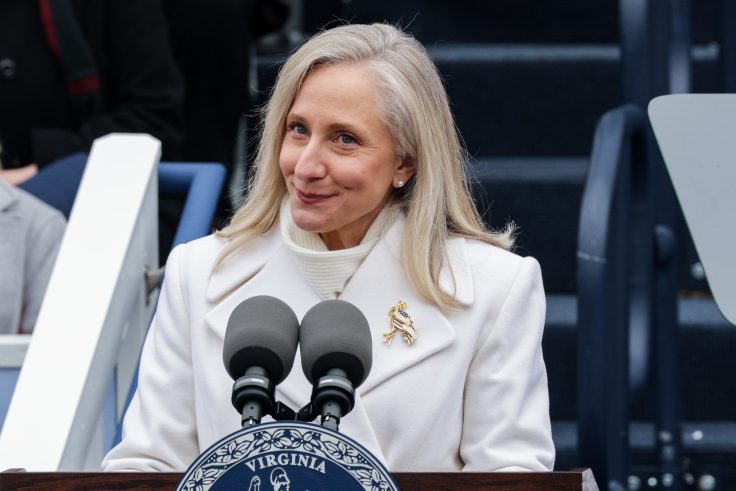
The ballot question described the measure as an effort "to restore fairness in the upcoming elections" and did not provide an image of the proposed map. Gov. Abigail Spanberger (D.) approved the legislation in February and threw her support behind it even though in 2019 she called gerrymandering "detrimental to our democracy" and said opposing it "should be a bipartisan priority."
Tuesday’s vote, however, doesn’t guarantee the gerrymandered maps will be implemented. GOP-led lawsuits before the Supreme Court of Virginia challenging the methods Democrats used to put the question on the ballot could make the vote moot. A lower court ruled on three grounds that Democrats’ political maneuvers were illegal and described the ballot phrasing as "misleading."
GOP legislators, including Virginia senate Republican leader Ryan McDougle, filed a lawsuit in October accusing Democrats in the General Assembly of illegally expanding a special session focusing on a budget bill to draft the constitutional amendment. Tazewell County Circuit Court judge Jack S. Hurley Jr. agreed in late January, calling it an "invalid expansion" since Democrats failed to secure the two-thirds supermajority vote needed to broaden the scope of the special session, rendering the proposed amendment void.
He also ruled that Democrats improperly placed it on Tuesday’s ballot. Proposed amendments must pass the General Assembly twice, once before a House of Delegates election and again at its first regular session following the election. Hurley found that the amendment’s first passage wouldn’t count since it occurred after early voting began, with more than one million votes already cast. Democrats were also legally required to publish the amendment three months before the election, but Hurley ruled that they failed to do that, as well.
In a separate suit, the Republican National Committee, the National Republican Congressional Committee, and Reps. Ben Cline (R., Va.) and Morgan Griffith (R., Va.), repeated some of those same arguments and alleged that the phrasing on the ballot was misleading, particularly its description that the amendment would "restore fairness in the upcoming elections." Hurley again sided with the GOP.
"It is misleading, in particular the ‘restore fairness’ language because it would lead a voter to believe he or she were doing something unfair by voting against the proposed amendment," he wrote in late February.
Democrats appealed both rulings. They were fast-tracked to the Supreme Court of Virginia, which ordered the election to continue, but declined to rule on the merits until after the vote. Oral arguments are set to begin Monday.
The seven justices’ elusive politics makes it unclear how the supreme court could rule, Honest Elections Project executive director Jason Snead told the Washington Free Beacon. His group filed an amicus brief arguing that the referendum was illegal since it passed the General Assembly through an "unlawful special session."
Snead called the amendment an attempt to "steamroll any provision of the laws or constitution of the state of Virginia."
"I think that the Virginia supreme court has an excellent opportunity to deliver a clear ruling that you cannot short-circuit the order here in Virginia for raw political power," he said.