




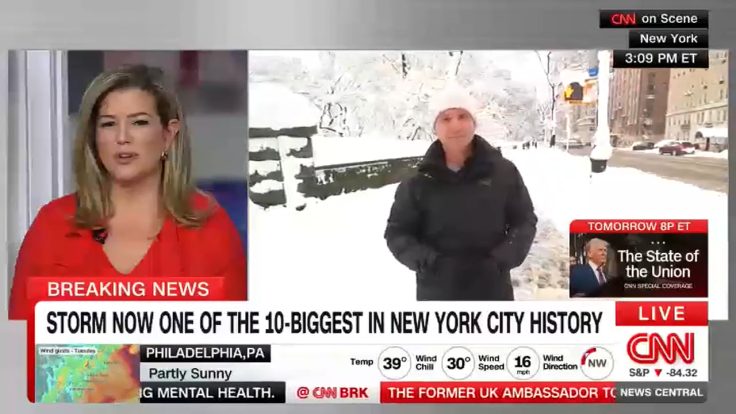
CNN's chief climate correspondent Bill Weir lamented that climate change has prevented people from ice skating on Central Park's ponds like they did "back in the 19th century." Videos from social media, however, show people have been skating on the ice in recent weeks.
"This is the new reality," Weir said during a live hit on CNN from New York City earlier this week, noting that there are bigger "water events on our overheated planet."
"I was talking to somebody, remembering, talking about how back in the 19th century, they used to ice skate regularly here in Central Park. It doesn't freeze. It's not cold enough for a long enough period of time for that to happen anymore."
But in early January, a TikTok user who goes by the name "evtheskater" filmed himself skating around the Central Park lake. Weeks later, the social media news account New Yorkers posted a video compilation of others doing the same.
"With NYC freezing for over a week, the lake in Central Park has frozen solid, and people are walking and skating on top of it," the account reported on Feb. 2.
A few days later, another news account also posted videos of people out and about on the frozen Central Park lake, commenting that "people started walking and ice-skating on it." A picture posted on Reddit showed a large number of people walking around on the lake: "This used to be a pond [a] few days ago !" the user wrote.
Some accounts noted that the New York City Police Department had started warning people to stay off the ice for safety reasons. The city’s Department of Parks and Recreation states on its website that people should never go on frozen waters, and the city has constructed two public ice rinks in Central Park, one of which has been in operation since 1950. It was then that city officials stopped allowing skaters to venture out onto the lake in Central Park, though climate change was not cited as a reason for the change.
Weir’s comments, which were made in the aftermath of a massive East Coast snow storm, are the latest example of the media appearing to overstate the impacts of global warming.
The New York Times, for example, published two articles with the exact same headline, "The End of Snow," 10 years apart in 2014 and 2024. New York City has accumulated 42 inches of snowfall this winter, nearly doubling the city’s average.
The Washington Post has repeatedly warned of global warming effectively taking Washington, D.C., winters away, making them much warmer. In February and December of 2020, the outlet reported that "global warming" and "human-caused climate change" were making D.C.'s winters "more Southern." The same outlet reported this year that the city’s temperatures had remained below freezing for a nine-day period ending on Feb. 2, 2026, the longest streak since December 1989.
Climate activists and other reporters have explained away this year’s cold weather and large snowfall. They argue that, just like above average temperatures, global warming causes below-average temperatures.
"The science is clear," Times climate reporter Sachi Kitajima Mulkey wrote last month. "The world is warming because of the burning of fossil fuels, and that doesn’t mean there won’t still be some cold days."