



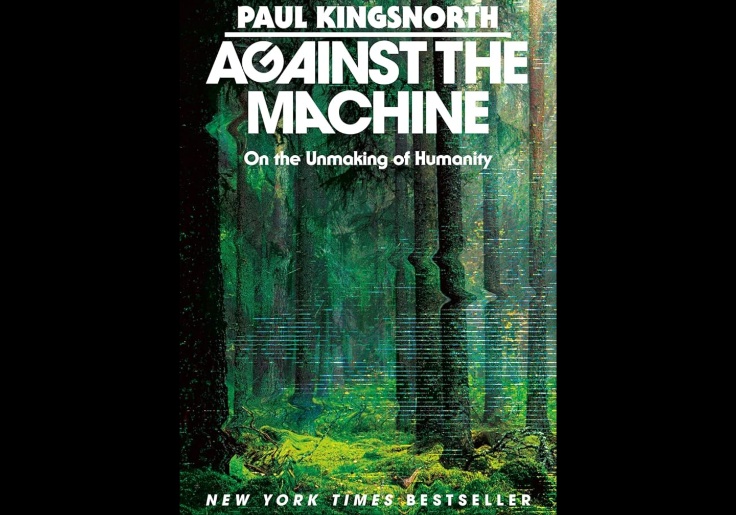
The poet Marianne Moore is credited with describing what poets do as "the art of creating imaginary gardens with real toads in them." Perhaps that is why it has taken a poet, Paul Kingsnorth, an Englishman who now lives in Ireland, to craft a compelling portrait not of a toad in an imaginary garden, but of the relentless march of the machine in the human world. In Against the Machine: On the Unmaking of Humanity, Kingsnorth offers a fresh take on an old question: How can we know when the technologies we have built to serve us instead end up enslaving us? Or, what happens when the toad destroys the garden?
In a culture as techno-optimistic as our own, we tend to think of critics of technology as fulminating prophets warning the masses of impending doom, and Kingsnorth has been called just that many times. But after reading his provocative, wise, but also meandering and at times frustrating book, prophet is not an adequate description. He is not a prophet but a pilgrim, and if you commit to following him on his journey, you will be rewarded. You will also likely reconsider your own technology use as well as its broader impact on our culture and politics.
Like the character of Christian in John Bunyan's 17th-century allegory, The Pilgrim's Progress, Kingsnorth's journey has taken him away from his earlier life—in his case, the enthusiasms of youthful activism on the environmental and anticapitalist left—to a more skeptical midlife posture, albeit one that remains dubious about corporations and profit-maximization.
His pilgrimage away from the Machine is grounded in the search for virtue and in a deep respect for human-scaled things. He is adamant about the need for humans to find meaning and purpose and their place in the world. We "have every gadget and recipe and website and storefront and exotic holiday in the world available to us," he observes, "but we are lacking two things that we seem to need, but grasp at nonetheless: meaning, and roots." These ideas are not idle abstractions—at a time when more of what humans do must be differentiated from the products of technology, distinctions become necessities. Many artists now feel they must distinguish their creations from AI slop by noting that what they do is "human made" and "guaranteed human." This is our new and unnerving reality.
And what is this Machine? In Kingsnorth's description, it is many things at once: "The Machine manifests today as an intersection of money power, state power and increasingly coercive and manipulative technologies which constitute an ongoing war against roots and against limits," he writes. "Its momentum is always forward, and it will not stop until it has conquered and transformed the world. … Its endgame is the replacement of nature with technology, in order to facilitate total human control over a totally human world."
The "anticulture" the Machine creates, Kingsnorth argues, seeks to replace the "Four Ps" of humanity—Past, People, Place, and Prayer—with the "Four Ss" of its own ideology: Science, The Self, Sex, and The Screen.
He is not wrong, even if this renders Kingsnorth a rather bleak pilgrim: "Now we find ourselves rootless, rudderless, unmoored in a great sea of chaos; angry, confused, shouting at the world and each other," he writes. "We have made of our world a nihil. We are both perpetrators and victims of a Great Unsettling." This unsettling is visible everywhere once you begin to pay attention, and those of us who abhor the transformation of public space and decline of civility prompted by technology use will find a kindred spirit in Kingsnorth when he confesses, "When I see people taking selfies on mountaintops, I want to push them off."
To combat the Machine, Kingsnorth marshals the guidance of a host of critics and prophets. He borrows from Alasdair MacIntyre—"the very notion of virtue itself would eventually become inconceivable once the source it sprung from was removed"—to frame his arguments about the steady march of Machine values, for example, and invokes the warnings of everyone from Oswald Spengler and Christopher Lasch to Wendell Berry and René Guénon. All had the uncanny ability to look into the future and understand the logical end point of new technologies—a skill too many modern people lack.
Kingsnorth also admires 20th-century technology critic Lewis Mumford and notes how prescient was Mumford's diagnosis of the problem: The myth of the machine, as Mumford described in his book of the same title, was "the notion that this machine was, by its very nature, absolutely irresistible—and yet, provided one did not oppose it, ultimately beneficent. That magical spell still enthralls both the controllers and the mass victims of the megamachine today.’" Like Mumford, Kingsnorth wants to reject this claim of inevitability and admires the resisters of earlier eras such as the Fen Tigers and Luddites of Britain, local communities that fought to hold on to their way of life in the face of the Machine, albeit unsuccessfully.
This history is a reminder that the system in which we now live (and which often feels near-compulsory in its demands) was not the result of individual choice or even group consent, but of a passive unwillingness to resist what technology had to offer. As Kingsnorth argues, "Many people have simply forgotten what it feels like not to be pulled and pushed and tugged and directed every hour of the day by the demands of the glowing screen. Many people are not paying attention." Certain passages in the book are reminiscent of novelist E.M. Forster's 1909 short story, "The Machine Stops," which imagines a dystopian future where everyone's needs are met by a Machine whose origins no one recalls but which has created such happy docility in its users that when it breaks down, they are helpless to repair it and cannot survive.
The antidote to this and the most powerful sections of Kingsnorth's book are his calls for a return to roots and embeddedness—both in the natural world and in our own physical bodies—as well as a recognition of human limits. The Machine undermines this sensibility at every turn. "Our daily experience of life is of being embedded; but the mechanistic revolution told us that the world was governed by set laws which could be 'objectively' known, as if observed, somehow, from the outside," Kingsnorth writes. The infrastructure of that pursuit of knowledge was "a deep desire for control."
Kingsnorth's analysis of our collective pursuit of control is unusual in that it embraces something control tries to eliminate: the mystical. The jejune description of faith too often given by modern people is that they are "spiritual but not religious." Kingsnorth is unabashedly spiritual and religious, and it grounds his argument in notable ways. A former practitioner of Wicca, he converted to Christian Orthodoxy in midlife yet hasn't lost his understanding of the power of mystical, unseen things. He does not use the word "awe," but what he is describing is the gradual disappearance of our ability to experience it, in part because the feeling of control our technologies offer us also reduces our sense of humility, and humility is necessary for experiencing awe.
Kingsnorth is not naïve; he recognizes the popularity of what the Machine produces. The public is more like the character of Pliable (easily persuaded) than Obstinate in The Pilgrim's Progress, uncritically embracing new things. And the Silicon Valley tech lords who would have us reject the qualitative, embodied, mystical aspects of humanity Kingsnorth prizes are like Bunyan's Mr. By-ends, focused on convenience and profitability above all else.
While I share Kingsnorth's disdain for the "global ruling class" who for decades thrilled to the sophomoric, misguided pronouncements of former New York Times columnist Tom Friedman (a man who never met a taxi driver in a foreign country whose life story didn't become fodder for his column), he often indulges in oversimplification and techno-determinism himself. Of the political critiques from the left and the right about the ideology of progress he writes, for example, "None of them have altered the course of a world in which technology is the driver of all change."
Similarly, his other bogeyman, capitalism, is presented as an abstraction with no redeeming features. "Want is the acid. Capitalism is the battery. Growth is the engine. Greed is the forming energy that moves us to where we are inevitably headed."
This renders some of his solutions to the challenge posed by the Machine tepid: "To liberate ourselves, steadily, one human soul at a time, we simply have to walk away from the Machine in our hearts and minds, as the Israelites of the Exodus walked away from its original master, Pharaoh." The Israelites only succeeded in their exodus through the divine intervention of God in the form of 10 plagues and through the powerful guidance of a prophet, Moses. There was nothing simple about the Israelites walking away from Egypt.
Likewise, Kingsnorth's admirable plea for people to "learn how to inhabit again," including learning "to write poems and walk in the woods and love our neighbours," seems too vague as do his calls for a "restoration." Stable societies embrace the rule of law and enforcers of that law. The alternative is a world where you must have the means and will to raise your own personal army to protect the place you've chosen to "inhabit." He also recommends a form of "reactionary radicalism," described as "politics from an older world" that is vague enough not to divide clearly along left-right lines, but does err on the side of conservative logic. It involves "drawing a line, and saying 'no further,'" Kingsnorth writes.
In Pilgrim's Progress, Christian left home to seek the Celestial City, a stand-in for the Christian understanding of heaven. Kingsnorth takes readers on a different journey, one more complicated than Bunyan's allegorical tale. "This is the devil's bargain of the technological society, and we have been falling for it forever," he writes. "Embrace the new, lose the old, and find yourself more deeply entwined in a technological web from which you cannot extricate yourself even if you want to." This journey doesn't take us to a Celestial City or deliver us easily from the Slough of Despond; rather, it demands that we confront a stark truth: "What progress wants is to replace us. Perhaps the last remaining question is whether we will let it." Kingsnorth's eclectic and fascinating exploration of the dangers of the Machine in a virtue-starved world doesn't offer straightforward solutions to this problem, but after reading his book, we can no longer pretend that we don't know what is at risk if we succumb to the depredations of the Machine: our humanity.
Against the Machine: On the Unmaking of Humanity
by Paul Kingsnorth
Thesis, 368 pp., $32
Christine Rosen is a senior fellow at the American Enterprise Institute. Her most recent book is The Extinction of Experience: Being Human in a Disembodied World (Norton 2024).