




This Thursday is sure to see packed pews where they may otherwise sit empty. Catholics who regularly attend Mass might find themselves seated next to a CEO—not a "Chief Executive Officer," but a "Christmas and Easter Only" Catholic. Protestant and Catholic churches alike advertise their times of worship for Christmas, expecting crowds too large to accommodate in one service. But this is not how it should be, according to Robert Cardinal Sarah. Instead, these churches should be full every weekend with reverential, traditional worshippers.
It is no secret there is a crisis of Christian tradition in the West. Churches that once stood as bastions of community in urban America have been left derelict, sold, or refurbished as mosques. "In Europe, many are baptized but not catechized," Cardinal Sarah told a crowded Princeton University lecture hall in November. "In Germany, do they even believe?" Some Catholic bishops in Germany and Austria have raised the case of ordaining women as priests, something Canon Law, the late Pope Francis, and his successor, Leo, have deemed impermissible. In England, Canterbury has chosen as its archbishop a woman for the first time; Canterbury Cathedral itself soon after saw church-sanctioned graffiti adorn its ancient walls.
Here in America, there has been a notable shift. The president touts Catholic holidays, though not a Catholic himself, while his Catholic vice president talks Augustinian and Thomistic ethics on X. The secretary of state proudly wears ashes on Ash Wednesday, and the secretary of war has a Jerusalem Cross tattooed on his chest. Many churches report that Gen. Z is returning in large numbers, with young men leading the charge. After the assassination of Charlie Kirk, those numbers grew ever higher.
Sarah’s new book, The Song of the Lamb, comes at an opportune time, then. Inquisitive converts and reverts alike can learn from an experienced theologian how worship ought to be conducted and why it should be that way. His eminence’s latest literary endeavor focuses on music in the liturgy and how to best make worship more reverent in his eyes: tradition. It is a great addition to an acclaimed catalog by a famous prince of the Church, one many thought could have been pope. His grasp on Catholic history, Scripture, and the writings of other scholars and saints gives the reader an experience akin to a collegiate lecture series. His eminence’s conversationalist, Peter Carter, head of the Catholic Sacred Music Project, proves to be a probing mind with important questions. Sarah, a Guinean (and 1 of 29 cardinals from Africa), is not afraid to call things as he sees them: This roadmap to more sincere liturgy is also packed with criticisms of modernism and the failings of the secular world.
While the book was unabashedly written from a Catholic standpoint, there is wisdom for non-Catholic and nonreligious conservatives, too.
Music is part of what makes us human. From the Epic of Gilgamesh to David’s psalms, man has been singing to the heavens since time immemorial. "Music has been an integral part of worship and culture from the earliest days of Christian worship, and before even that, during the time of the Temple in Jerusalem," Sarah writes.
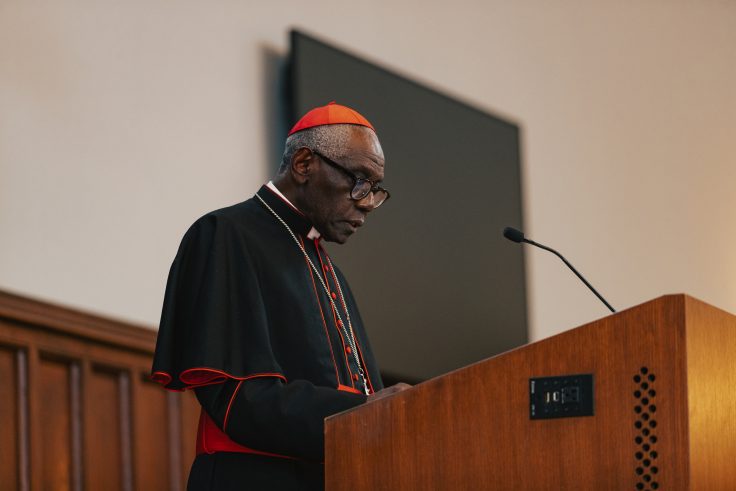
But his eminence cautioned against the use of local musical styles and instruments in modern worship, instead calling for a return to Latin Gregorian chants. In his talk at Princeton, Sarah noted that the language of the world God chose to enter, Latin, allowed the Gospel to spread like wildfire. The cardinal, like many others, believes Latin has a special place in the divine plan of God and that it must be preserved—that it truly unites the universal Church.
"Multiculturalism may be a reality in the world today," Sarah writes, "but in the celebration of the liturgy we should not seek to reinforce separate cultural identities but to be united in our faith as Christians."
Sarah continues, "The aversion to Latin and Gregorian chant is rooted in an ideology of liturgical revolution that asserts that the Church’s identity has changed. … To promote revolution is to echo the words of Lucifer, the first revolutionary, when he said, ‘I will not serve.’"
For Sarah, Latin should persist not only in the music of worship but in spoken prayer as well. The Second Vatican Council permitted, in the Latin rite, the use of the vernacular local language in readings to make the faith more accessible to the common man. A laudable cause, but one some critics argue has eroded the Church’s ancient identity. The problem did not begin with the Church, however.
Students aren’t taught Latin in school anymore, or Greek, for that matter. One can even go to Catholic preschool through high school and not once be made to learn the ecclesiastical language. Meanwhile, the ancient world is all around us, not only in the Church: Look at the architecture of Washington, D.C., or the reverse of the dollar bill. Conservatives, religious or not, should be interested in rearing their children with a knowledge of their national heritage: the languages and cultures the Founding Fathers were all familiar with. "It is truly regrettable," Sarah writes, "if we ‘cancel’ our history and tradition, attempting to start everything anew. … To be fully alive and thrive, we must know and celebrate our tradition and maintain continuity with it."
"Modern man readily has music at his disposal, but he is often not fully formed and matured into becoming a musical being," Sarah writes. To sing, for Sarah, is an act of selflessness, a "giving of one’s voice." But not all music is fitting for the worship of the Lord. "A significant portion of current pop music is often physical and sensual, primarily engaging the body." Thus, listeners should spend less time wondering which new pose Sabrina Carpenter will strike on tour and more time on their own knees in the house of the Lord.
Christians should read Cardinal Sarah’s words and seek to learn how best to give the Lord what he is due. All readers should seek to understand how tradition can positively influence our lives and our nation.
The Song of the Lamb: Sacred Music and the Heavenly Liturgy
by Robert Cardinal Sarah in Conversation with Peter Carter
Ignatius Press, 262 pp., $18.95 (paperback)