




Here's a nice illustration of the personal and professional range of John Updike, the novelist, poet, essayist, critic, and short story writer who rose to singular fame (appearing twice on the cover of Time magazine, then the ultimate mark of celebrity) in the second half of the 20th century. During the year 1960, he volunteered to teach Sunday school at his local church. Meanwhile, he was fighting his publisher's lawyers, who worried that the sex scenes in his latest novel, Rabbit, Run, were explicit enough to violate U.S. obscenity laws, which were still a thing.
If he saw a complication between the two activities, or these two sides of himself, he doesn't mention it in any of the hundreds of thousands of words that make up Selected Letters of John Updike. As it happened, the sex in his work grew much more explicit in the years after Rabbit, Run. U.S. obscenity laws went the way of Prohibition and the dodo, and the introduction of the birth control pill made extramarital sex more plausible and more common in the suburban circles that Updike took as the territory for many of his short stories and novels. The sex scenes in his most popular novel, Couples (1968), made Rabbit, Run look like a McGuffey Reader. Sales were enormous, and he became a millionaire. He retired from teaching Sunday school.
When he was a young writer—Updike was astonishingly precocious, becoming a regular contributor to the New Yorker when he was barely out of Harvard—the protagonists of his fiction tended to be sex-obsessed young men. As he grew into middle age, the protagonists evolved into middle-aged men obsessed with sex. Entering his dotage, full of honors and years, he somehow conjured up older, materially successful protagonists who were obsessed with sex. One of the great American stylists, he nevertheless managed to write sex scenes that were unbearably cringe-making. The meticulous, magical gift for poetic physical description that led him (for instance) to describe a snowfall at night as "an immense whispering" was misapplied to the mysteries of sex. A year before his death in 2009, the British magazine Literary Review, famous for its annual Bad Sex in Fiction competition, simply threw up its hands and gave him a Lifetime Achievement Award.
And yet it would be a mistake to call him the horniest writer of his time. It was quite a time. And he had lots of competition—an entire class of phallocrats, as they were sometimes called. These were male novelists who were too old to have enjoyed the vanguard of the sexual revolution, led by youthful baby boomers, and who were making up for lost time. In the 1990s, the novelist David Foster Wallace lumped several of them together—Updike, Norman Mailer, Philip Roth, Frederick Exley, Charles Bukowski—under the heading GMNs, the Great Male Narcissists. As Wallace pointed out, however, Updike was the one who evoked an especially intense mockery, at least among Wallace's own contemporaries (Wallace was under 40 at the time, Updike in his 60s). One of Wallace's feminist friends called Updike "a penis with a thesaurus," a deathless tag that followed him to the grave.
It didn't help that he delighted literarily in his horniness the way Willa Cather might have delighted in a windswept field of golden wheat or Mark Twain in a sunrise over the Mississippi. In addition to "mainstreaming" explicit sex in his books, Updike wrote an erudite and kind of gross essay on fellatio in literature, published a long taxonomic poem called "Cunts," and, most unforgivably of all, wrote a rave review in the New Yorker of Erica Jong's novel Fear of Flying (1973). Jong's book was a piece of prurience by which a female novelist proved that you didn't have to be a Dirty Old Man to write like one: Dirty Old Women could play that game too. Updike's rave launched Jong's book to the top of the bestseller lists, where it stayed for what seemed like forever. We now learn, thanks to the Selected Letters, that Jong repaid the favor with a typically tasteful gesture: She wrote a poem about a father who sleeps with his daughter and dedicated it to Updike. (Updike politely asked her to take his name off it, out of respect for his own daughter's feelings.) Quite a time, as I say.
Readers could be forgiven for thinking the incessant rutting in Updike's suburban stories was purely imaginative, the wish fulfillment of a wallflower who could never quite rise to the occasion. After all, Rabbit, Run, about a virile, handsome high school basketball star going prematurely to pudge, had been rightly described as a nerd's-eye-view of what it might be like to be a big man on campus. The Selected Letters puts this speculation to rest. The daisy chain of adultery in Couples and Updike's other fiction actually had its precise inspiration in the suburban idyll of Ipswich, on the North Shore above Boston, where Updike lived with his first (but not for long!) wife and their four children.
The Letters suggest that Couples was a near-documentary account of Updike's world in the mid-1960s. Indeed, before the novel's publication, lawyers advised him to go much further in disguising his characters, all of them based on friends and neighbors, changing personal details in hopes of making them less transparently recognizable and forestalling lawsuits. Thus in the final draft of Couples the setting is changed from the North Shore to the South Shore. One cuckold becomes bald, another grows a beard, a third becomes a trust officer in a bank instead of a mutual funds analyst. A hapless family loses five daughters and gets three boys. A brunette becomes a redhead. Only the orgasms remain the same.
There were no lawsuits but, over the course of a writing life spanning decades, many friendships were either broken or made uneasy. Looking back on his serial and simultaneous affairs he wrote (to one of those selfsame lovers, in a letter reprinted here): "I hated the sadness and incompletion [of adultery], but enjoyed the romance and sex and the window into other lives, and may even have found the duplicity suitable to me." The narcissism that Wallace identified never slackened. That "window into other lives" is a rollicking bit of self-justification. Updike wasn't cheating on his wife, he wasn't recklessly indulging his appetites, he was doing research. As Joan Didion said, "Writers are always selling somebody out." In Updike's case, sometimes two at a time.
It's too bad all the sex talk in the Selected Letters outshouts so much of the rest on offer—good gossip, glad tidings among fellow craftsmen, firsthand details about the tricky business of editing, much excellent writing. There are glimpses of the great. His early hero James Thurber, for example, completely blind and teetering like a scarecrow: "It was touching to see those great shoes shuffle along the carpet, wary of the step or table lurking in the darkness, and even more so when, before he got us situated by our voices, he directed his smiles and remarks to an empty portion of the room."
Beyond his dazzling facility on the page, there was a lot to admire about Updike, as the Letters also make clear. He refused, at some cost, to join in the anti-American chorus of the literary class as it radicalized in the heat of the Vietnam war, which he frankly supported. He was a New Deal Democrat who loved his country and revered the American idea. More than anything, we get a renewed appreciation for his sheer industry and productivity, which is, I suppose, another aspect of his Americanness. The editor of this massive volume, James Schiff (whose annotations are as thorough and helpful as any reader could wish for), compiles the rough numbers: More than 60 books, nearly 2,000 published short stories, poems, essays, and reviews, and 25,000 letters. "Updike needed to write the way the rest of us need to breathe or eat," Schiff writes.
When he died of lung cancer, at age 76, he had just finished a cycle of poems about his illness and lurking death. He had no fewer than four books at the printers, ready to go.
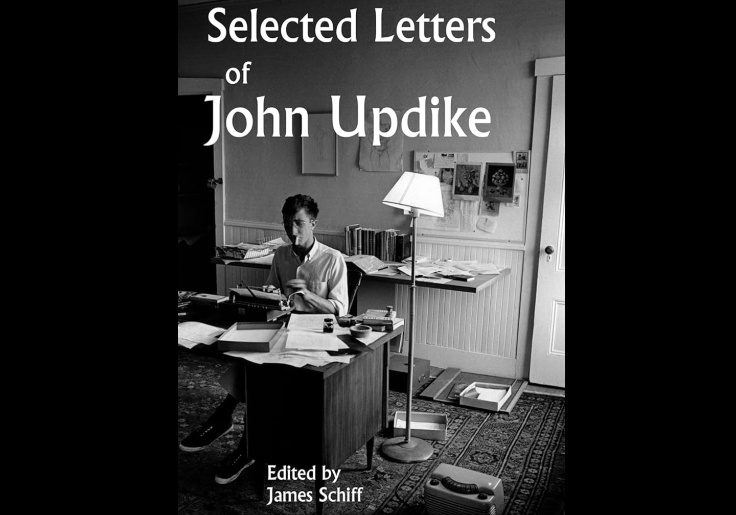
Selected Letters of John Updike
by John Updike, edited by James Schiff
Knopf, 912 pp., $55
Andrew Ferguson is a contributing writer at the Atlantic and a nonresident fellow at the American Enterprise Institute.