




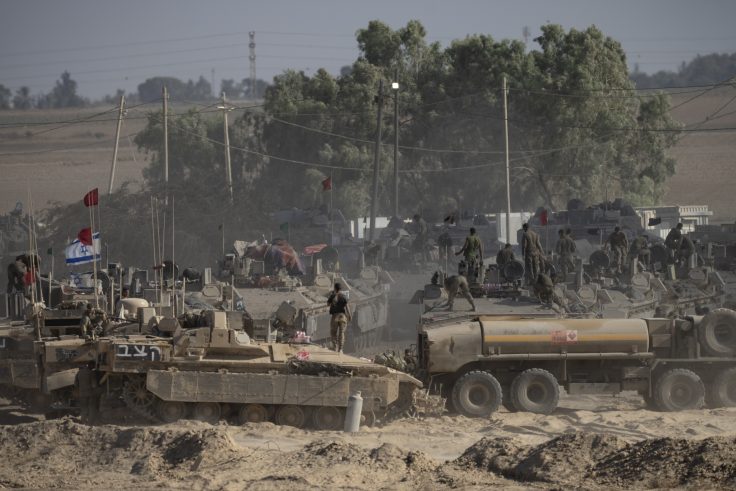
Overnight on Thursday, Israel’s security cabinet approved a plan to conquer Gaza City and end the war in the Gaza Strip. But it remains unclear whether the Israeli endgame involves full occupation of Gaza.
In a 10-hour meeting, a majority of the ministers in the wartime decision-making body voted for the plan, pushed by Prime Minister Benjamin Netanyahu, over a proposal to encircle and conduct raids into Gaza’s population centers that was preferred by the Israel Defense Forces’ top brass. Netanyahu’s office announced the decision early Friday.
"The IDF will prepare for taking control of Gaza City while distributing humanitarian assistance to the civilian population outside the combat zones," its statement said. "A decisive majority of security cabinet ministers believed that the alternative plan that had been submitted to the security cabinet would neither achieve the defeat of Hamas nor the return of the hostages."
While details of the plan have not been released, current and former Israeli officials said that residents of Gaza City will have until Oct. 7 to evacuate southward to tent camps in Deir al-Balah and Al-Mawasi in central Gaza. In the two months until then, the military will expand the camps along with nearby aid distribution sites run by the Gaza Humanitarian Foundation, an upstart U.S. nonprofit organization, according to the officials. They said GHF will continue providing aid directly to Gazans, preventing large-scale theft by Hamas.
U.S. ambassador to Israel Mike Huckabee on Wednesday said there was an "immediate plan to scale up" from four GHF sites with limited operating hours to 16 sites that will be open 24 hours a day. Huckabee also seemed to confirm an Axios report that President Donald Trump was considering plans to significantly increase U.S. involvement in aid distribution in Gaza.
A spokeswoman for GHF declined to comment.
After the Oct. 7 evacuation deadline, which will fall on the second anniversary of the Hamas-led massacre in southern Israel that started the war, Israel will impose a siege on Gaza City, according to the officials. Israeli forces will then eliminate any remaining Hamas presence in the city, which before the war was the Palestinian terrorist group’s de facto administrative capital in northern Gaza, the officials said.
"The city of Gaza will look just like Beit Hanoun, Rafah, and Khan Younis," said Amir Avivi, a retired Israeli brigadier general who is close to the government, referring to other former Hamas strongholds that the military has reduced to rubble during the war. "It will be completely in Israeli hands and completely cleared of Hamas."
According to the officials, the plan allows for Israel to move ahead with the military occupation of all of Gaza, which would be necessary to separate Hamas from Gazan civilians. But they disagreed on how likely that was to happen.
"If the best way of destroying Hamas’s military and governing capabilities is to take over all of Gaza militarily, then that’s what we’ll do. If there’s a better way, we’ll do it a better way," said a senior official, speaking on condition of anonymity. "We’ve already accomplished a lot in that direction, and we’re going to finish the job. We’re going to free Gaza from Hamas."
Amid international and domestic backlash to the security cabinet vote, Netanyahu said in a post to X on Friday: "We are not going to occupy Gaza—we are going to free Gaza from Hamas. Gaza will be demilitarized, and a peaceful civilian administration will be established, one that is not the Palestinian Authority, not Hamas, and not any other terrorist organization. This will help free our hostages and ensure Gaza does not pose a threat to Israel in the future."
Hamas in a statement reacting to the plan on Friday accused Netanyahu of "sacrificing" the hostages and warned," Expanding of aggression against our Palestinian people will not be a walk in the park."
Prime Minister vs. Defense Minister
Netanyahu indicated in interviews hours ahead of the security cabinet meeting that Israel intended to temporarily take control of all of Gaza. That plan may have changed by the meeting's end, and Israel may be seeking to pressure Hamas to accept an agreement for a ceasefire and the release the 50 hostages still held by the Palestinian terrorist group, among whom were 20 Israeli men presumed to be alive.
During the meeting, military chief of staff Eyal Zamir reportedly reiterated his opposition to the "occupation plan," warning it would risk the lives of the 20 Israeli men still believed to be alive in Hamas captivity, increase the toll on war-weary troops, and raise humanitarian concerns.
"There is no way to guarantee we will not harm [the hostages]," Zamir said, according to Israel’s Channel 12. "Our forces are worn out, the military tools need maintenance, and there are humanitarian and sanitary [concerns about the Gazan population]."
Shas party chair Aryeh Deri agreed, saying, "The war is causing ongoing diplomatic damage. The hostages will be in danger. We should listen to the army," Israel’s Kan public broadcaster reported.
Netanyahu replied that Israel must stop "perpetuating Hamas" and move toward "defeating it," according to Channel 12. "The current method has not resulted in the release of the hostages, and we will not continue like this."
Deri’s office declined a request for comment.
Israeli finance minister Bezalel Smotrich through a spokesman on Friday expressed disappointment that the plan does not go further, calling it "immoral, unethical, and not Zionist."
"The proposal spearheaded by Netanyahu and approved by the cabinet may sound good, but it’s actually more of the same," the spokesman said. "This is not an operation to conquer the strip, take full military control of the territory and push for a decisive outcome—the only way to ensure victory, lasting security, and the return of the hostages—but a specific and dangerous operation whose sole purpose is to return Hamas to the negotiating room—a goal that isn’t a goal of the war."
He predicted that once again, Netanyahu will promise that Israel is going "all the way," only to, "at the moment of truth, withdraw from the field after dozens of heroes have died and without any real operational achievements."
Israel Hayom reported that Smotrich had voted against the plan.
Zamir told division commanders and top generals on Friday that the military will carry out the plan "in the best possible way," according to a statement by the military.
"As the war develops, the IDF will act to safeguard the lives of the hostages, allow the forces to refresh in order to strengthen endurance, and operate according to the values and spirit of the IDF," Zamir said.
A Potential Compromise
Following the meeting, Netanyahu's office said the security cabinet had "adopted five principles for concluding the war": disarmament of Hamas, demilitarization of Gaza, the return of all the hostages, ongoing Israeli security control of the strip, and "establishment of an alternative civil administration that is neither Hamas nor the Palestinian Authority," the main rival Palestinian political faction.
Avivi described that plan as a compromise between Netanyahu and Zamir, saying their positions are "not so far apart." Both men, he said, seek to avoid taking military control of the tent camps, where, following the Oct. 7 evacuation deadline, Israel expects Gaza’s 2 million residents to live alongside thousands of Hamas terrorists who flee Gaza City.
"I don't think either of them wants full military occupation," Avivi said of Netanyahu and Zamir.
Instead, according to Avivi, the plan is for a relatively small military force will secure a perimeter just outside of the camps, from which GHF will distribute "large amounts of aid." At the same time, a "brigade or two" will "constantly attack" Hamas targets within the camps "to degrade them more and more" with the help of airstrikes.
"This way, we’re destroying Hamas but not taking responsibility for the society," Avivi said. "We’re creating a reality where they cannot kill us, and we can kill them endlessly."
Avivi said Hamas will either realize "they’re fucked," surrender, and release the hostages or Israel will continue the "war of attrition" indefinitely.
"The message to Hamas is simple," he said. "Our troops are safe, our towns are safe, we are rebuilding ourselves and going back to normal life. You will be stuck forever in tents along the beach—no future, no reconstruction, nothing until you lay down your weapons and give us the hostages."
The Occupation Option
But other well-connected former Israeli officials said they understood the government to be committed to taking full control of Gaza. Kobi Michael, a former deputy director general of Israel’s Ministry of Strategic Affairs, said, "It looks like the government has already decided. They are going for full occupation of the Gaza Strip."
The only real alternative to full occupation, according to Michael, a researcher at the Misgav Institute for National Security and Zionist Strategy and the Institute for National Security Studies, was "to go for an agreement on Hamas’s terms, which means to surrender."
Michael has long predicted that Israel will take full control of Gaza at the end of the war and then, in a staged process over the course of two or three years, transfer civil administration of the strip to local Palestinians backed by Arab and Western states. To bring in the international partners, according to Michael, Israel will have to give the Palestinian Authority a limited role in governance of Gaza and a pathway to leadership conditioned on the West Bank-based regime undertaking major reforms. The idea that the Palestinian Authority must be involved governing in Gaza, while seemingly at odds with the position of Netanyahu and the security cabinet, has been privately shared by senior Israeli officials.
Erez Winner, a retired Israeli brigadier general and the former head of the military’s Operations Directorate, said that under the plan approved by the security cabinet, the military will follow up on its conquest of Gaza City not by keeping the camps in place indefinitely but rather by relocating Gaza’s population from the camps to other areas of the strip, like Rafah, that are cleared of Hamas. After screening out terrorists who attempt to leave the camps, he said, the military will occupy them and force Hamas to "choose between fighting to the death, surrendering, or starving."
"If we do it the right way, you will see Hamas in a very short period of time come back to the table and ask for some sort of deal," Winner said. "I hope Israel won’t accept the deal and will continue until the decisive victory that Netanyahu has been talking about for a long time."
Winner, who played a leading role in developing Israel’s Gaza war plans until he was dismissed from duty in March, pointed to the past three months of the war as evidence that Israel cannot defeat Hamas without isolating the group from the rest of the population. During Operation Gideon’s Chariots, which Israel launched in early May, the military took control of roughly 70 to 75 percent of Gaza, degraded Hamas’s military and governing capabilities, and launched the GHF aid distribution system with the primary goal of pressuring Hamas to accept a U.S.-backed temporary ceasefire and partial hostage release agreement, according to Israeli officials.
That effort appeared to fail late last month when the United States and Israel withdrew from negotiations with Hamas in Doha, with officials saying the Palestinian terrorist group was not serious about reaching an agreement. Israeli and U.S. officials indicated they would pivot to an all-or-nothing approach that would give Hamas a choice between releasing all the hostages and disarming or facing continued military assault by Israel.
Winner said the Palestinian Authority cannot be involved in governing Gaza, pointing to the group’s support for terrorism and corrupt and unpopular administration in the West Bank.
Amit Halevi, a Likud lawmaker and member of the powerful Knesset Foreign Affairs and Defense Committee, said he had not yet been briefed on the plan approved by the security cabinet. But he said the government will have to guide implementation of the plan step by step to overcome the military’s reluctance to "control Gaza" and ensure victory.
"I can tell you for sure that if the government will not be very strong and very specific, this plan will not work," he said. "As the elected representatives of the Israeli people, we must be the decision makers."
"If this war ends with Hamas still standing, it will be a disaster—not only for Jerusalem but also for Washington and Paris and London," he added. "The lesson will be that a radical Islamic terrorist organization—an enemy without tanks or fighter jets—can stand against a powerful Western country, in this case the Jewish state. The bottom line must be total destruction of Hamas and total control of Gaza by Israeli forces."