



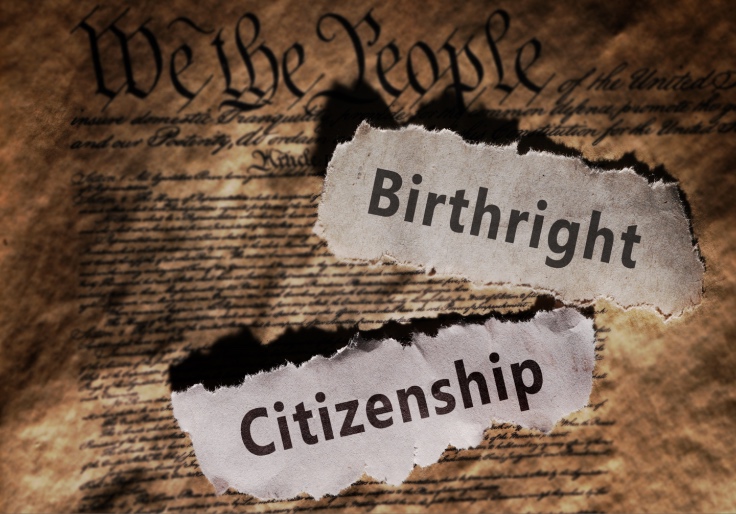
Most Americans have been raised since childhood to understand that the 14th Amendment to the Constitution confers American citizenship automatically at birth to all those newborns fortunate enough to find themselves on United States territory. Unlike European countries or, for that matter, almost everywhere in the world, America, we are taught in elementary school civics classes, welcomes citizens on the basis of ius soli, the law of the soil, rather than ius sanguinis.
But the renowned legal scholar Richard Epstein disagrees vehemently, and in The Myth of Birthright Citizenship, he mounts a timely, quixotic challenge to the conventional wisdom: timely, because President Trump issued an executive order last year purporting to curtail birthright citizenship; quixotic, because the Supreme Court just rejected both Trump's and Epstein's attempts to restrain it.
"All persons born or naturalized in the United States, and subject to the jurisdiction thereof, are citizens of the United States and of the State where in they reside." So reads the plain text of the 14th Amendment, which post-Civil War America ratified on July 9, 1868, and which, per Epstein, has given rise to "one of the most contentious constitutional debates of our time." Amid this contention, Epstein parts ways with most of his fellow originalist academics, arguing that "the children of illegal aliens were never part of the constitutional structure of the United States in the years before the Fourteenth Amendment; nor was this posture changed in any way by the adoption of the Fourteenth Amendment."
Refreshingly, Epstein articulates his policy priors at the outset. "I am opposed today to birthright citizenship on its merits," he writes, "even though I am the grandson of immigrants from eastern Europe. Yet I am also strongly supportive of expanded immigration, as authorized by Congress after public deliberation and debate." That his legal conclusion aligns with his political outlook shouldn't be held against him.
Epstein anchors that conclusion in the legacy of the Naturalization Acts of 1790 and 1795, which offered citizenship to "any alien, being a free white person, who shall have resided within the limits and under the jurisdiction of the United States for the term of two years." He regards the phrase "under the jurisdiction of the United States" as requiring something more than mere formal presence in a legal precinct or simple "local allegiance" to its laws, but rather the exclusive and unequivocal submission to American authorities, which he contends both illegal immigrants and short-term legal visitors cannot provide, given their citizenship elsewhere. In other words, it's not enough for immigrants to comply with local, state, and federal laws; they must instead abjure their loyalty and obedience to their country of origin and subjugate themselves to American authority—an impossibility given their status.
As proof, he adduces statements presented during congressional debate over the amendment, including the insistence by Michigan Republican senator Jacob Howard that the citizenship it bestowed "will not, of course, include persons born in the United States who are foreigners, aliens, [or] who belong to the families of ambassadors." The children of foreigners and aliens, Howard proclaimed, do not automatically merit citizenship. Epstein also contends that "the 1866 Civil Rights Act, whose foundations the Fourteenth Amendment was meant to solidify, excluded from its scope citizens of foreign nations and members of Indian tribes."
Epstein also invokes the maxim ex turpi causa, non oritur actio, or "out of a wrongful cause, a legal cause of action cannot arise," in service of his claim that children of illegal immigrants should not benefit from their parents' wrongdoing. Similarly, he contends that "birthright citizenship would mean that a child, in violation of natural law, can be separated from his parents at birth when they are deported while he remains, breaking the bond of natural love and affection between parent and child."
And he squarely confronts the strongest evidence to the contrary: The 1898 Supreme Court decision in United States v. Wong Kim Ark that "every citizen or subject of another country, while domiciled here, is within the allegiance and the protection, and consequently subject to the jurisdiction, of the United States." Writing for a 6-2 majority, Justice Horace Gray declared that "to hold that the Fourteenth Amendment of the Constitution excludes from citizenship the children, born in the United States, of citizens or subjects of other countries would be to deny citizenship to thousands of persons of English, Scotch, Irish, German, or other European parentage who have always been considered and treated as citizens of the United States."
In response, Epstein correctly notes, first, that the parents in Wong Kim Ark were not illegal aliens but long-term residents. More importantly, he asserts that Gray's ruling was "flatly wrong" in one place, "plainly wrong" in another, and logically and legally inferior to Justice David Brewer's impassioned dissent. Along similar lines, he also strongly criticizes the recent district court opinions that enjoined enforcement of Trump's executive order.
But Epstein has numerous additional counterarguments to contend with, among them the clear injunction by the authoritative 18th-century English jurist William Blackstone that "the children of aliens, born here in England, are, generally speaking, natural-born subjects, and entitled to all the privileges of such." Then, too, most legal scholars interpret "subject to the jurisdiction of" much less strictly than Epstein does; Supreme Court justice Joseph Story said as much in the early 19th century when he held that "allegiance by birth, is that which arises from being born within the dominions and under the protections of a particular sovereign."
In addition, as explained by UC Berkeley law professor John Yoo—Epstein's chief birthright citizenship antagonist among originalists, whom the author credits in his acknowledgments for "forc[ing] me to delve deeper into materials that I thought I had mastered"—"the Reconstruction Congress is responsible for the greatest expansion in the recognition of constitutional rights other than the First Congress, which proposed the original Bill of Rights."
Furthermore, Epstein quotes extensively from senators engaged during Reconstruction in the heated debate over the 14th Amendment. But as Yoo argues, "it is unclear whether the views of individual members of the Reconstruction Congress should count more than the views of the states that ratified the Amendment," which don't appear to provide support for Epstein's thesis. And even within the congressional debate itself, Pennsylvania senator Edgar Cowan expressly asked supporters of the amendment, "Is the child of the Chinese immigrant in California, a citizen? Is the child born of a Gypsy born in Pennsylvania a citizen?" California senator John Conness responded in the affirmative.
Epstein presents rejoinders to these arguments, too, which the reader may or may not find persuasive. He faces a steep uphill climb even among legal scholars with whom he generally shares a common outlook. And a majority of the Supreme Court just rejected his arguments, holding in Trump v. Barbara that "the Citizenship Clause uses jurisdiction in its ordinary sense—referring to the power of the United States to govern those within its territory."
But The Myth of Birthright Citizenship skillfully lays bare the complexity of the issue, as three justices noted in dissent in Barbara, largely tracking Epstein's historical and legal contentions. In plain, cogent terms, he exposes everyday Americans to plausible arguments that run contrary to our basic civics programming. For that, he's to be roundly commended.
The Myth of Birthright Citizenship: What the Fourteenth Amendment Really Says
by Richard Epstein
Encounter Books, 232 pp., $19.99
Michael M. Rosen is an attorney and writer in Israel, a nonresident senior fellow at the American Enterprise Institute, and author of Like Silicon From Clay: What Ancient Jewish Wisdom Can Teach Us About AI.