
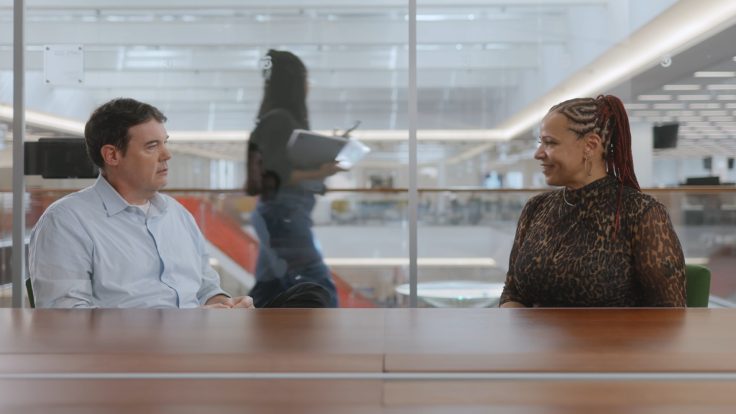
Nikole Hannah-Jones—the New York Times magazine staff writer, MacArthur Foundation "genius" grant winner, 1619 Project Pulitzer Prize winner, and Howard University faculty member—is out with a new analysis of New York City education policy that faults "school choice" for creating inequality in the city’s schools while also complaining that some of the city’s students "don’t have a choice."
The analysis comes in a "Times Insider" column in which Hannah-Jones is interviewed by the assistant managing editor for standards and trust at the New York Times, Patrick Healy. The focus of the interview is a recent New York Times Magazine article (now with an Editors’ Note appended) by Hannah-Jones. In the magazine article, the writer recounts the abysmal education her daughter Najya, now 16, received in New York City public schools, in part because Hannah-Jones and her husband "decided that our role in this struggle meant upending the status quo and sending our child not to a wealthy white school but to a poor Black one."
The column advises that the interview "has been edited and condensed for length and clarity." The newsworthy parts are here (the Times uncharacteristically goes with first names):
PATRICK: Was there any part of the criticism of the article or of you that you agreed with?
NIKOLE: I mean, of course. It would sound crazy if I’d say none of the critique was valid. But I’m like, what is the critique? … And then, of course, the conservative critique, which is that this is an argument for school choice, which I adamantly push back on, because New York City is a system of school choice. And school choice is actually what has led to the inequality. And any other critiques of me personally, I don’t care.
PATRICK: Yeah, you’ve been to that rodeo before.
NIKOLE: Well, yeah, and also, what does it matter? … You know, in the end, I’m fine. I will be fine. My feelings got a little hurt because I’m a human being, but in the end, people are talking about these kids who don’t have a platform, who don’t have a choice.
In one answer Hannah-Jones is claiming that "New York City is a system of school choice." In the next answer she’s talking about kids "who don’t have a choice." So which is it?
A senior research fellow at the Center for Education Policy at the Heritage Foundation, Jason Bedrick, said New York’s problem is not enough choice. "It’s ironic that Hannah-Jones laments that disadvantaged parents lack school choice while condemning New York City for implementing a ‘system of school choice,’ especially when its choice system is so limited," Bedrick told the Washington Free Beacon. "NYC only offers a choice among public schools, including magnet schools and charter schools, but even those offerings are prevented from expanding despite long waiting lists. Those who want to help disadvantaged children get access to a quality education should support expanding school choice options, including to private schools, microschools, virtual schools, and a host of other learning environments."
"New York should follow the lead of states like Florida and Arizona and enact K-12 education savings accounts that give families the freedom and flexibility to customize their children’s education," Bedrick said. New York’s governor, Kathy Hochul, a Democrat, has indicated that she will participate in a tax credit scholarship program that was part of President Trump’s One Big Beautiful Bill Act, but Florida and Arizona’s programs predate the federal legislation and offer larger dollar amounts.
In response to a query from the Free Beacon, Healy, the Times assistant managing editor, suggested the apparent paradox of choice and no choice wasn’t as contradictory as it might appear. "The New York City public school system has extensive public school choice, as Nikole notes. She is also pointing out a practical reality: Many New York City children don’t have the choice to demand and receive a high-quality public school education from a system that does not provide it to all. Both things can be true at once," he said.
A video version of the interview—with bylines from an astonishing nine Times journalists, Hannah-Jones, Healy, Jillian Eugenios, Seth Carlson, Santiago Garcia Muñoz, Adam Wolffbrandt, Lauren Pruitt, Luke Piotrowski, and Mike Abrams—includes the line about "these kids who don’t have a platform, who don’t have a choice." But the video version does not include the claim about how "New York City is a system of school choice. And school choice is actually what has led to the inequality."
People might think that claim was dropped because it’s preposterous. Jewish and Catholic school parents have been fighting for decades in New York for a school choice system that would include those schools. Senator Daniel Patrick Moynihan, Democrat of New York, proposed a federal tuition tax credit in 1977, nearly half a century ago. Charter school operators like the great Eva Moskowitz have been trying for years to get the state’s charter school cap lifted, against fierce teachers’ union opposition. Though the growth of charter schools and of certain religious schools has been impressive, the choice advocates in New York have largely been stymied. So to describe New York as some kind of libertarian utopia, a Milton and Rose Friedman fantasy of unlimited education options, is a delusion. It’s misleading. Perhaps a system with absolutely zero choice would be less unequal. But short of outlawing private schools entirely or fencing in Mayor Zohran Mamdani’s New York like Communist-era East Germany to prevent parents from moving to suburbs or other places with better schools, and thereby forcing everyone to be equally miserable, any choice is almost unavoidably going to introduce some inequality, just as people are born into families with different resources and talents. (Hannah-Jones has praised the education system in Communist Cuba.)
New York has genuinely extensive restaurant choice, from halal sidewalk carts to fancy sitdown restaurants. If a restaurant is severely rat-infested and generates repeated food poisoning complaints, maybe the health department will shut it down, but otherwise no one really complains about the extensive restaurant choice leading to inequality in meal tastiness. With education, there are higher stakes. A functionally illiterate or innumerate child may be less likely to become a virtuous citizen of democracy or productive participant in the economy. But that makes the case for increased student ability to exit bad schools, or a quicker trigger to shut down bad schools. It doesn’t undercut the case for choice of schools, any more than the existence of mediocre restaurants undercuts the case for restaurant choice. The government-run schools, unlike the restaurants, are funded with tax dollars extracted even from those taxpayers who do not make use of the schools.
Healy said the "New York City is a system of school choice" passage had been cut from the video for length reasons. "The video was a condensed version of the interview because we didn’t want the video to be too long. Most of our videos are 1-2 minutes; this one is already very long because it was a rich conversation. We noted that in the published interview intro that the video was shorter/condensed," he told the Free Beacon.
Luckily, the First Amendment guarantees a system of media choice in America. No one is forced to read or watch this stuff. Hannah-Jones is a genius for attracting attention. Her magazine article had the virtue of not flinching from the public schools’ failings or from the reality that some parents will hurt their own children in misguided pursuit of leftist ideals. Yet even three New York Times cinematographers and the assistant managing editor for standards and trust, however capable, are going to have a hard time convincing New York parents, or voters, that the big problem with the Big Apple’s schools right now is too much choice.