

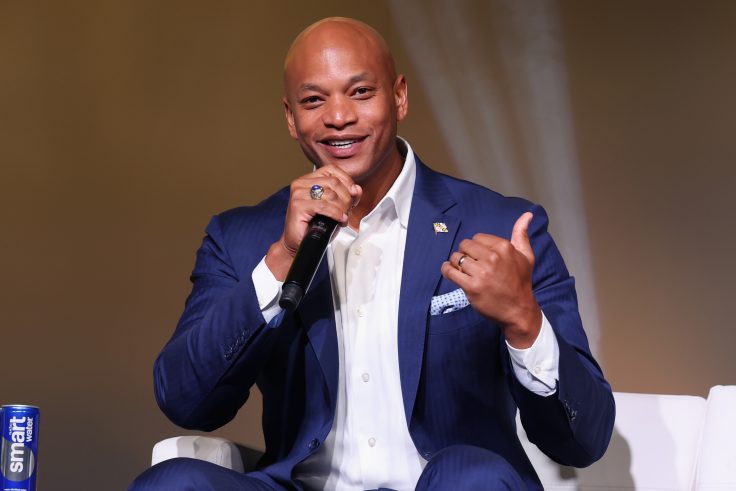
Maryland Gov. Wes Moore (D.) gave shifting and evasive answers—or doubled down on dubious claims—when asked about misrepresentations and falsehoods in his biography during a CBS "town hall" Sunday evening, where the rising Democratic star was the main attraction.
Moore, who’s seen as a likely presidential contender, was the subject of two document-based investigations by the Washington Free Beacon which cast serious doubt on his boasts about his scholarship at the University of Oxford and his claim that his great-grandfather was chased out of the country by the Ku Klux Klan.
During the televised town hall, CBS News correspondent Norah O’Donnell posed some simple questions to Moore, first about the Oxford graduate thesis he has claimed was the basis for his recognition as a "foremost expert" of radical Islam in the wake of 9/11:
"Oxford says it doesn’t have a copy of your thesis," said O’Donnell, citing the Free Beacon. "Did you ever submit it to Oxford, and do you have any idea why it’s now missing?"
Moore, who has made multiple, provable falsehoods about his life story—including lying about military honors, his athletic achievements, and where he spent his childhood—didn’t answer O’Donnell’s question. Instead, the Maryland governor said he is a "person of honor and integrity" who has never exaggerated anything about his life, accusing the Free Beacon, which he derided as "a conservative blog," of engaging in the "politics of personal destruction" for reporting on his missing graduate thesis and his claim that he was enrolled there as a doctoral student (neither Oxford nor Moore can verify this claim).
"I think Oxford has said that I have completed my degree," Moore said. "There is no denying that. And that I received a Master’s degree at Oxford University in international relations. I am a person of honor and integrity—I take that very seriously. I was raised right by my family, and I was trained right by the Army."
"So when I am watching this game of politics, frankly this is what I think people hate about politics so much, it's the politics of personal destruction," Moore added, using a phrase that was popularized by former president Bill Clinton during the Monica Lewinsky scandal. "Where, as a person who has nothing to be ashamed of or nothing to exaggerate about my life, that this is the thing that conservative right-wing blogs want to attack, particularly when it is something that Oxford University has verified already."
Moore’s careful deflection when asked about his missing thesis indicates that his dubious academic claims could continue to haunt him should he launch his expected 2028 Democratic presidential bid.
Moore, who said Sunday he is not running for president (carefully using the present tense), has been playing defense ever since the Free Beacon reported in early December that Oxford confirmed he never submitted a copy of his thesis to its Bodleian Library, as is customary for any graduate student to do over the course of the legendary library's 400-year-old history. The document’s disappearance calls into question how it ever could have established him as a "foremost expert" of radical Islam, a claim he made in the application he submitted to obtain a prestigious White House fellowship in 2006, which jumpstarted his political career. Moore said in a separate interview with the Baltimore Sun in December that he wouldn’t waste "a second" of his time finding his missing thesis.
O’Donnell also asked Moore to respond to a Free Beacon report from early February based on historical records that undercut a story Moore has told repeatedly on the campaign trail about his great-grandfather, who served as a pastor in South Carolina in the 1920s. While Moore claims his great-grandfather was run out of the country by the Ku Klux Klan, historical records obtained by the Free Beacon show he made an orderly and public transfer to Jamaica, the island of his birth, to succeed a prominent Jamaican pastor who had died unexpectedly. The copious documentation of the life and career of Moore’s great-grandfather contains no mention of troubles with the Klan.
While Moore’s communications gurus have said—in addition to accusing the Free Beacon of racism—that the story was passed down orally and pointed to the low literacy rates among African Americans at the time, suggesting the tale may be unreliable, Moore doubled down on his version of the story—without offering additional evidence or documentation.
"I'm the grandson of someone who was born in South Carolina, and when he was just a child, the Ku Klux Klan ran my family out," Moore said. "And not out of South Carolina, they ran them out of the United States of America, and they went to Jamaica. And much of my family has always said they would never come back to this country."
"So if some blog has a question about the Klan’s history, maybe they should ask the Ku Klux Klan," he added.
Moore’s press secretary, Ammar Moussa, told Fox News on Tuesday that the story was "a family’s century-old oral history," which had to be true because "intimidation and racial terror were pervasive in the Jim Crow South."
Moore’s communications director, David Turner, went a step further in his response to the reporting, suggesting in a statement to WMAR-2 News on Wednesday that the reason there’s no documentation supporting Moore’s version of his great-grandfather’s story is that he was illiterate.
"As most people with a basic understanding of American history know, Black Americans often carried an oral tradition of their history due to low literacy rates at the time," Turner said before scolding the outlet for engaging in the "siren song of hackish trolling."
But the Free Beacon visited archives at the College of Charleston, where the Episcopal church kept copious and detailed written records, including about Moore’s great-grandfather.
Moore’s family was literate and educated—his great-grandfather and grandfather were both ordained ministers in the Episcopal Church—and there’s documentary proof. Located in the archives of the Episcopal Diocese of South Carolina is a handwritten note from the Rev. Josiah Johnson Thomas, Moore's great-grandfather, dated Jan. 14, 1922, in which he explained the differences between the Presbyterian and Episcopal churches.