


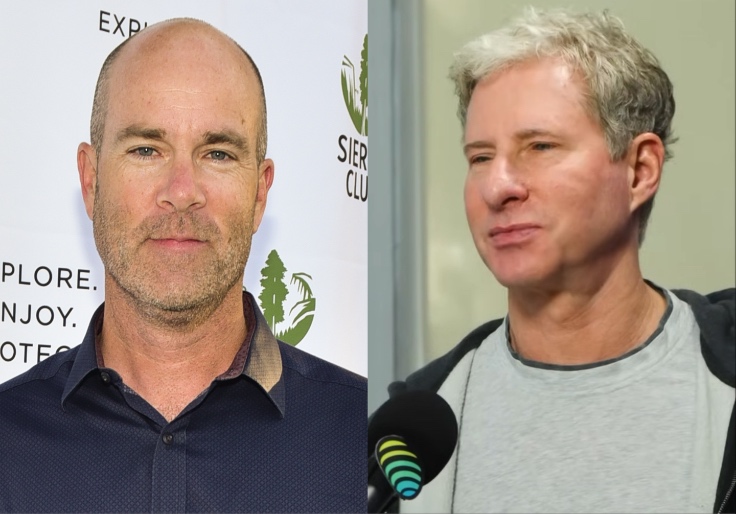
The crypto billionaire and Democratic megadonor Chris Larsen is pouring millions into Republican primaries through the Invest in Tomorrow Coalition, a PAC devoted to climate activism led by the scandal-plagued former executive director of the Sierra Club, Michael Brune. The two are strange bedfellows: Brune has branded crypto, the industry in which Larsen made a fortune, a "climate catastrophe" that facilitates "money laundering and fraud."
Larsen, Ripple Labs's cofounder, contributed $6 million to the Invest in Tomorrow Coalition PAC. Several solar companies and climate-oriented hedge funds also contribute to the PAC. (Jigar Shah, a former Biden administration energy loan czar who allegedly engaged in "pay-to-play" schemes involving his cronies, has contributed $50,000 to the coalition.) The group tapped Brune to lead the operation after he resigned from Sierra Club in 2021 amid an internal investigation into "abuse and misconduct." That investigation concluded that Brune had tolerated a culture of "anger and aggression" and led to a "Restorative Accountability Process."
Invest in Tomorrow's aim, according to PAC leaders and donors, is to "punish" and "take out" Republicans who oppose tax credits for solar and renewable energy firms. The group spent $2 million against Trump-backed Rep. Andy Ogles (Tenn.) in his primary race and $1 million against Rep. Ralph Norman (S.C.) in his Senate campaign. It also spent roughly $640,000 in the GOP's Texas attorney general primary to attack Rep. Chip Roy (Texas), a longtime opponent of renewable-energy incentives. Ogles, Norman, and Roy lost those primaries.
Larsen and Brune make for strange bedfellows. Brune, who also stoked controversy at the Sierra Club in 2020 for calling group founder John Muir a "racist," has been an outspoken critic of cryptocurrency and called for more regulation of the industry. In 2022, Brune said that a lack of regulations for the industry would create "a climate catastrophe" and an "increased risk of money laundering and fraud."
In 2015, the Obama administration sued Ripple Labs, which operates the cryptocurrency XRP, in the first ever lawsuit against a cryptocurrency exchange for failing to implement a system "to protect its products from use by money launderers or terrorist financiers."
Larsen has decried efforts to regulate the industry, railing earlier this year against Sen. Elizabeth Warren (D., Mass.) as "violently anti-crypto."
Larsen, who has amassed a $15 billion fortune through Ripple Labs, has argued that XRP and Ripple's technology are significantly more energy-efficient than Bitcoin, which is mined with energy-heavy supercomputers. And while Larsen has criticized Bitcoin, one of Ripple Labs's first angel investors was the Bitcoin Opportunity Fund, a cryptocurrency venture capital fund.
And Larsen and Ripple Labs are supporters of the cryptocurrency industry writ large. Ripple Labs has contributed $93 million to Fairshake, a super PAC that backs pro-crypto congressional candidates.
Brune has been on Larsen's payroll since his ouster from the Sierra Club. Larsen's charity, the Larsen-Iam Climate Change Foundation, paid Brune $1.4 million for "environmental advisory" services in 2023 and 2024, according to tax filings.
Larsen, who funds the foundation largely with shares of XRP, has paid more than $500,000 to Ken Kurson, the former publisher of the New York Observer and a former Ripple Labs board member who has written extensively about crypto. Ripple Labs removed Kurson as a board member after the Department of Justice indicted him on cyberstalking charges related to his ugly divorce. President Donald Trump pardoned Kurson, who has close ties to Trump son-in-law Jared Kushner, in 2021.
The Invest in Tomorrow Coalition relies heavily on so-called meddle ads, in which partisan groups run ads to influence voters of the other party.
The PAC's ads make no mention of climate change or renewable energy. Instead, they paint the PAC's Republican targets as insufficiently conservative. The ads attacking Ogles called him "Lyin' Andy Ogles" and touted Ogles's Republican challenger Charlie Hatcher as "the America First Conservative." The ads against Norman call the pro-Trump, hardline conservative a "MAGA traitor."
The PAC directs its ads, using a tactic called "microtargeting," at social media users with interests in "light beer" "motorboat," "football," and "hunting," according to data published by Facebook.
Larsen and his comrades are by and large liberal Democrats. Larsen, who lives in the liberal stronghold of San Francisco, has contributed $555,700 to the Democratic Congressional Campaign Committee, the largest PAC supporting House Democrats. Larsen contributed $500,000 to Lone Star Rising PAC, which is backing James Talarico's Texas Senate campaign, and nearly $12 million to support Kamala Harris in 2024, according to campaign finance records.
While the coalition's "meddle ads" may trick many voters—as noted, all three of its conservative targets lost their primaries—the PAC leaders are more than happy to acknowledge their controversial political strategy.
"This is political warfare," Larsen, who cofounded Ripple Labs in 2012, said in a recent interview. Larsen singled out Roy as "the biggest enemy for solar in Congress," adding that "there has to be a consequence to that."
"We're running these ads that are coming from a MAGA perspective because we want to win," Brune said in the same interview.
Shah, the former Biden administration energy loan czar, has also described the PAC's strategy, saying that it was created to teach anti-solar Republicans that there would be "real consequences" for attacking the industry.
The Invest in Tomorrow Coalition has indicated it will continue its efforts beyond primary races. Tom Matzzie, the group's chairman, said his group will "take this fight across the country through November." The PAC has $3.2 million cash on hand as of July 31, according to campaign disclosures.
Invest in Tomorrow Coalition, Ripple Labs, and Brune did not respond to requests for comment.