



On June 19, 1964, one year from the day President John F. Kennedy introduced it, the Civil Rights Act won final approval in the United States Senate, clearing the way two weeks later for President Lyndon Johnson's signature. The vote in the Senate was 73 to 27, several votes clear of the two-thirds needed to break a filibuster by Southern Democrats. Because of the split in his own party, Johnson needed overwhelming support among Republicans to pass the bill. They delivered in the final tally, with 27 Republican senators voting for the legislation, against just 6 opposing it. It was a bipartisan achievement, not unusual in an era when such coalitions were needed to pass important legislation.
There were stalwart and eloquent advocates on both sides of the issue. Johnson used his bully pulpit, and the memory of Kennedy, to rally support for the bill. Sen. Hubert Humphrey was an effective floor manager for the legislation. Minority Leader Everett Dirksen marshaled support among Republican senators, declaring in debate that, "The time has come for equality of opportunity in government, in education, in employment. It will not be stayed. It is here." Southern Democrats, led by Strom Thurmond and Richard Russell, fought a last-ditch battle to hold off or weaken the bill via legislative machinations and a record 75-day filibuster. In the end, a majority of Americans agreed with Sen. Dirksen: The time had come to end the South's racial caste system.
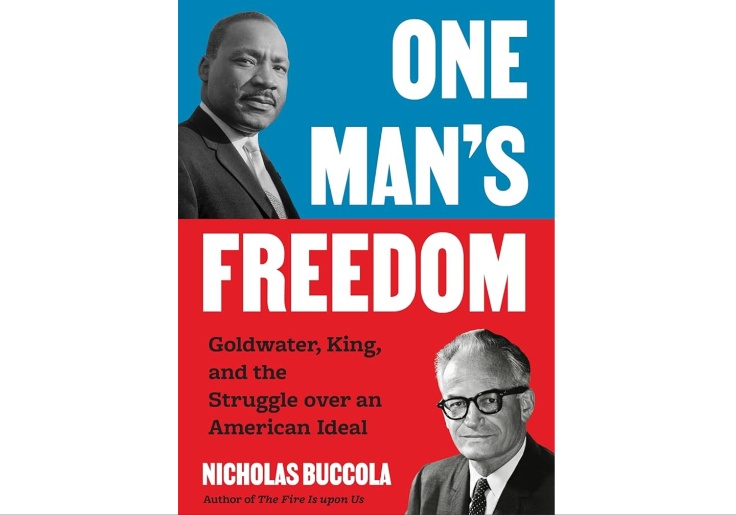
Nicholas Buccola writes in One Man's Freedom: Goldwater, King, and the Struggle over an American Ideal that the battle that led to the Civil Rights Act is well captured in the personal lives and public careers of two protagonists: the Rev. Martin Luther King, who led the civil rights movement at the time, and Sen. Barry Goldwater, one of six Republicans to vote against the Civil Rights Act and Republican nominee for president in 1964. Buccola, professor of government at Claremont McKenna College, writes that these two leaders battled over the essential meaning of freedom in a constitutional republic dedicated to "liberty and justice for all."
King maintained that government power should be used to guarantee freedom not only for American blacks, but for all citizens. He expected that federal power, unleashed by the Civil Rights Act, would advance the cause of freedom. Goldwater argued for the reverse: that freedom requires limitations upon government, and a large zone in which people are free to do as they wish. From his point of view, the Civil Rights Act empowered the federal government to interfere with vital constitutional freedoms.
The book is partly a history of that eventful era, partly a political biography of two advocates for rival conceptions of liberty. The author traces the words and actions of both men from the point in the mid-1950s when they emerged as national figures to the struggle over the civil rights bill and the election of 1964. Buccola shows how these different conceptions of freedom shaped their approaches to the political controversies of the time, and how six decades later they still inform differences between conservatives and liberals.
In some ways, however, the author's approach makes for an awkward historical juxtaposition. King and Goldwater rose to prominence at the same time in the mid-1950s when King, then a novice preacher in Montgomery, Ala., led a successful boycott of the segregated bus system in that city, and Goldwater, a first-term senator, began to use the term "conservative" to describe his evolving views. But the two men never met, either in person or in debate.
King had the more complex and challenging assignment, as the author suggests throughout the book. He first had to mobilize fellow blacks around a common cause while fighting off multiple and sometimes violent attacks from die-hard segregationists, even as he crafted appeals to moderate whites uncomfortable with the racial situation in the country. Goldwater, by contrast, had to appeal to fellow Republicans, and later Southern Democrats, on the basis of his conservative philosophy, a difficult proposition but one nowhere near as difficult or dangerous as the one King addressed. King led a crusade, often fought out in the streets; Goldwater led a "war of ideas."
The Montgomery campaign was a seminal event, not least because it launched the postwar civil rights movement, following the Supreme Court's decision in Brown the previous year. King demonstrated throughout the 12-month campaign that his nonviolent tactics could succeed both in shaming Southern leaders while appealing to white moderates still on the fence on racial issues.
Because of King's leadership, supported by other ministers, it added a pronounced religious dimension to the civil rights movement that was essential for its eventual success. King used biblical imagery to frame the struggle for freedom as a spiritual crusade so that, as he declared, it was partly about individual rights but also about collective deliverance from tyranny. "Let my people go," he declared. The campaign also elevated King's stature as a civil rights leader and national figure. Two months after the boycott ended, King was featured on the cover of Time magazine.
King's campaign called national attention to the race problem in the South and succeeded in placing the issue on the national agenda. He followed it up with a "pilgrimage" to Washington on May 17, 1957, the anniversary of the Brown decision, where he delivered a speech titled, "Give us the Ballot." In response to these campaigns, Congress took up a new civil rights bill designed to add new protections to voting rights in the South. At length, Congress passed a watered-down bill that established a Civil Rights Commission to investigate claims of voter intimidation and a civil rights division in the Justice Department. A few weeks later, Eisenhower sent federal troops to Little Rock, Ark., to enforce a federal court order to integrate the public schools in that city. At this time, near the end of 1957, it appeared that King's campaign was on an upward swing, though that was something of a mirage.
These events proved that neither party could be relied upon to support King's cause. Democrats were divided between Northern liberals who favored civil rights and their Southern bedfellows firmly opposed to any and all legislation on the subject. Republicans, meanwhile, descendants of Lincoln, were generally sympathetic to the plight of blacks but now had a growing faction of members who, in the aftermath of the New Deal, opposed the expansion of federal power for any purpose, including civil rights. Those factors stalled progress on civil rights, notwithstanding King's success in calling attention to the issue.
Goldwater was part of that growing Republican faction. He was not a bigot, as nearly everyone acknowledged, including King. Prior to his election to the Senate in 1952, he had a reputation as a progressive on racial matters and had voted many times to end segregated practices in his home state. He supported local branches of the Urban League and NAACP. In the Senate, he voted for the 1957 Civil Rights Act. He criticized the racial system in the South and supported measures to protect the right to vote. Goldwater's doubts about the use of federal power to change the South were rooted, not in racial animus, but in views of the Constitution as a document designed to protect liberty.
Goldwater's rise to prominence coincided with the formation of the modern conservative movement through the efforts of William F. Buckley Jr., Russell Kirk, James Burnham, Frank Meyer, and a host of other writers on the "new right," as it was sometimes called. In 1955, Buckley launched National Review as a vehicle for publishing these authors and for advancing conservative ideas in national politics. The magazine developed out of frustrations with the tepid approaches of the Eisenhower administration toward two issues: the Cold War and the expansion of federal power into new areas of American life. The editors soon saw Goldwater as a potential presidential candidate who might thrust those ideas into national debates.
In 1960, with the help of Brent Bozell, Buckley's brother-in-law, Goldwater published The Conscience of a Conservative, a surprise bestseller that cemented his reputation as the candidate of conservative voters across the country. In the introduction to that book, he identified the country's main challenge: "to preserve and extend freedom." In a chapter on civil rights, he criticized the Southern system, but wrote that, in view of constitutional restrictions, neither he nor the federal government was authorized to impose reformist programs on the Southern states.
The two causes led by King and Goldwater sputtered and failed to gain traction in the early years of the Kennedy administration. Kennedy had little use for Goldwater's views but was also wary of King and the civil rights crusade, understanding its potential to blow apart his party's fragile coalition. King expressed frustration and disappointment with Kennedy's "go slow" approach. Yet events were working in his favor.
The dam broke in 1963, as Buccola emphasizes, when civil rights were pushed to the forefront of the national agenda. In April of that year, King led a campaign in Birmingham, which he called "the most segregated city in America," during which police used dogs and fire hoses to disperse demonstrators, while reporters and television cameras conveyed the events to a national audience. Weeks later, with those events in mind, Kennedy announced support for a sweeping civil rights bill that would address employment, voting, and segregation in commercial and government facilities. In August, a coalition of labor and civil rights groups organized a March on Washington, where King delivered his "I Have a Dream" speech, with its plea to "Let Freedom Ring!" Days later, a bomb went off in a black church in Birmingham, killing four black girls. Then, on November 22, a gunman assassinated President Kennedy in Dallas. Lyndon Johnson, his successor, pledged to pass a civil rights bill as a tribute to his late predecessor. Johnson, as King believed, was more likely than Kennedy to be a forceful advocate for the legislation.
That proved to be the case, as Johnson pushed the Civil Rights Act toward passage, while Goldwater cruised toward the 1964 Republican presidential nomination. If Kennedy's assassination doomed Goldwater's campaign from the start, as some have said, then his vote against the civil rights legislation further undermined his cause, leading to Johnson's landslide victory.
Though attacked as a foe of civil rights, and even as a bigot, Goldwater had principled reasons for voting against the legislation. He opposed sections II and VII of the act, the first banning racial discrimination in public accommodations and the other banning discrimination by employers in businesses with more than 15 employees, on the grounds that these sections interfered with constitutionally protected freedoms of association. He supported sections of the bill protecting the right to vote and banning discrimination in institutions receiving federal funds. He feared that vague terms used in the bill, such as discrimination, would be subject to unlimited expansion. As an alternative, Goldwater advocated for a gradual approach that would encourage Southern states to address the race problem on their own.
For his part, King believed Goldwater was more dangerous than Southern racists because his cramped view of the role of government would impede progress not only on race but on social and economic issues as well. After the passage of the Civil Rights Act, King moved "from protest to politics," endorsing Johnson's Great Society, while calling for more aggressive measures to address unemployment, poverty, and inequality. At the time of his assassination in 1968, King was staking out progressive positions that were eventually embraced by the mainstream of the Democratic Party.
The author recognizes that the issues and personalities in play in 1964 have had a long afterlife. It is a good question which of these two movements—King's or Goldwater's—has had the greatest impact on the nation's politics in the post-1960s era. A case can be made for either one.
Buccola is more sympathetic to the civil rights revolution, and to King's ongoing legacy as its founder and champion. This revolution coursed through U.S. politics for decades after the passage of the Civil Rights Act, aided by ever more expansive interpretations of the legislation, which have severed its connections to its original purposes. Designed to bring about an end to the racial caste system in the South, it was passed at the moment blacks were leaving that region for Northern cities. The act created a bureaucracy in Washington and a brigade of activists that, working in tandem, twisted the legislation beyond recognition to require a never-ending sequence of new programs organized around race, gender, and identity. That movement captured several major institutions, including schools, universities, and the Democratic Party. It is no exaggeration to say that the Civil Rights Act set in motion a permanent revolution in U.S. politics, one that has not yet run its course.
Goldwater's campaign, on the contrary, though unsuccessful in the short run, laid the groundwork for future conservative successes, including Ronald Reagan's victories in the 1980s, the end of the Cold War, and the permanent capture by conservatives of the Republican Party. Goldwater's fears about the implications of the Civil Rights Act proved to be correct. A major goal of the conservatives over these past many decades has been to arrest this elastic interpretation of the Civil Rights Act and bring an end to the race and gender preferences that have developed out of it.
They may be succeeding. A conservative majority on the Supreme Court has struck down racial preferences in college admissions and expressed skepticism about the constitutionality of other programs that fly under the banner of the Civil Rights Act. The Trump administration escalated its war on those programs by holding up federal funds to institutions still promoting them. Is the rights revolution of the 1960s, having accomplished its main goals, now coming to an end? That appears to be the case. If that is so, then it will be a fitting coda to the lives of the two leaders featured in this book—King, whose ideas launched the civil rights revolution, and Goldwater, who supplied the platform now bringing it to an end.
One Man's Freedom: Goldwater, King, and the Struggle over an American Ideal
by Nicholas Buccola
Princeton University Press, 447 pp., $35
James Piereson is a senior fellow at the Manhattan Institute.