




Amherst College was founded over two centuries ago to prepare young Christian men for the ministry. Today, however, the prestigious college has become a hotbed of administratively sanctioned sex performances and "sexual skills" programs, with a focus on "queer" and transgender students and on free-sex practices such as polyamory. The graphic nature of school-sanctioned sex events has made many current Amherst students deeply uncomfortable, according to students who spoke to the Washington Free Beacon.
Amherst, in central Massachusetts, is one of the country’s most exclusive small liberal arts colleges. The acceptance rate for the class of 2029 was 7 percent and annual tuition plus room and board exceeds $93,000, making it the sixth-most expensive college in the country.
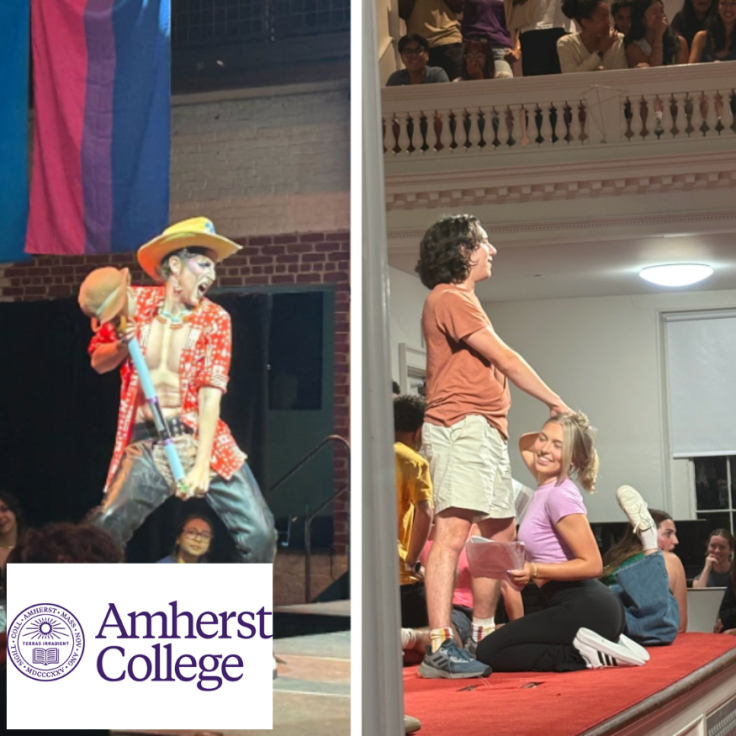
Every year, first-year students are instructed, as a part of orientation, to attend an event—dubbed "Voices of the Class"—in which they are familiarized with Amherst’s "code of conduct" through a theatrical performance scripted using out-of-context excerpts from their own admissions essays. An entire section of the performance is dedicated just to sex.
The event takes place in Johnson Chapel, which Amherst calls its "most important building," and is used for worship services, convocations, senior assemblies, and other significant gatherings. Johnson Chapel displays 36 portraits of the college’s most notable figures and alumni—including all 19 former presidents of the college, influential trustees, clergymen, civil rights leaders, poet Emily Dickinson, and former U.S. president Calvin Coolidge, who all likely would have looked on in horror if they saw the event on August 31st, 2025.
On the chapel’s chancel, students performed mock sex acts including oral sex, masturbation, and group sex. A young woman bent over while another student pretended to penetrate her from behind. Others pretended to do drugs and shared their "high thoughts."
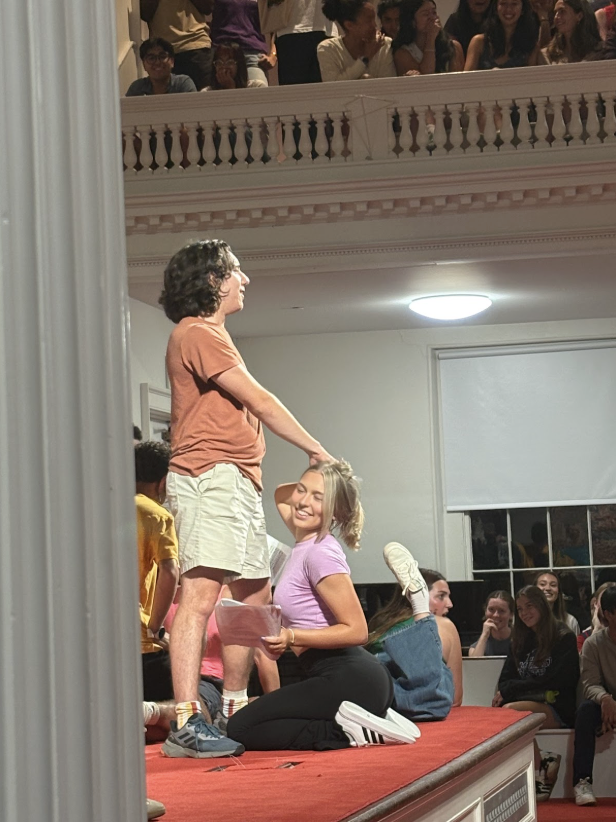
Every first-year was urged to attend the performance by their orientation leader. The administration advertises the event as a "lighthearted tradition" to "celebrate the humor, creativity, and individuality of your class." The school funds the performance, and Amherst administrators work closely with the student performers, offering feedback and approving the script.
"‘Voices of Amherst’ has been part of New Student Orientation since 2007 and is coordinated by New Student and Family Programs in Student Affairs. Each year, the script is newly written by junior and senior students using excerpts from the incoming class’s admissions essays," the Office of Student Affairs told the Free Beacon. "The final script is reviewed and approved by staff before the performance. Funding for production comes from the Orientation budget; student performers are not paid, and Johnson Chapel serves as the traditional venue."
Following the event, the Office of Student Affairs asserted in an email that "Voices of the Class" is "not graphic."
Students receive a general description of the event beforehand and are asked for permission to use their essays in the script, but many first-years said they never imagined Amherst administrators would use their words for the event they saw. Student attendees expressed discomfort with the performance, with one upperclassman orientation leader telling the Free Beacon, "The administration instructed us to send the first-years to the event. Had I known what it was, I certainly wouldn’t have."
On the popular app Fizz, in a chat limited to Amherst community members, critical reactions were upvoted by as many as 663 students—roughly 35 percent of the student body.
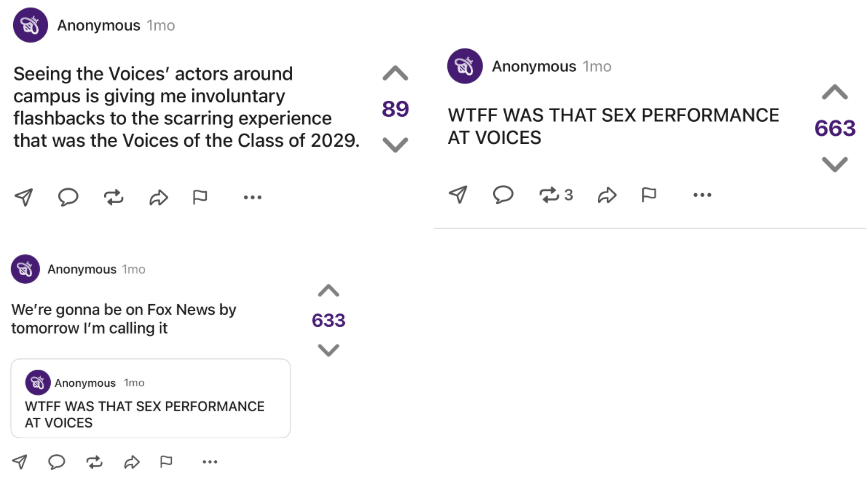
"WTFF WAS THAT SEX PERFORMANCE AT VOICES," one user posted. "Seeing the Voices’ actors around campus is giving me involuntary flashbacks to the scarring experience that was the Voices of the Class of 2029," another said.
Isabella Niemi, an Amherst junior, said administrators didn’t appear interested in any pushback on the sex performances. "There were feedback forms for all the orientation events except the most grossly sexual ones, so I had no opportunity to make my voice heard on the excessive oversexualization," she said. "It was almost like they were avoiding feedback, actually, because they didn't want to be told that this isn't normal, or useful, or funny."
The Center for Religious and Spiritual life—which has a Buddhist, Hindu, Jewish, Muslim, and interfaith and humanist chaplain—declined to comment on the use of Johnson Chapel for the performance. Amherst does not have a Christian chaplain.
The "Voices of the Class" performance is just the beginning for the newly initiated Amherst first-years. Year-round sexual programming is organized by full-time staff, primarily through the administrative offices of Health and Wellbeing Education, Residential Engagement and Wellbeing, Student Engagement and Leadership, and the Queer Resource Center. (Like many elite colleges and universities, Amherst has a large number of non-faculty staff which contribute to the astronomical tuition costs. The college has 1,400 faculty and staff and only 1,900 students.)
Also part of orientation, the administration requires students to attend mandatory "Wellbeing Skits," which depict students roleplaying various casual and drunken sexual scenarios, including sex with strangers. The Wellbeing Skits are funded, developed, and approved by staff in the Office of Health and Wellbeing Education and performed by student "peer educators" employed by the Office.
Niemi, who’s from Idaho, describes the skits as simulated sex, with students moaning and thrusting under a blanket, and says that the peer educators "showered handfuls of condoms on students like confetti."
"I thought about leaving 10 minutes in. I’m not someone who breaks rules or skips mandatory events, but it was disgusting enough it almost forced me to leave," Niemi recalled.
But Amanda Vann, Amherst’s "director of health and wellbeing education," told the Free Beacon that the skits help students build up their skills when it comes to sex. "The skits are part of our broader commitment to promoting wellbeing and sexual respect on campus," she said. "They encourage conversations about topics that can sometimes feel difficult to discuss, from sexual health and communication to harm reduction and self-care. By presenting these subjects in a relatable, engaging format, the skits help students build the skills and awareness needed to care for themselves, support one another, and contribute to a healthy, respectful community."
Vann additionally noted that Amherst College health educators have performed the skits for more than 25 years, and described costs associated with the programming as "minimal."
John Collier, an Amherst junior from the Atlanta area, said the school-sanctioned sex simulations and obscene skits are backfiring. "I understand that Amherst is trying to remove the taboo behind sex on campus, but this has gone way too far," he said. "The way it's forced in our faces does the exact opposite."
"Sexual respect" has been a campus buzzword since the early 2010s, when the Obama administration cracked down on colleges and universities, mandating that they aggressively police student sexual conduct to comply with Title IX federal law. Over the last 10 or 15 years, schools have built up staff, offices, and programs to educate—and regulate—sex and gender.
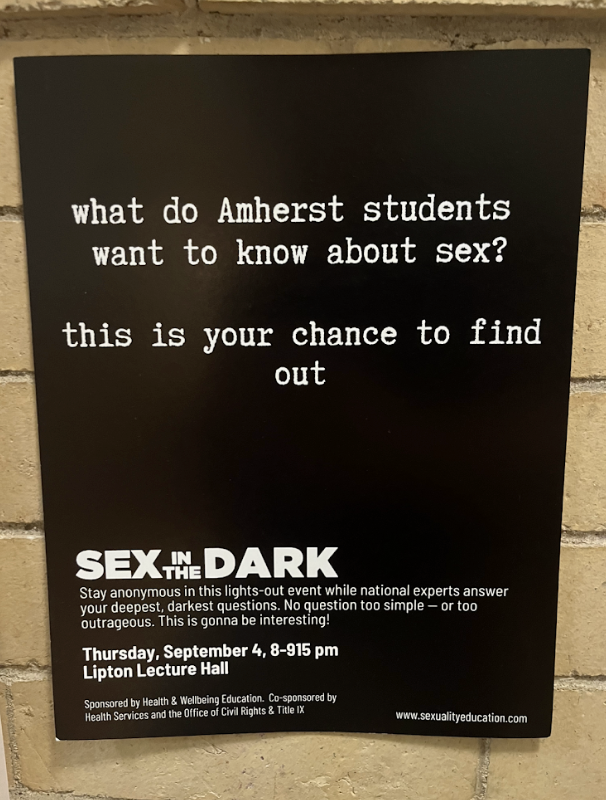
Another official event at Amherst is "Sex in the Dark," an annual program held at the beginning of each school year. Organized by the Office of Health and Wellbeing Education, the event takes place in darkness. Students report being encouraged to speak about uncomfortable sexual topics, such as their sexual orientation, habits, kinks, and fantasies with the "sex experts" in the dark room.
An event advertisement reads, "Stay anonymous in this lights-off event while experts answer your deepest, darkest questions about all things sex, relationships, sexual health, and more! No question is too simple - or too outrageous." Students are given glow-in-the-dark condoms for attending. On Amherst’s website, the staff contact for the event is Claire Dutton, whose job title is "wellbeing educator – sexual respect."
Amherst’s staff also encourages students to explore unconventional sexual lifestyles such as polyamory, where people in a group—often living together—have multiple sexual relationships simultaneously with the consent of everyone in the group. The convicted crypto fraudster Sam Bankman-Fried is perhaps the most famous practitioner of polyamory. He lived in a luxury penthouse with several colleagues in an arrangement described as a "polycule."
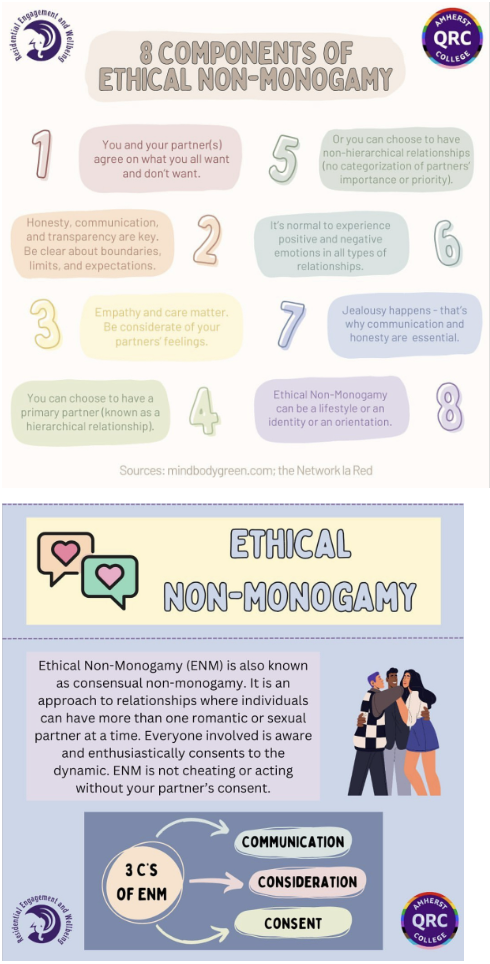
At "Beyond Monogamy," organized by the Residential Engagement and Wellbeing Center and Queer Resource Center, students were encouraged to speak with three licensed therapists who "specialize in polyamory and ethical non-monogamy" about "building healthy non-monogamous relationships in college and beyond."
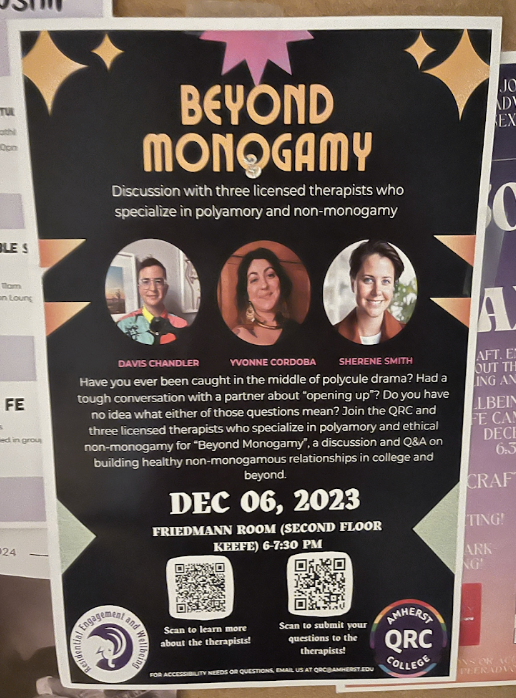
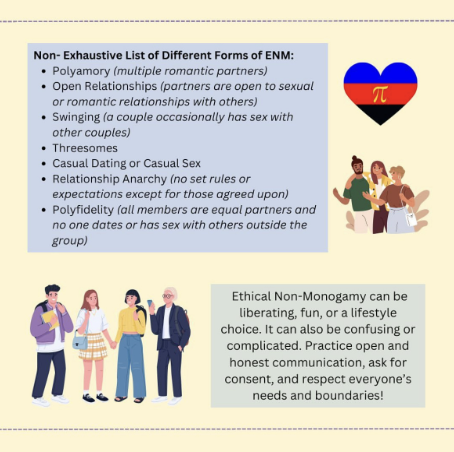
Materials promoted by the Queer Resource Center aimed to teach students different types of healthy non-monogamous relationships, listing sexual scenarios such as "open relationships," "threesomes," and "swinging," as well as newer sex concepts like "relationship anarchy," and "polyfidelity." The Amherst communication office categorized "Beyond Monogamy" as part of its sexual health education programming.
The materials reassure students that it is "normal to experience positive and negative emotions in all types of relationships."
"Jealousy happens—that’s why communication and honesty are essential," a poster added.
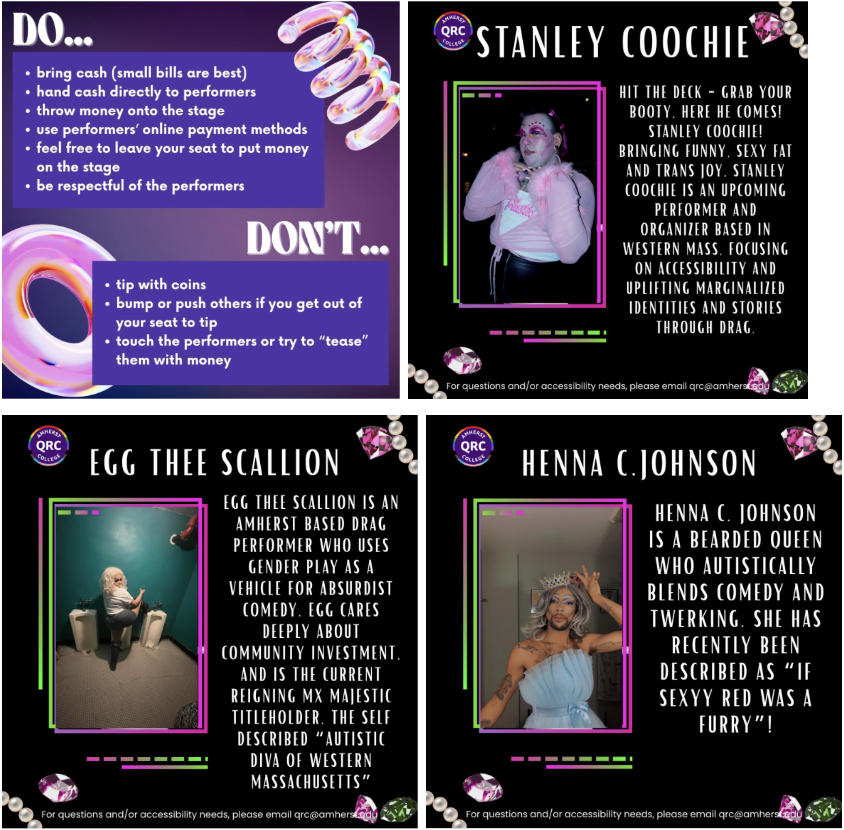
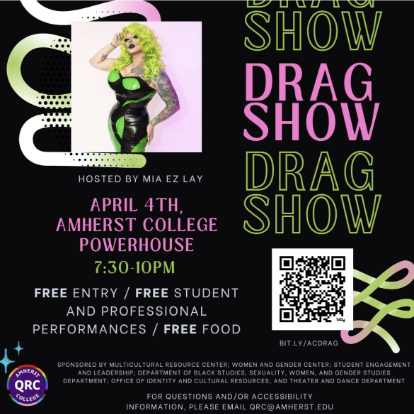
The administration has also begun funding an annual drag show. Last year, the Office of Student Engagement and Leadership funded nine performers, including one who went by the name "Stanley Coochie." The two-and-a-half-hour show included songs "Vagina" and "Big Ole’ Freak." Students were encouraged in the event’s registration link to tip the "queens" if they felt inclined, and instructed by the Queer Resource Center to either hand cash directly to performers or throw it onto the stage. At the event, a table helped students exchange larger bills to ones for "more fun tipping."
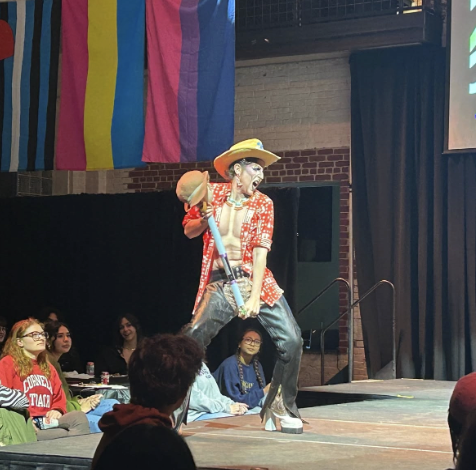
Students were provided free entry, free food, queer flags, and taught the history of drag through a slideshow before performers took the stage. The event featured performers dressed as the devil, while others stripped off clothing and twerked. One performer projected on the screen videos of himself taking estrogen shots, and another gave a speech on "the benefits of being fat."
The event was co-sponsored by multiple staff-controlled groups, including the Black Studies Department, Sexuality, Women’s, and Gender Studies Department, Queer Resource Center, and Women’s and Gender Center (the number of gender-focused groups at Amherst is remarkable, considering that its student body is smaller than that of many New York City public high schools).
The focus on sexual outsiders and norm-breaking sexual behaviors "is so normalized here, I just kind of laugh it off at this point. It just feels so disturbing and dystopian," junior Evana Toumazatos told the Free Beacon.
Toumazatos said that the administration’s decision to shell out $90,000 to bring rapper CupcakKe to perform on campus in 2024 was disappointing. The rapper, whose songs include "Spoiled Milk Titties," "Whoregasm," and "Juicy Coochie," opened the event with "Deepthroat" and brought students on stage to twerk to "Spiderman Dick." The Amherst Student reported that she described Amherst as a "bunch of freaks" and closed the performance as follows: "Goodbye guys, I’m about to go suck some dick right now."
Amherst is certainly a long way from Idaho for Niemi. "If I knew how constantly repressed, bad, and weird I would feel for not partaking in campus culture, I would have thought a lot longer about coming to Amherst. … It takes a huge toll on you constantly hiding your opinions from students and professors all the time," she said.