


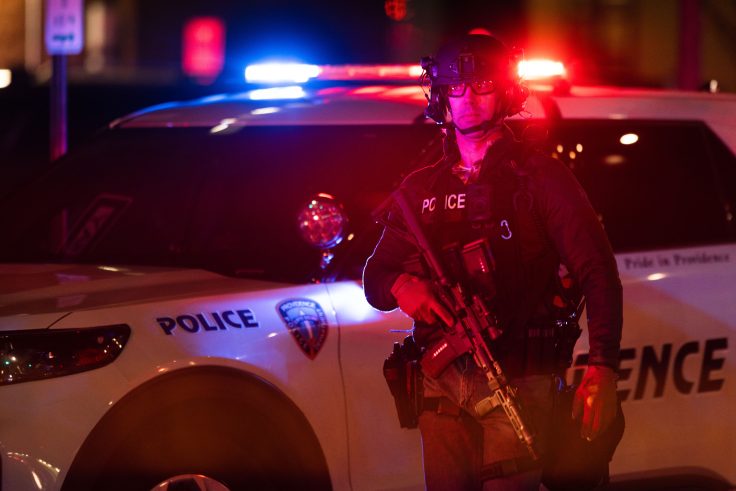
Brown University is facing questions over its security policies after its emergency sirens never sounded in response to Saturday's shooting, while taking nearly 20 minutes to send an alert out to students. The scrutiny comes after campus cops passed no-confidence votes against their police chief and questioned the school's emergency response capabilities.
Rodney Chatman, the university's director of public safety and emergency management, blamed the lack of sirens on the hectic nature of the crisis. He said police became aware of the incident when an officer saw students fleeing the scene.
Fire officials learned of the shooting at 4:05 p.m., according to Providence fire chief Derek Silva. Students didn't receive an alert until 4:22—17 minutes later, according to the Rhode Island Current. They were then warned to lock their doors, run, hide, and "FIGHT as a last resort."
From there, Brown issued and retracted a series of alerts. It sent one at 4:51 saying a suspect was in custody, then another 20 minutes later walking back that claim. A 5:27 alert warned that there was another shooting, but a 6:10 message said that was actually "unfounded."
A shooter, who has not been caught, opened fire Saturday into a lecture hall filled with roughly 60 students as a final exam review session for an economics course was underway, killing 2 and injuring 9. The professor, Rachel Friedberg, who was not present, also teaches in the Judaic studies department and is a trustee at the Jewish Day School of Rhode Island and lectured at the Hebrew University of Jerusalem for four years before joining Brown's faculty.
Police arrested Benjamin Erickson early Sunday morning in a hotel roughly 17 miles from Brown and recovered a revolver and a small Glock handgun with a laser sight attached. He was released later that night because evidence "now points in a different direction," Rhode Island Attorney General Peter Neronha said, adding that there "was no basis to consider him a person of interest." Neronha refused to detail next steps in the investigation because "we have a murderer out there, frankly, and so we're not going to give away the game plan." Providence mayor Brett Smiley added, "we believe that you remain safe in our community," even though the assailant remains at large.
Ella Cook, a sophomore from Alabama, was one of the two students killed in the shooting. She served as vice president of Brown Republicans.
Chatman joined Brown in 2021 after his predecessor resigned amid calls from student activists to abolish police. In recent months, his department has been riddled with complaints, including concerns from officers that the department wasn't adequately disclosing information surrounding bomb and shooting threats across campus, the Brown Daily Herald reported in April. The officers felt leadership shrugged off their concerns.
In October, the school's Security Patrolperson's Association became the second union in as many months to issue a vote of no confidence in Chatman and deputy chief John Vinson.
A statement from the Patrolperson's Association said Brown's Department of Public Safety's decision to decrease the number of field officers to make room for more administrative positions "directly contributed to an all-time low in morale and has strained the department's ability to effectively serve the Brown University community."
It also cited a "climate of fear and possibility of retaliation" in the department and said officers have faced technology failures in the field. Those problems "have led to high turnover and burnout among officers."
Providence authorities have provided little information surrounding Saturday's suspect. Smiley, in fact, began Sunday's news briefing by saying, "At this time we have no official updates to share with respect to the investigation."
Providence police chief Oscar L. Perez then refused to provide details about the suspect, such as his name, whether he was a local, or if a weapon was found. He declined to comment on allegations that the assailant shouted something during the shooting and didn't answer questions about the lack of camera footage, considering the university has an extensive surveillance network and covers the engineering building where the shooting took place.
In response to the shooting at Brown, Columbia University heightened its own security, restricting campus to students, faculty, staff, and registered guests, and will monitor its buildings more frequently.
Update, 11:22 p.m.: This story has been updated with additional information.