




Critics of higher education heaped praise on Yale University president Maurie McInnis in late April, when a committee she convened on trust in higher education issued its findings.
The Wall Street Journal editorial board, among others, lauded the university's self-reflection, and the report was correct in many of its observations, acknowledging the public's plummeting trust in the Ivy League thanks to exploding tuition, runaway grade inflation, and student activists whose theatrical intolerance made national headlines.
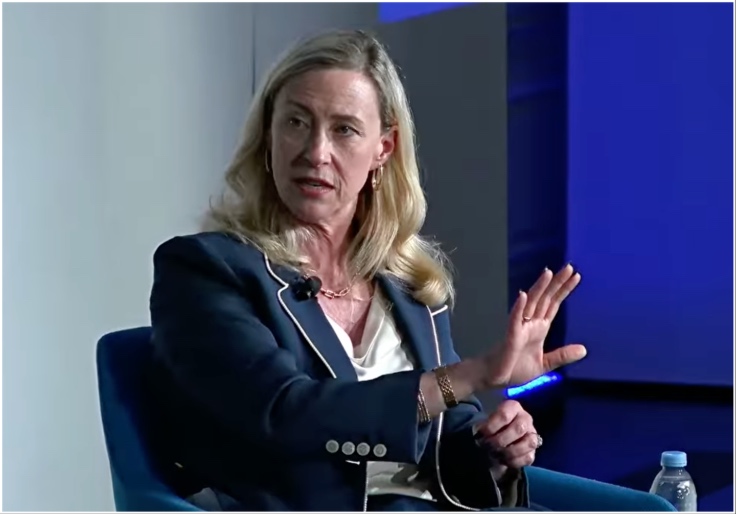
The question remained: What would Yale do about it? McInnis appeared at the American Enterprise Institute on Wednesday afternoon in conversation with senior fellow Frederick Hess to answer that question. She herself acknowledged the committee's conclusion that "trust comes from saying what you will do and then doing it."
And yet she couldn't quite say how Yale is going to tackle this problem. It's hard. There are contributors beyond Yale's control. It requires collective action. And, of course, there are other committees at work.
On admissions, McInnis defended Yale's holistic approach against a "test-based system" because Yale doesn't want undergraduate classes in which "maybe everybody's going to want to be a physics major." (We would like to see the meritocratic, test-based system that produces an entire class of physics majors as opposed to a class of students with diverse academic interests.)
Rather, she said, "I want to be sure that we both have physics majors and arts majors, that we have people who play on 1 of our 35 Division I athletic teams or play in our Yale Symphony Orchestra."
Yale has furtively brought back the requirement, starting this fall, that all applicants must submit ACT or SAT scores. But informed observers aren't buying that Yale has truly reformed its ways.
In one breath, McInnis said that Yale holistically selects for eagerness to "engage and debate and dialogue and wrestle with ideas, both in and out of the classroom." (It doesn't.) In the next—pressed about why a third of Yale students say they don't feel they can express themselves freely on campus—McInnis said that, thanks to social media, students are arriving at Yale "without the skills to be ready to engage with people who completely disagree with them." So which is it?
Yale might consider that its holistic admissions—especially after the so-called national racial reckoning in 2020—have opened its wrought-iron gates to angry, identity-obsessed kids who want to burn the place down rather than enrich a great institution. Yale's corrupted admissions office is polluting the campus with activist students whose hearts are filled with certainty and whose heads are filled with nonsense. From a campus meltdown in 2015 over a gentle suggestion from a lecturer that students can talk to one another if they are offended by a Halloween costume, to law students shouting down a talk on free speech in 2022, to a 2024 survey showing vastly more Yale undergraduates support a boycott of Israel than of China, perhaps Yale's holistic admissions are selecting for wholly the wrong thing and a test-based approach would do some good.
McInnis's response to how Yale will tackle grade inflation was similarly dispiriting. While we might think it's "easy to fix grade inflation," she said, it actually requires "multiple institutions," as well as "K-12," because Yale students arrive on campus so fragile they are actually incapable of receiving anything but an A. Students "have never seen anything other than an A their entire lives, and it can be really challenging for the faculty who are the first trying to give that student that grade that is not an A," she said. Maybe it's time for a committee on faculty fragility?
Were Yale to implement an honest grading regime, she added, "What you would hear from the students are [sic] 'Well then, you're putting me at a disadvantage when I apply to medical school. You're putting me at a disadvantage when I apply for other sorts of graduate and professional schools.' So that's why it kind of needs to be a collective conversation."
We don't believe for a moment that graduate and professional schools wouldn't take into account what a Yale GPA really means were the institution to chart its own course, just as Yale itself takes into account what GPAs really mean from more and less rigorous high schools across the country.
But that would mean standing up to activist and entitled students, something McInnis evidently isn't yet prepared to do. Don't worry, though, there is a committee, and "we will see what comes out of this committee."
The Washington Free Beacon awards this performance no points, and may God have mercy on your soul.