

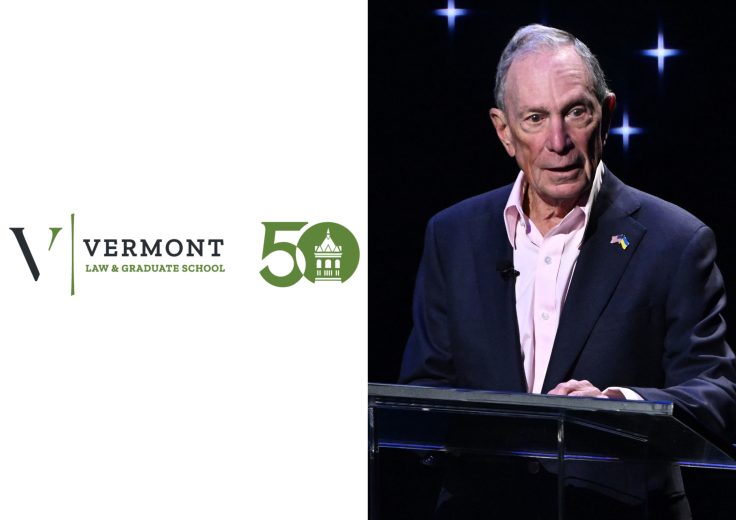
A controversial, climate-focused initiative at New York University—that paid the salaries of top officials in Democratic attorney general offices nationwide but quietly shuttered earlier this year—appears to have found a new home about 230 miles north.
According to a review of Vermont Law's staff directory, nine members of the shuttered NYU State Energy and Environmental Impact Center, including its executive director and legal director, have migrated to the Vermont Law and Graduate School’s new Multistate Assistance for Public Service Leadership and Excellence (MAPLE) initiative in recent months. The top two NYU Impact Center officials joined MAPLE on Aug. 19, 2026, while the others—including the chief operations officer, senior staff attorney, communications manager, and director of environmental justice programs—joined on Sept. 15, 2026.
Those hirings came around the time that the NYU Impact Center, which had received significant funding from billionaire environmental philanthropist Michael Bloomberg, unexpectedly shut down on Aug. 31, 2026, nearly a decade after it was founded, without any public announcement, the Washington Free Beacon reported. The closure came amid multiple congressional and state-level investigations over alleged ethics issues related to its funding and its practice of paying the salaries of environmental officials it placed in state attorney general offices.
The nine individuals who moved from the NYU Impact Center to MAPLE, meanwhile, represent all of the new initiative's known staff. They also each retained the exact title they had while at the NYU Impact Center.
The MAPLE initiative, its website states, supports students in "exploring state public service." To do that, it says it offers "experiential learning opportunities where students can engage in state agency work on energy and environmental law," trainings, workshops, internships, and fellowships; and resources to help educate the public on how state agencies shape energy policy.
On the surface, that mirrors the NYU Impact Center's practice of embedding "fellows" inside state governments and paying their salaries while these fellows, as state employees, pursue and enforce climate regulations. The practice has attracted at least one ongoing legal complaint and a probe from the House Oversight and Government Reform Committee, which stated the scheme "raises questions as to whether participating state attorneys general are acting on independent judgment to best serve the interests of their states' citizens."
It remains unclear whether the MAPLE initiative's programs will—like its precursor at NYU—fund the salaries of the fellows it directs to state agencies. It also remains unclear whether the initiative has retained the same revenue stream as the NYU Impact Center—Bloomberg's eponymous charity notably helped found the center in 2017 with two seed grants worth $2.8 million each, according to tax filings.
A spokeswoman for the MAPLE initiative did not respond to a request for comment.
Still, the migration of the NYU Impact Center staff suggests that the two initiatives are, to some extent, intertwined.
"The quiet migration of the NYU Impact Center's leadership and staff to Vermont Law and Graduate School raises serious questions," American Tort Reform Association president Sherman Joyce told the Free Beacon.
"When a privately funded organization shuts down under congressional scrutiny, only to immediately resurface under a new name, it looks less like a true closure and more like a rebranding strategy," he continued. "House Oversight and relevant state officials should closely scrutinize this entity to determine whether it is continuing to place privately funded fellows in public prosecutor offices without standard government oversight."
Vermont Law School's involvement, meanwhile, is notable because Christophe Courchesne, who is a professor at the school and the director of its Environmental Law Center, previously served as the deputy chief of the Massachusetts attorney general's environmental protection division.
In that role, Courchesne worked with the NYU Impact Center to hire a fellow at the attorney general's office. That fellow reported directly to Courchesne, according to the application Massachusetts submitted to the center.
"We appreciate your consideration of our application and fully expect that the NYU Fellow would make a needed and valuable contribution to the AGO's nationally significant work to protect the environment and the climate and to advance a clean energy future in the Commonwealth and beyond," the 2017 application, which was coauthored by Courchesne, stated.
In addition, the Vermont Law boasts connections to a high-profile nationwide legal effort, which has been led by Democratic state attorneys general, to sue oil companies for billion-dollar damages related to their alleged role in causing global warming.
For example, Vermont Law professor emeritus Pat Parenteau has advised Sher Edling, a San Francisco-based environmental law firm that specializes in suing corporations on behalf of Democrat-led state and local governments.
According to tax disclosures reviewed by the Free Beacon, Vermont Law School also shares a revenue stream with Sher Edling. The left-wing charity Chicago Community Trust—which donated $650,000 to a fund that backs Sher Edling's oil lawsuits—gave $7.1 million to Vermont Law School between 2023 and 2025 for undisclosed programs.
And Vermont Law's newly announced president, Melissa Hoffer, was a lead attorney on Massachusetts's climate change lawsuit against ExxonMobil alongside Courchesne, according to the state's 2019 complaint.