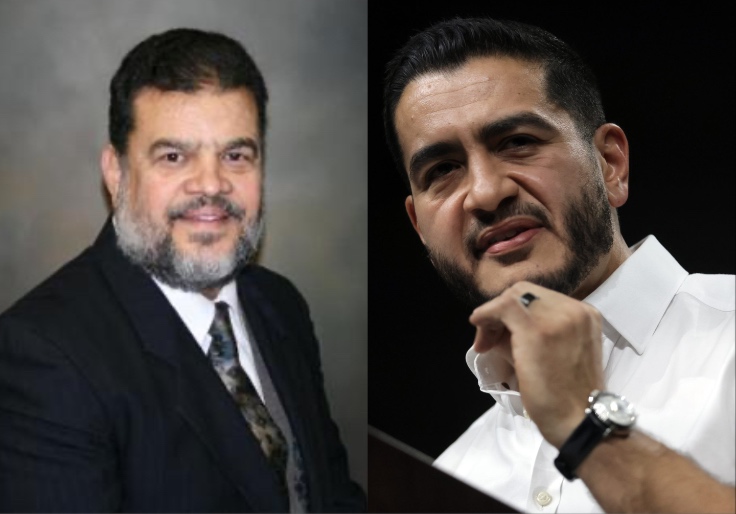
Abdul El-Sayed's father sits on the board of a notorious Islamic charity that was once busted for funneling cash to Saddam Hussein and has been raided by the FBI and the U.S. military. The board also features two current members who belonged to the Muslim Brotherhood, according to documents from federal prosecutors.
El-Sayed's father, Michigan academic and imam Dr. Mohammed El-Sayed, serves as a board member of the group Life for Relief and Development, which proudly displays his affiliation on its website.
"Dr. Mohammed El-Sayed, P.E., is a Professor of Engineering at Eastern Michigan University with over thirty years of industrial and academic experience. He is a Fellow of ASME and SAE—distinctions awarded to engineers recognized for excellence in leadership, research, and innovation," the site describes him, adding that he is a "visiting imam" at various other "community organizations."
The elder El-Sayed has been affiliated with Life for Relief and Development since at least 2020, federal tax forms show.
Abdul El-Sayed's father-in-law, Jukaku Tayeb, previously served on the group's board.
The group bills itself as "a trusted top-rated global humanitarian organization committed to helping people in crisis from natural disasters to man-made emergencies." But its past is considerably more controversial and includes a six-figure settlement with the U.S. Office of Foreign Assets Control, which accused it of funneling cash to Saddam Hussein in violation of U.S. sanctions.
The story began in 2006 when the FBI raided the charity's office. A year later, its CEO was charged by a grand jury with violating sanctions and money-laundering laws, and the charity's accounts at Bank of America were closed.
Federal agents also raided the home of the charity's then-CEO, Khalil Jassemm, the Detroit Free Press reported in September 2006.
Among the files seized were all "correspondence, notes, e-mails, facsimiles and other documents and records" related to the Islamic African Relief Agency, court records show.
The Islamic African Relief Agency was a known alias for the same group for which El-Sayed's mother, Fatten Fathy Elkomy, worked. The agency was later shut down after being identified as an al Qaeda-linked terrorist organization.
The case against Life for Relief and Development was only dropped in 2014 after an agreement was reached with the government. Its troubles were reported in the Detroit Free Press in 2016.
That agreement came in the form of a $780,000 settlement with the Office of Foreign Asset Control.
"[Life for Relief and Development] appears to have violated §§ 575.210 and 575.211 of the Regulations between September 9, 2002, and March 19, 2003, when it knowingly and willfully formed a conspiracy for the purpose of transferring funds from the United States to Iraq, by and through Amman, Jordan, and appears to have made funds transfers pursuant to this conspiracy," the government said.
"[Life for Relief and Development] appears to have willfully violated U.S. economic sanctions regulations; prior to the relevant transactions, LRD had written notice from OFAC that such transfers were prohibited and that OFAC did not authorize such transactions; LRD's highest management levels—i.e., its President—knew of the conduct giving rise to the apparent violations and directed the funds transfers to Iraq via Jordan," the statement continues, calling the violations an "egregious case."
The cash transfers took place during the height of U.S. tensions with Saddam Hussein's regime and ran until the day the United States began bombing the country, the OFAC settlement shows.
In 2004, after Hussein's fall, the United States military raided the Baghdad offices of Life for Relief and Development, the San Francisco Chronicle reported at the time.
Twelve computers and 20 boxes of files were confiscated, U.S. officials told the paper. Life for Relief and Development leaders told the Chronicle that the United States likely suspected them of collaborating with the local insurgents.
Life For Relief and Development public relations coordinator Muthanna al-Hanooti was later charged with acting as an unregistered agent for Hussein's government. He ultimately pleaded guilty to violating the International Emergency Economic Powers Act.
Life for Relief and Development also "gave millions to a group the FBI identified as Hamas' Jordanian operation," the New York Post reported in October 2007, citing law enforcement sources, adding the group was "suspected of funding al Qaeda insurgents in Iraq."
In addition to the raft of legal troubles, the organization's current members have long histories of terror ties, the Washington Free Beacon reported.
Life for Relief and Development CEO Hany Saqr was listed in a 1992 phone directory of U.S.-based Muslim Brotherhood leaders submitted by federal prosecutors as part of the terror financing case against the Holy Land Foundation in 2008. The directory was seized from the Virginia home of alleged Hamas operative Ismail Elbarrasse. In 2018, Saqr used a Muslim Brotherhood logo as his Facebook profile photo and blasted Egyptian president Abdel Fattah el-Sisi—a foe of the Muslim Brotherhood—as a "dog of the Jews."
Saqr—along with Abdul El-Sayed—also signed the 2012 letter urging then-Egyptian president Mohamed Morsi, an affiliate of the Muslim Brotherhood, to purge the media and police in he country.
Another Life for Relief and Development board member, Mohamed Yahia Abdulrahim, also appears to be listed as the head of the "economic department" in the phone directory of Muslim Brotherhood leaders released as part of the Holy Land trial.
Sherif Gindy, a third Life for Relief and Development board member, called for Muslims to carry out "jihad" in all of its "forms"—including by "force"—to impose hair coverings on girls and push Jewish people out of Israel.
Saqr, Abdulrahim, and Gindy have each also donated $1,000 to Abdul El-Sayed's Senate campaign, records show.
Abdul El-Sayed has resisted answering questions about his family's ties to Islamic extremism and his own past support for the Muslim Brotherhood, attacking the inquiries as "Islamophobic."
Life for Relief and Development and Mohammed El-Sayed did not respond to requests for comment. Abdul El-Sayed's campaign did not provide a response on the record.