


Newly released data on the Harvard College class of 2030 say the class is 43.2 percent Asian-American, a record high and more than double the level when Students for Fair Admissions first sued Harvard alleging racial discrimination in admissions.
The U.S. Supreme Court ruled in 2023 that Harvard was unlawfully using race as a factor in admissions. Since then, the numbers of Hispanic and black students in the incoming Harvard classes have dipped, while the numbers of Asian-Americans have soared.
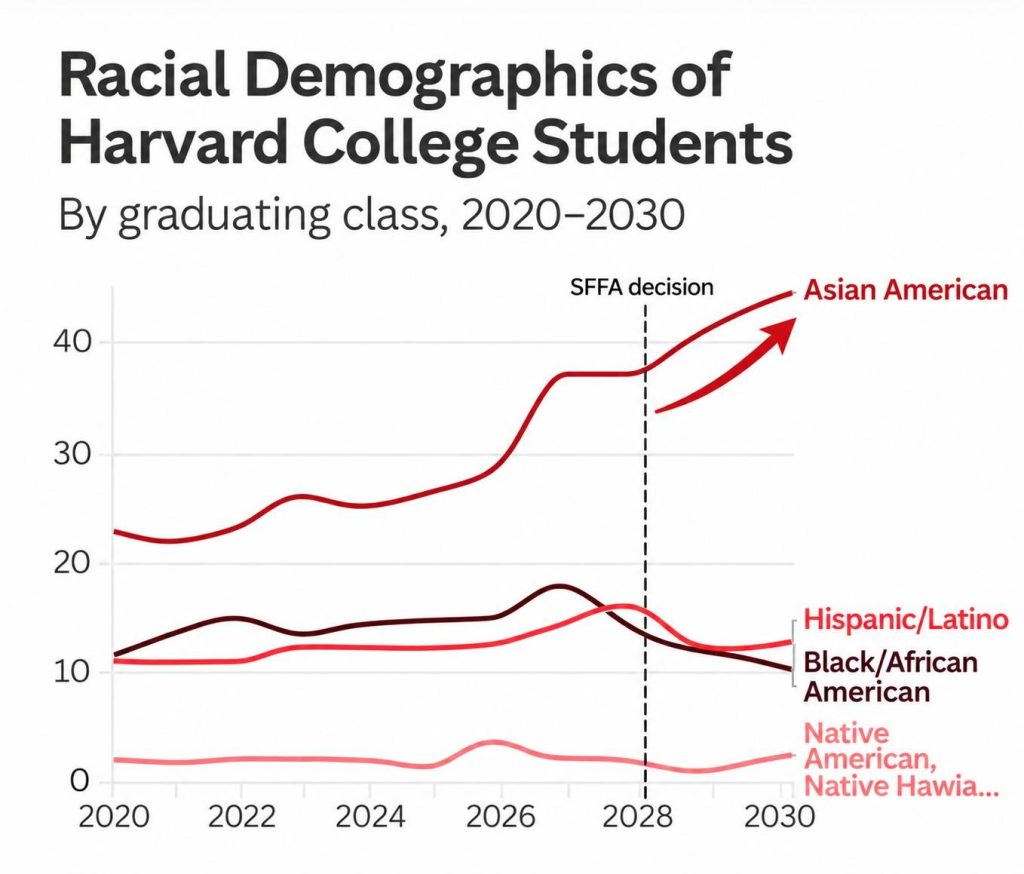
Even the 43.2 percent figure undercounts the number of Asians on campus. It only reflects "U.S. Citizens and Permanent Residents who chose to report their race/ethnicity." Some additional Asians may not box-check, and others may be foreigners, among the 15 percent of the incoming class that Harvard categorizes as "international students."
The president of Students for Fair Admissions, Edward Blum, told the Washington Free Beacon, "In 2014, the year Students for Fair Admissions sued Harvard, Asian-American students accounted for approximately 19% of its entering freshman class. Today, following the Supreme Court's 2023 decision prohibiting race-based admissions, that figure has more than doubled to 43%. This is powerful evidence that Harvard used race as a primary factor in its admission decisions for decades."
"The Supreme Court’s decision in 2023 didn't require Harvard to admit more Asian-American students or fewer whites, blacks and Hispanics. It required Harvard to stop discriminating by race. The results speak for themselves," he said. "It is important that Congress must now require colleges to fully disclose admissions data by race and academic qualifications. Only this kind of empirical transparency will reveal whether universities are truly complying with the law."
The College Admissions Accountability Act, backed by Senators Banks, Budd, and McCormick and championed in the House by Rep. David Taylor of Ohio, would create a Special Inspector General for Unlawful Discrimination in Higher Education with investigative powers. The Justice Department is suing Harvard to try to get access to data to see if Harvard is complying, but Harvard has been resisting turning over the data, using President Biden’s White House counsel, Stuart Delery, to argue the case in federal court.
Beyond the legal implications, the news discloses two related trends.
First, Asians are culturally ascendant at Harvard. And not only at Harvard. Both New York City’s horrible socialist mayor, Zohran Mamdani, and New York’s amazing Republican attorney general candidate, Saritha Komatireddy, are children of immigrants originally from India. Komatireddy is a graduate of Harvard and Harvard Law School. The Pew Research Center reports that the U.S. Asian population has more than doubled since 2000. "The number of Asian Americans grew from 11.9 million in 2000 to 24.8 million in 2023. Both the U.S.-born and immigrant populations increased significantly over this period. The Asian share of the U.S. population overall increased from 4% to 7% during this time," Pew reported in 2025. James Ho of the Fifth Circuit is a likely Republican Supreme Court contender. The 2024 Democratic presidential candidate, Kamala Harris, is the daughter of an immigrant from India.
For all the complaints that Asian-American is a manufactured identity that includes people—Pakistanis, Vietnamese, Bangladeshis, Koreans, Japanese, Chinese, Indians—with vastly different languages, religions, and cultures, they do seem on the upswing at Harvard. Recent additions to the university’s governing Corporation include Michael Chae, Kannon Shanmugam, and Joseph Bae. The vice-chair of the other governing board is Sheryl WuDunn. Major Harvard recent donors include Priscilla Chan and Alfred Lin. The Harvard business school dean, Srikant Datar, is Indian American, as is the CEO of the Harvard Management Company that invests Harvard’s $68 billion endowment, N.P. "Narv" Narvekar. Ann Yahanda, Harvard president Alan Garber’s wife, is Asian-American. Korean-born Harvard Law professor Jeannie Suk Gersen writes for the New Yorker and is involved with Harvard’s Council on Academic Freedom. Another New Yorker writer and star Harvard professor is Atul Gawande. Harvard Chabad has a weekly Chinese food night and hosted a historic bat mitzvah in 2025 for undergraduate Erica Ho. The Harvard Chan School of Public Health is named after Gerald Chan, who has also bought up a lot of the real estate in Harvard Square. What used to be a Crate & Barrel store on Brattle Street is now a location of Muji, the Japanese chain. Another "Japanese variety store," Minoso, is nearby; the Boston Globe quoted someone talking about "the upturn of Gen Z’s interest in Asian culture."
Institutions that Harvard considers its peers report lower levels of Asian-Americans. Stanford says it was 31 percent Asian in Fall 2025; Princeton says its Class of 2030 is 23 percent Asian-American, Yale says its class of 2030 is 27 percent Asian. MIT, which has no legacy admissions preferences, says its class of 2029 was 38 percent Asian-American. Harvard’s hometown public schools include Cambridge Rindge and Latin School, which is 13.2 percent Asian, and Boston Latin School, which is 31 percent Asian. In the litigation, Harvard released the racial breakdown of the applicant pool, but it doesn’t disclose that information unless it is forced to. Some of the Harvard result may be driven by prospective applicants choosing alternative institutions, such as Vanderbilt, Washington University in St. Louis, the University of Florida, or Yeshiva University, that have reputations as better managed or less hostile to Jewish students.
Second, for all the hope that the Supreme Court decision would usher in a new era in which race receded in importance, Harvard’s "admissions statistics" still report a racial breakdown but not religious or political dimensions. That reflects the persistence of a tendency on some college campuses to view racial diversity and identity as paramount, with religious or ideological diversity ignored or treated as an afterthought. In a way the real victory of Students for Fair Admissions will be when the Crimson, or Harvard itself, start talking about the number of conservatives or evangelical Christians or National Merit Scholars in the incoming class rather than, or at least as much as, the numbers of blacks and Hispanics or Asian-Americans.