


An indifferent grade-school student, a bored high-school one, my least favorite subject was English grammar, with punctuation a close second. Best I was able in those papers I wrote for school I steered clear of punctuation; the only punctuation I availed myself of was the capital letter at the beginning of a sentence, the period at its conclusion. Semicolons, colons, dashes, parentheses, and the rest of punctuation was, in a cliché of the day, all Greek to me.
Today I have come to delight in punctuation, in all that it can do to give direction to writing, lend character to prose, develop style. If I were to search my own writing, I am fairly certain I could find more than one single sentence that uses commas, semicolons, dashes, parentheses, three dots, and closes with a question mark. Punctuation, bring it on.
Where did punctuation derive? What is its history? In the ancient world, early in the development of literacy, documents were produced at first on papyrus, then on parchment; initially in lengthy scrolls, eventually in bound books. Even the alphabet had to be invented. Spacing between words, periods signifying the ends of sentences, the prose unit known as the paragraph—all of this and more came about gradually, freeing reading and writing from much of its early difficulty and often obscurity.
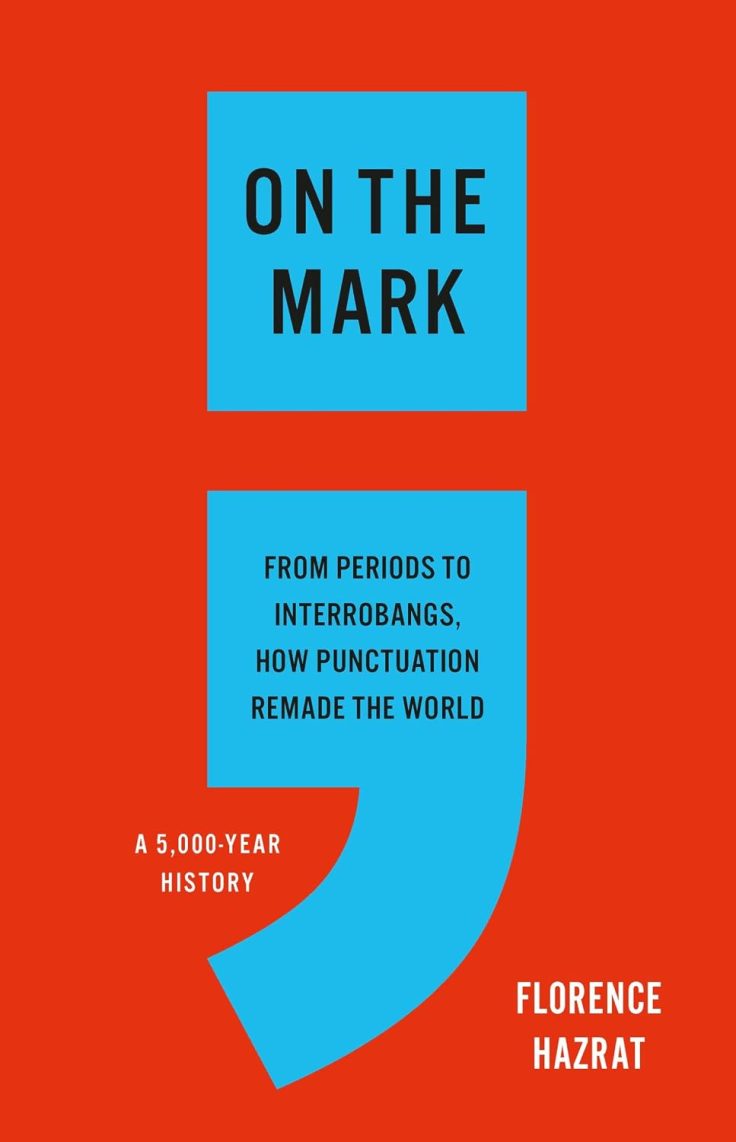
This is recounted in elaborate detail in Florence Hazrat's remarkable On the Mark, From Periods to Interrobangs, How Punctuation Remade the World. (An interrobang is a punctuation mark meant to combine the functions of a question and an exclamation mark.) Ms. Hazrat has written a previous book, A Brief History of the Exclamation Mark! and has contributed to journals both here and in England. She is clearly in love with her subject, no minuscule aspect of it failing to stimulate her.
Punctuation, in Hazrat's words, is "a way of organizing text for better readability." In her introduction, she writes: "Punctuation has been the neglected stepchild of writing, its marks designated as the invisible ushers of the sentence, simply telling words where to sit. Now we'll encounter them as the main characters they really are. Punctuation marks should not hover at the fringes of literary analysis, or indeed of any kind of writing or scrutiny of human communication, but should be placed at the center of it all—because the history of punctuation is the history of humanity."
The pleasure in Hazrat's book, along with our old friend the devil, is in the details. These are abundant throughout On the Mark. So much so that at various points they threaten to overwhelm the book. She recounts the use of punctuation in, among other writers, Shakespeare, Ben Jonson, Walt Whitman, Emily Dickinson, Charlotte Brontë, Mark Twain, e.e. cummings, William Faulkner, the last named having written a single sentence of 1,288 words.
Oddly, she leaves out Gertrude Stein and Ernest Hemingway; the former held that commas and punctuation generally deprived words of their full force, while it is harder to find a semicolon in the latter than to find an honest personal-injury lawyer. H.W. Fowler, that font of good literary sense, felt writing flowed better without punctuation, though he memorably described the colon as a mark "to deliver the goods that have been invoiced in the preceding words."
In On the Mark Hazrat supplies a history of punctuation, which, in its modern sense, begins in the third century B.C. with Aristophanes of Byzantium, whom she calls "the father of punctuation." Slowly over the centuries new punctuation marks were added: spacing between words, periods, upper and lower-case letters, the colon, the dash, the hyphen, quotation marks (including, later, air quotes and scare quotes), the apostrophe, the paragraph, italics, the ampersand, the exclamation mark, the forward slash, the comma. ("Why is a penis like a comma?" Hazrat asks, adding, "Let no one say that punctuation isn't sexy.") In each case, she sets out how the mark came into being and explains why it has endured.
Then there are those attempts at punctuation that have failed to catch on. Perhaps the most interesting is the attempt to establish a punctuation mark that would reveal irony. Irony is of course saying one thing but meaning another. Some need help in understanding when this is the case. Yet to supply such help would be to kill the subtlety implicit in much irony. As Hazrat notes, "in the early chatrooms of the 1990s, users played with a typeface, adding two backward slashes on either side of the words they meant ironically causing the line to tilt backward, a clever take on saying one thing while intending the opposite. Baptized 'ironics,' these never left the chatrooms they were born in."
The two great events in the history of punctuation have been the invention of the printing press in circa 1440 by Johannes Gutenberg and the ever-widening use of the internet in our own. The printing press made possible the book in its modern form, which gave greater prominence to the paragraph, the chapter, and punctuation generally. The internet on the other hand is a threat to punctuation. With its special language—LOL, BTW, and the rest of it—it may even be said to be the enemy of the formal sentence. One tends not to write in paragraphs on the internet. Many lines there go without periods at their conclusion.
There is even a sense, as set out in the pages of On the Mark, in which the internet is not only anti-punctuation but the enemy of language itself. Hazrat writes: "Punctuation, it can't be denied, is under threat today. Some of us are chasing it with the full might of modern technology, obliterating those fussy dots and dashes at every possible turn (courtesy of smart-phones and cost-free texting). Writing (which also means thinking) is being hijacked by machines."
If On the Mark has a flaw, that would be in its author allowing her politics into the subject. Politics and scholarship are always uneasy bedfellows. Some punctuation, to be sure, is inherently political. Whether to use the upper case B in blacks is a current example. Hazrat objects to the hyphen in the phrase "Israel-Palestine conflict," on the grounds that, as she puts it, it "fails to hold apart the colonizer and the colonized." She later accuses the Israelis of establishing the "state of Israel in 1948 based on a racial apartheid system." On the other hand, she mentions that Joseph Goebbels "was positively obsessed with exclamation marks, using them everywhere himself and inserting them into his boss Adolf Hitler's speeches, which is a good reason always to use an exclamation mark with the most scrupulous discretion."
Florence Hazrat holds punctuation in the highest possible esteem. At one point she writes, "An intimate knowledge of punctuation enables one to truly inhabit a language." This is followed by her noting that we "cannot partake of all the nuance of a sentence without punctuation." She calls punctuation "an unfiltered expression of who we are," and ends her book by informing us that we neglect punctuation at our "peril." Does all this seem exaggerated, extravagant, overdramatized? Probably. My problem is that I happen to agree with it.
On the Mark: From Periods to Interrobangs, How Punctuation Remade the World
by Florence Hazrat
Basic Books, 352 pp., $32
Joseph Epstein is the author, most recently, of The Novel, Who Needs It? (Encounter Books).