




Only with a certain trepidation—and, increasingly, weariness—does one venture into the debates over liberalism today. Liberals and post-liberals, dug into their trenches, have spent the better part of 10 years firing at each other, and it is not clear that either side has managed to inflict much damage, intellectually speaking.
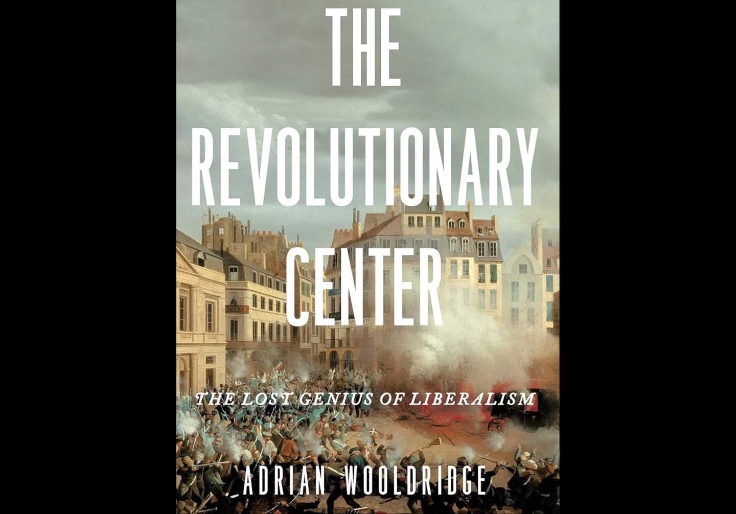
Adrian Wooldridge's The Revolutionary Center is a welcome contribution, inasmuch as his sights are trained mainly on his own side. Wooldridge's book is in three parts. First and foremost, it is a summons to liberals by a liberal to acknowledge the disrepair and disrepute into which liberalism has brought itself through a half-century's worth of philosophical deviation, bad policy, and arrogance. Second, it is a sweeping, literate history of liberalism, from its origins in "proto-liberals" such as Desiderius Erasmus and Thomas Hobbes through to the present day, where it is "torn apart by a war between opposites: between elitists and populists, capitalist-triumphalists and capitalist-catastrophists, woke warriors and crusty traditionalists." And, third, it is a reflection on liberalism's essence, its core convictions and practices. Each part is observant, insightful, and provoking. Each part is also in some degree of tension with the others, in a way that is suggestive of the internal tensions of liberalism itself.
A longtime writer and editor at the Economist, now a columnist at Bloomberg Opinion, and an Oxford-trained doctor of history, Wooldridge is possessed of what was once called common sense: a knack for seeing what is in front of one's nose. For example, he is able to see that liberal drug policy ("the most misguided liberal policy of recent decades") has been little more than a vehicle of mass immiseration, especially in poor and minority neighborhoods. Likewise, liberal immigration policy in Europe and the United States (one of "the most difficult subjects for liberals to discuss") has fomented a populist upheaval that correctly identifies mass immigration's profound economic, social, and political costs. Liberal education "reforms," such as the elimination of magnet schools and accelerated programs in this country, or the British government's cancellation of funding for Latin and music education under Keir Starmer, "crush excellence." (The decline of liberal arts education he calls a "tragedy.") And so on.
Wooldridge is at his best on the subject of elite self-dealing and hypocrisy. "There is an ancien régime feel to the new liberal establishment—a culture of doing whatever is necessary, saying whatever is expedient and scratching whatever back demands scratching to hold onto your rich emoluments." Or, "Liberals flatter themselves on their support for openness in all its dimensions. … Yet it is easy to be pro-openness when you are protected from its downside and enriched by its upside." Or, "The quintessential image of modern liberalism is the billionaire taking a private jet to Davos to deliver a speech on climate change." Wooldridge offers a pithy indictment of liberal elites: On the question of elitism versus democracy, global versus national or local, and optimism versus fear, "today's elites emphasize the first of these pairs." A persuasive 21st century liberalism will require recalibrating toward the second.
All of this is needful and overdue, and one hopes the target audience is listening. As Wooldridge argues, the refreshment of liberalism has always required internal "revision." At particular moments—at the end of the 19th century, for example, when "liberalism was in danger of becoming a fossilized orthodoxy, sealed off from the social problems and intellectual currents that were transforming the world, and ready to be supplanted by more up-to-date and vigorous creeds, nationalism and socialism"—liberalism has had to rediscover and reinvent itself to meet changed historical circumstances. There can be little question that liberalism, in its current presentation, has lost its imaginative hold and requires a return to its deeper resources.
There is, though, a knot at the center of Wooldridge's account, where his philosophy, history, and prescription come together, that bears directly on this task and that is difficult to disentangle. As a political doctrine, he writes, "the core belief of liberalism is that the individual must be cherished: his or her rights must be protected and autonomy preserved." Its "core values" include "freedom of speech … defence of universal rules versus special rules for special categories of people; individualism, competition and meritocracy." Liberalism is "the philosophy of people who question authority rather than accept it," he continues, "who feel, in their bones, that we can do better than this" (italics in original). Yet liberals are also voices of moderation and balance who, caught between "extremists" on both sides, seek to "reconcile the opposites." Liberalism is "an argument not a catechism," it is "a way of living before it is a political philosophy." At their best, liberals are self-skeptical and self-restrained practitioners of a radical moderation, or perhaps a moderate radicalism.
This is an appealing formulation—and it does some justice to a political tradition that has been capacious enough to include both Adam Smith and John Maynard Keynes, Edmund Burke and Woodrow Wilson—except that it is in tension with, for example, Wooldridge's account of the origins of liberalism. To wit: "a band of heroic liberals saved us all from bigotry and backwardness and created the modern world." This grand "rupture" thesis suggests a tradition that is more revolutionary than reconciliatory. But if Wooldridge's story of rupture is true, it becomes harder to protect his liberalism against those corruptions it is suffering today—which, by his own telling, are simply liberalism's internal logic pressed to the breaking point.
Wooldridge's account is that liberalism in the post-World War II era broke free of an inherited internal reserve and pushed its logic to the extremes: the moral extremes of the 1960s counterculture, the economic extremes of neoliberalism, and the technocratic extremes of managerial liberalism. If "the first thing that we need to do before anything else is to rid liberalism of its recent taste for extremism," as Wooldridge advises, then it would help to have a more moderate history of liberal order.
That might require a larger reconsideration of what we mean by liberalism. For example, throughout his book Wooldridge treats mainly the United States and Great Britain, so the liberalism he chronicles is predominantly Anglo-American. But it is not self-evident that the Anglo-American experience should be treated as liberalism tout court. Liberalism grew differently in different soils. In fact, the Anglo-American experience might be the outlier. Wooldridge rightly observes that the United States and Great Britain successfully resisted the totalitarian waves of the 1920s and '30s. He attributes this to their ability to revise liberalism to meet changing demands on political, economic, and social life.
Perhaps more important, though, is that neither the United States nor Great Britain were strictly liberal. Both retained, to a significant degree, elements of their pre- or non-liberal character. (They still do.) As Forrest McDonald argued in Novus Ordo Seclorum: The Intellectual Origins of the Constitution (1985), the political order established by the Constitution was a prudential mixture of different traditions: Enlightenment liberalism, yes, but also classical republicanism, the English common law, and Scottish Common Sense philosophy. The genius of the Framers was not liberalism but the ability to weave liberalism into the intellectual fabric of American constitutionalism.
Put in classical terms, the essential virtue of a healthy, sustainable liberalism—the virtue that Wooldridge needs in order to anchor his account—is prudence. It is prudence that takes the measure of the moment, that decides whether circumstances call for rebellion or conservation, advance or retreat, denunciation or reconciliation. The trick is that the capacity for prudential judgment must be formed, and it cannot be formed out of the resources that liberalism on its own, self-birthed of John Stuart Mill, can provide. The liberalism Wooldridge describes, with however much nuance, does not contain within itself the resources to form the moral perception that can keep liberalism on the straight path. Wooldridge needs the philosophical resources that his history jettisons. If we are to find within liberalism the resources for its renewal, we need a liberalism that is broader, deeper, richer than what is on offer here.
In his 1938 memoir, My Early Beliefs, John Maynard Keynes—one of Wooldridge's liberal heroes—summarized the misguided convictions of his young set that had led to the devastations of the early 20th century:
In short, we repudiated all versions of the doctrine of original sin, of there being insane and irrational springs of wickedness in most men. We were not aware that civilisation was a thin and precarious crust erected by the personality and the will of a very few, and only maintained by rules and conventions skilfully put across and guilefully preserved. We had no respect for traditional wisdom or the restraints of custom. … It did not occur to us to respect the extraordinary accomplishment of our predecessors in the ordering of life (as it now seems to me to have been) or the elaborate framework which they had devised to protect this order. … As cause and consequence of our general state of mind we completely misunderstood human nature, including our own.
Here is, perhaps, the quintessentially liberal conclusion to the present crisis: What liberalism needs today is to be more liberal—and less.
The Revolutionary Center: The Lost Genius of Liberalism
by Adrian Wooldridge
Pegasus Books, 416 pp., $35
Ian Tuttle is a research fellow at the Aspen Institute's Philosophy & Society Initiative.