





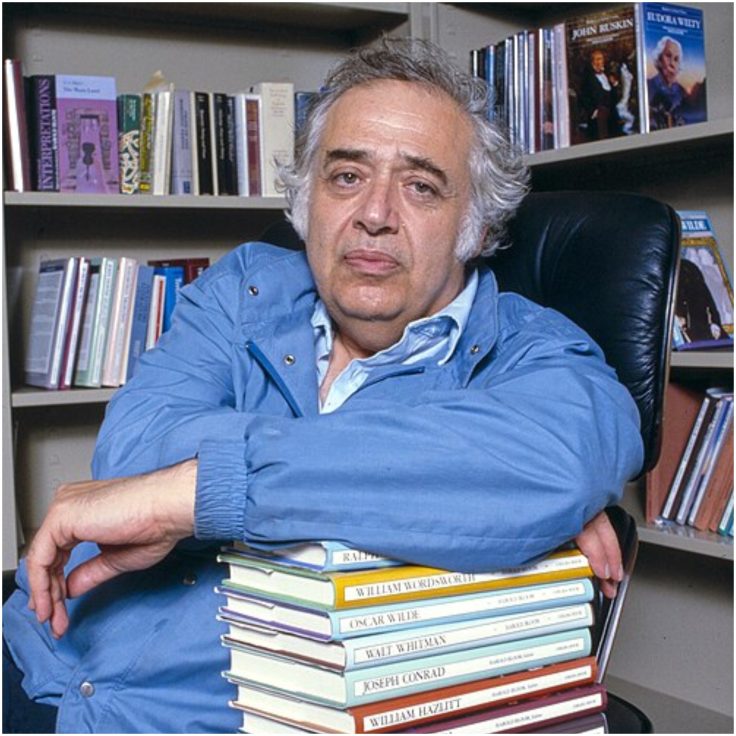
If your ideal critic is someone who is learned, widely read, with the ability to concoct new ideas, and possessed of a powerful memory, Harold Bloom may well be your man. Bloom has written about more writers than perhaps any critic in the modern era. He came up with the idea of anxiety caused by literary influence and put forth the notion that a woman wrote the Bible. He is said to have memorized Wordsworth’s poem "The Prelude," a mere 736 pages in its Penguin edition. Had I lived in New Haven, where Harold Bloom taught at Yale, I should have called him in to recite "The Prelude" as a sure-fire way to end dull parties.
Yes, Harold Bloom may well be your ideal critic, but he isn’t mine. I wrote about him in an essay of 2002 in the Hudson Review under the heavily ironic title "Bloomin’ Genius." (Bloom also wrote a book called Genius: A Mosaic of One Hundred Exemplary Creative Minds.) In that essay I found his ideas unpersuasive; his prose—he claimed never to revise—unrewarding; and that he was more learned than intelligent. Bloom also insisted on his own sensitivity, informing his readers that he teared up whenever he read Bleak House and read Walt Whitman to assuage grief, and was all but emotionally overwhelmed when reading Emily Dickinson.
In her introduction to The Man Who Read Everything: The Literary Letters of Harold Bloom, Heather Cass White notes that Bloom claimed to be able to read 1,000 pages an hour. This would make speed-reading seem closer to remedial reading. (One recalls here Woody Allen’s old joke about speed-reading: "I was able to go through War and Peace in 20 minutes. It’s about Russia."
Now a professor of English at the University of Alabama, White was a student of Harold Bloom’s at Yale and seems never quite to have gotten over her youthful admiration for her old teacher. In her introduction she recounts Bloom’s many publications: "In his sixty years as a working literary critic he published nearly fifty original books, two of them after his death in 2019, several of which made the New York Times best-seller list. He published hundreds of critical collections, each with an introductory essay of his own. He lectured in countries around the world, and taught thousands of students."
Born in 1930 to émigré Jewish parents, Harold Bloom was by his own account—more hyperbole?—precocious beyond reckoning. He claimed to have learned Hebrew by the age of 3 and to have read Moby-Dick before the age of 10. His parents’ original plan was for him to become a rabbi, a Talmudic scholar. By the age of 16, however, he had decided on an academic career, one he would eventually achieve by his appointment to the English Department at Yale. An old anecdote has Cleanth Brooks remark to Robert Penn Warren, "I wonder if we were right to grant Harold Bloom tenure?"
A slender volume of just over 200 pages of ample-sized type generously spaced, The Man Who Read Everything includes the correspondence of Harold Bloom with six contemporary poets, the critic Northrop Frye, and the novelist Ursula K. Le Guin. Professor White writes that "in all cases I have edited the letters to focus on Bloom’s work rather than his personal life. My interest is in Bloom as a reader, so that has been my guide in deciding what to publish." And yet, contrary to this claim the personal note, which is often sounded in these letters, rings more emphatically than the professional or strictly literary one.
We learn, for example, of Bloom’s antipathy to T.S. Eliot, the Eliot who viewed criticism as correction of taste and who felt that the critic needed to be disinterested, impersonal, and objective in his own criticism. As for his own critical writings, Bloom, in a letter to John Hollander, noted: "Lord knows what I am—not a poet, critic, scholar, historian, psychoanalyst, philosopher, or theosophist—but a worthless melange of the gang of it." He added: "Sometimes I get gloomy and believe it is because I’m not smart or learned enough or because I can’t keep any philosophy in my poor head—in a few good moments I feel that way only I will say things I’m going to say and then I feel someone should say them anyway. But often I wonder."
Anxiety, gloom, and doubt infest the letters White has assembled. Bloom won various prizes and awards, among them a MacArthur Fellowship, or so-called genius grant. He was interviewed or written up, as White reports, in "the Atlantic, Esquire, the New York Times, the New Yorker, Vanity Fair" and elsewhere. But none of this seems to have eased his depression. At one point he claims to have wanted to write a modern version of Robert Burton’s The Anatomy of Melancholy, which is surely high on the list of books the world could do nicely without.
The letters to and from Northrop Frye, whose views Bloom admired more than that of any other living literary critic, are marked by Frye’s rejection of the argument in Bloom’s magnum opus, The Anxiety of Influence, a rejection that stung Bloom badly. Frye wrote: "I should think that this was simply something that happens, and might be a source either of anxiety or of release from it, depending on circumstances and temperament." Frye would later write that Bloom "seems to me to be increasingly isolating himself from the general critical tradition, and I find his books progressively less rewarding." C.S. Lewis, in a review of Bloom’s book The Visionary Company, wrote: "This is one of the most difficult books I have ever read. … Sometimes by a small emendation I can hammer out a meaning, but I don’t know for sure whether it is Mr. Bloom’s." T.S. Eliot died in 1965, before Bloom came into prominence, so one can only imagine his response to Bloom’s oeuvre.
A persistent note among these letters is Bloom’s flattery of those to whom he is writing. He tells the poet Alvin Feinman, "a very great poet, which you assuredly are; indeed the only poet writing in English now who really matters." He informs John Ashbery that "you have written poems that redeem life" and that his "own difficult life would wane more quickly if I could not look forward to more Ashbery." He cites A.R. Ammons’s book Briefings as "your great work to date, and one of the supreme books in our poetry—a book beyond my praise but not beyond my love." He tells the young Henri Cole, "You are now a great poet, Henri. There is no question about it." As for the poetry of Ursula K. Le Guin, he reports to her that the work of other poets do not "interest me as much as your poetry does. I need to read and reread as much of it as I can get hold of. I still hope that you will give us one more novel appropriate to our deep need at this bad time."
Alongside this altogether too lavish praise, the letters record Bloom’s depression, his inability to break free for long of the slough of despond. The very last letter in the book refers to his exhaustion after teaching. Harold Bloom died in 2019, at the age of 89. Had he lived on, one suspects he would have never allowed publication of the fawning and dolorous collection of his letters that is The Man Who Read Everything.
The Man Who Read Everything: The Literary Letters of Harold Bloom
by Harold Bloom, edited by Heather Cass White
Yale University Press, 248 pp., $30
Joseph Epstein is the author, most recently, of The Novel, Who Needs It? (Encounter Books).