


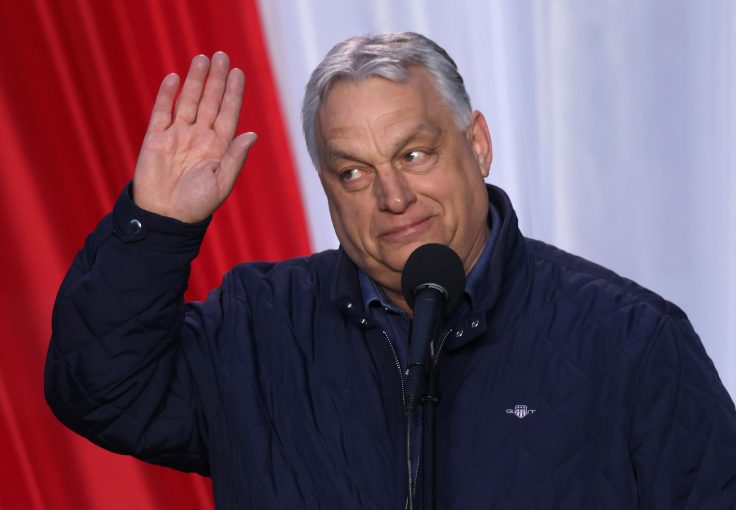
Results of Central European parliamentary elections rarely make much news in the United States, but Viktor Orbán's defeat certainly did. The Hungarian prime minister conceded Sunday after ruling for 16 years, and many wonder if the result predicts the downfall of Donald Trump's populism the same way that the 2016 Brexit vote foretold his shocking victory that year.
The attention Orbán drew is remarkable, particularly since his country has fewer people than New Jersey and accounts for about 1 percent of the European Union's economy. He gained the admiration of some Americans on the right because he opposed some of the great failures they see in Europe. But he contributed to other problems that more directly affect U.S. interests and failed to address his own country's core problems. Orbánism, it turns out, is a dead end for Hungary and for the United States.
Two different concerns animate American conservatives when they look across the Atlantic: The first is that, despite their wealth, Europeans do not provide enough security for their own people, to say nothing of the rest of the world. The other is that Europe has abandoned the heritage that made its culture so vibrant and is sinking under a weight of supernational bureaucracy, mass immigration, and politically correct gobbledygook. So Europe cannot protect itself from external threats, such as the Russian Army, or from internal erosion and decay.
Orbán became a hero for parts of the right because his unapologetic nationalism and self-described illiberal democracy seemed to provide an antidote to the cultural malaise. He talks openly about Christianity and made his country one of the increasingly rare safe havens in Europe for Jews. Like nearly every industrialized country, Hungary's birth rate has plummeted, so he spent over 5 percent of GDP on subsidies for parents and children.
He also delighted in skewering the global elite's pieties. When German chancellor Angela Merkel announced in 2015 that her country would take one million refugees, setting off a stampede across Central and Eastern Europe, Orbán built border fences and traveled to Bavaria to denounce her "moral imperialism." He then drove out George Soros's Central European University. Small wonder that some types of cultural conservatives have flocked to Budapest.
But Americans who focus on national security see Budapest as one of the most pernicious foot-draggers on European defense. Orbán has cozied up to Russia throughout his tenure, most recently signing a new trade and energy agreement in December. Unlike virtually every other European country, Hungary has increased its dependence on Russian oil since the February 2022 invasion of Ukraine and repeatedly slowed or vetoed sanctions on Russia. It currently blocks a $100 billion EU loan for Ukraine.
Orbán is also close to China and Iran. Shortly after expelling Soros's university, he tried to approve a campus for China's Fudan University. Xi Jinping has richly rewarded Orbán for being his lawyer in Brussels: He established an "All-Weather Comprehensive Strategic Partnership" during a visit to Budapest in 2024, and Hungary was the top European destination for Chinese investment that year. Budapest signed a trade deal with Iran a few months after October 7 and promised to help Iran investigate after Israel detonated thousands of Hezbollah's pagers.
Hungarian nationalists do not understand their problems or how to solve them. Before World War I, they co-ruled a massive, multiethnic empire with Austria and never recovered from the consequences of that defeat. They now complain bitterly about their lost territory and the Hungarian communities there—one of Ukraine's top drone commanders is ethnically Hungarian—blame the United States for somehow holding them back, and fantasize about getting even. This is one of the key sources of Europe's malaise rather than a solution for it.
For all of Orbán's posing and strutting, he ultimately had to adapt to the needs of other, more powerful countries. His most effective economic policy was for Hungary to make subcomponents for the German auto industry. He blocked EU votes that require unanimous consent to wring carveouts and subsidies from other Europeans, but he never seriously challenged European integration because he could not afford to. And because of his dependence on the German economy, he could only push Brussels as far as Berlin allowed him.
And his cultural nationalism failed. Hungary has grown less religious during his tenure and is behind every American state. His pro-natalist policies never got the birth rate back to replacement levels, and it is dropping again. Between the poor economic outlook and the corruption—the wealthiest man there is Orbán's childhood friend—it's no wonder that ambitious young Hungarians are leaving. The country's population is shrinking.
Hungary's story under Orbán is one of managed decline. It did not solve either of Europe's biggest problems. A United States that looks like Hungary will fail, too.