





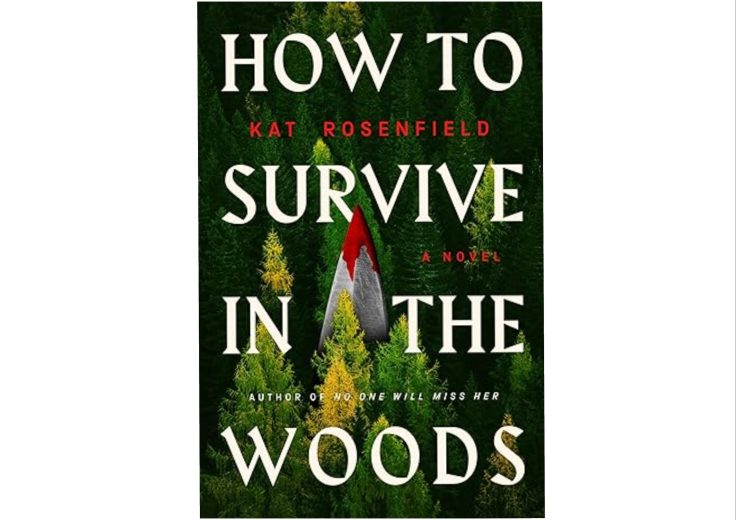
I’ve never been to Maine, and all of the hikes I’ve ever taken can be tallied on one hand. Yet, somehow, in reading How to Survive in the Woods, Kat Rosenfield’s latest thriller, I find myself transported to a dense stretch of forest somewhere along the Appalachian Trail. Not the postcard version, the one with signposts and day-hikers and lunchboxes, but something far more oppressive: a landscape that feels closed in on itself, watchful, sentient. In Rosenfield’s hands, the wilderness does not just house the action, but it participates in it, conspiring with whatever darkness her characters carry within them.
The same might be said of those characters, who are, frankly, awful people. At the center is Emma, a meek startup founder now bound in a marriage to Logan, a man whose cringy charisma barely masks what lies underneath: control, anger, violence. When Taylor—Logan’s former lover and business partner—reappears into their lives, she offers Emma something that looks, at first glance, like escape. Though it soon becomes clear it is an illusion. What follows is a kind of intimate entanglement: two sordid affairs, one woman, and a decision to venture together into Maine’s Hundred-Mile Wilderness. It is the sort of premise that might, in lesser hands, resolve into melodrama. Rosenfield, however, is a pro, and just when you think you know what’s coming next, alliances shift, loyalties evaporate, and whatever moral footing you were hoping to secure proves, almost immediately, unreliable. These are not characters you root for, and yet, against all better instincts, their fates acquire a certain urgency. The pages flip quickly not out of affection, but out of morbid curiosity: How far will they go? And who—if anyone—will make it out alive?
At its core, the novel is a story about survival, and Emma, at least, has been groomed for it. Her father, a man of the doomsday-prepper persuasion, throughout her life subjected her to a series of harsh lessons—among them an episode in which she was abandoned in the wilderness, injured and alone, and had to find her own way back. It is a background that makes her peculiarly well-suited to the physical demands of the Hundred-Mile Wilderness, with its isolation and danger. But Rosenfield’s interests lie elsewhere. The more compelling question is not whether Emma can survive the forest, but what, precisely, she has already survived—and at what cost. The novel’s true landscape is relational: the muddy ground of dependency, control, and the fictions people construct in order to endure one another. Emma’s marriage to Logan resembles less a partnership than a negotiated captivity, while Taylor’s return reveals the extent to which all three have been performing to each other, and to themselves.
It’s here that Rosenfield’s talent is most apparent. The atmosphere she constructs between these wholly unlikeable and irredeemable characters is charged and complex. Desire is inseparable from power, and tenderness, when it appears, is fleeting and strategic. Emma initially presents as the novel’s most likable and legible figure—a woman undone, newly tethered to the man who appeared, almost miraculously, at her lowest point. But what appears accidental rarely is. Logan, for all his studied ease, is a man who operates by design, and his presence in Emma’s life, we learn, was intentional. More like an acquisition than an intervention.
The dynamic among the three resists any stability. It’s not a triangle—rather, it resembles a rotating hierarchy, with power shifting from one to another when different alliances shift. Logan’s authority rests on a brittle foundation; for all his insistence on control, there is something parasitic in his dependence on the women around him, a suggestion that he is less an architect of his dream life than a plain-old opportunist. Emma, meanwhile, undergoes the novel’s most disturbing evolution, slipping from an object of pity into something far less containable—someone whose capacity for self-preservation begins to eclipse any claim to innocence. Even Taylor, initially introduced with the dismissible gloss of an influencer, acquires a sharper outline as the novel progresses. Rosenfield knows that tension does not live in what is concealed, but in what is partially revealed: the glance that lingers a moment too long, the remark that carries a second meaning, the sense that each character is engaged in a careful, ongoing performance.
Rosenfield’s prose reflects this sensibility with considerable finesse. Her style is conversational, even offhand, laced with a dry wit that has the effect of disarming the reader just enough to make what follows more unsettling. One is inclined, at first, to trust the voice, to relax into its ease, only to find that the ground has shifted. The novel’s darker moments do not arrive with spectacle. Instead they insinuate themselves, creeping in at the edges of scenes that might otherwise feel almost domestic. Structurally, too, Rosenfield is manipulative. Just as tension threatens to resolve, the narrative slips backward, interrupting the present with flashbacks that defer gratification and sharpen anticipation. When we’re dragged into the past, the story tightens rather than accelerates. The seemingly impenetrable characters open up, and we’re drawn inward through delay, deflection, and the slow disintegration of trust.
By the novel’s end, survival feels like the wrong word. What Rosenfield is really exploring is adaptation—the process by which people reshape themselves to fit their circumstances. No one comes through intact. To live, Rosenfield suggests, is to adjust—morally, instinctively—until the person who emerges bears only a passing resemblance to the one who entered the forest.
How to Survive in the Woods: A Novel
by Kat Rosenfield
Harper, 320 pp., $30
Kara Kennedy is a freelance writer based in Washington, D.C.