





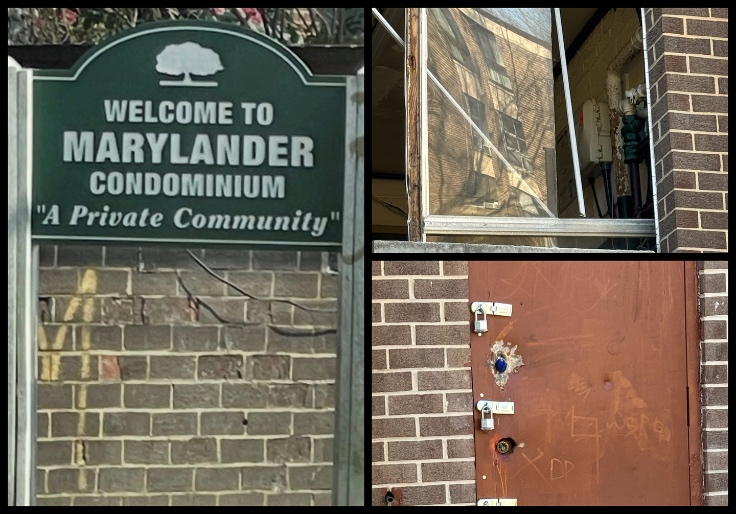
At a town hall meeting on February 28, Devan Martin, the deputy chief of staff for Prince George's County executive Aisha Braveboy, told residents of the Marylander condominiums—which for years has been besieged by squalid homeless encampment next door—that they would be evicted on Friday, March 6.
Martin also sought to dispel some "misinformation" about their predicament: The homeless encampment, which has drawn drug deals to the area and whose inhabitants allegedly broke the building's heat, had nothing to do with it, he said.
"There are some that are advancing a narrative that unhoused or homeless individuals are creating crime," Martin told the condominium's embattled residents. "We're not going to point our fingers all the way [at] individuals who are already marginalized … to say that they are responsible for something that they are not responsible for."
Over the past 60 days, Martin explained, police arrested 33 people around the Marylander, only 2 of whom were homeless. The other 31 were "residents or visitors" who were "not related to the … homeless situation."
"The statistics do not lie," he said.
But when Martin visited the Marylander two hours later, he was forced to wait outside as police searched for a homeless man in one of the buildings. And when the officers finally found him, he wasn't arrested. Instead, this reporter watched as police released him, uncuffed, in full view of a sign that said trespassers would be "prosecuted to the full extent of the law."
The statistics, it seemed, had lied after all. As one resident explained to Martin, the homeless don't show up in the arrest data because the police don't arrest the homeless.
"He will come back," the resident said of the trespasser. "They aren't doing anything."
Martin—a former police chief who was suspended in 2022 for his alleged mishandling of excessive force complaints—did not respond to a request for comment.
The incident provides a snapshot of how Prince George's County, an overwhelmingly Democratic stronghold in the suburbs of Washington, D.C., has sought to deflect blame for a crisis it helped create.
The county made no attempt to clear the encampment until its residents allegedly vandalized the condo's boiler room, leaving 100 units without heat and under evacuation orders from a judge. Condo-owners say police refuse to arrest vagrants who defecate in their halls, while property managers blame local officials for ignoring repeated requests for help.
That inaction could now cost the county up to $100 million: On Thursday, the condominium sued county officials for presiding over what it described as a "state-created danger" sustained by "deliberate indifference," arguing that the encampment was a direct result of government policy that "caused foreseeable vandalism, crime, and damage to Condominium Property."
The complaint, filed in federal court, argues that the county "destroyed a residential community" and deprived condo-owners of their constitutional rights. It relies heavily on the county's policy—outlined in a previously unreported document—of delivering food to homeless encampments.
"Regular visits to known encampments to drop off food, warm blankets and other necessities create opportunities to build trust and ensure the relative health and safety of this population," the county's 2021-2025 housing plan states.
Those deliveries continued even as police chastised the condo's legal residents for feeding the camp, arguing that such behavior would only "incentivize the unhoused population to return."
"The County's deliveries sustained the encampment … adjacent to the Condominium Property, and the County was the moving force behind all the risks and harms suffered by the Condominium," the lawsuit says. "The County was aware of the dangers and harms faced by the Condominium … and it played a central role in creating them."
The lawsuit also describes how police refused to arrest trespassers like the one Martin encountered during his visit. And it notes that the condo has no money for repairs after an onslaught of citations spooked private lenders, leaving the Marylander with just $600,000 to address as much as $17 million in property damage.
The Marylander is also prohibited from applying for public aid without county approval. Officials said in February that they would not sponsor a federal loan application until the code violations were cleared up, and the county refused to back a loan from a private bank that said it would only lend on the condition of a county guarantee.
The lack of credit has the condominium in a bind. Officials say the complex would have fewer break-ins if it improved security. But securing the complex costs money that the condo, already $3 million in utility debt, doesn't have, thanks in part to alleged embezzlement by the previous property managers.
Meanwhile, vagrants have become adept at bypassing what little security exists. As Martin toured the Marylander, one resident pointed out a door that had been secured with three separate locks. A determined trespasser had gained access by smashing a nearby window.
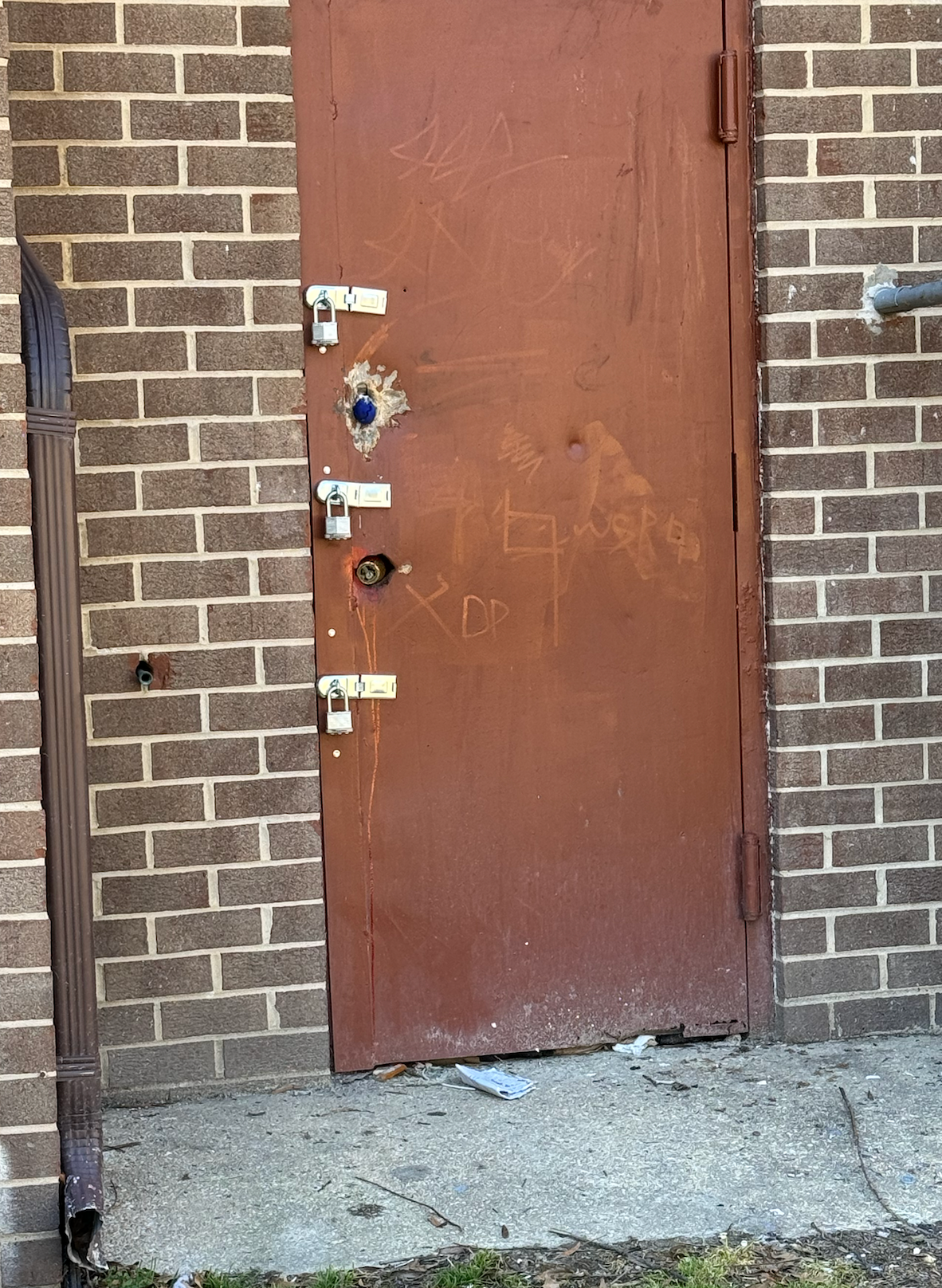
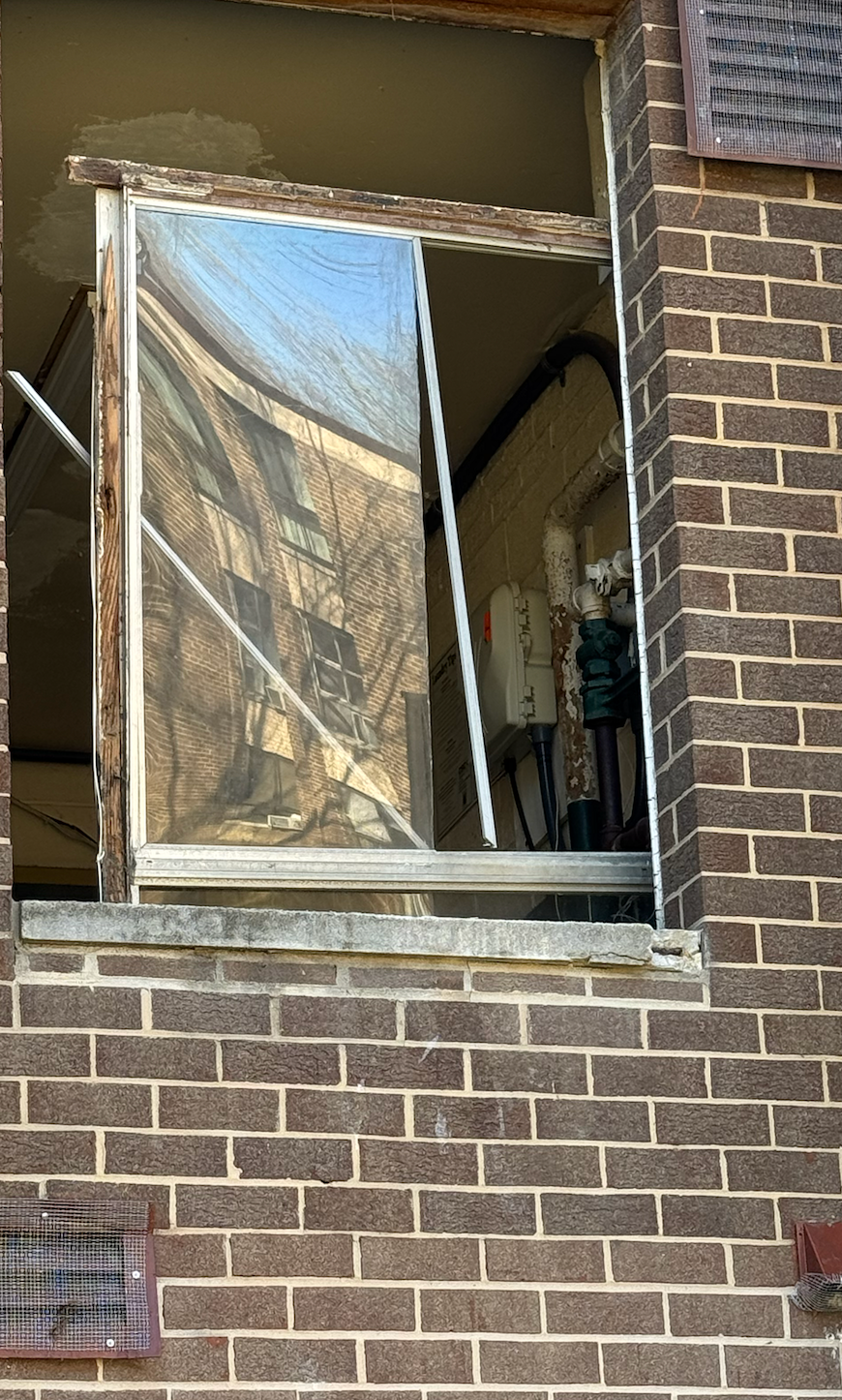
"They broke all the glass and they went inside," the resident explained. At a previous town hall on January 22, Martin had attacked the condo's property management firm, Quasar Real Estate, for not repairing the locks.
"Every time we lock one door up, they cause damage elsewhere," Quasar CEO Ken Brown said.
The problem has been exacerbated by what rank-and-file police officers describe as a kind of catch-and-release policy, in which arrests rarely lead to more than a few hours in jail.
"We are locking the same people up for, like, transporting guns, but they're only at [the Department of Corrections] for two hours, and then they let them go," one officer told Brown in a January phone call, audio of which was obtained by the Washington Free Beacon. "We're doing as much as we can."
Another officer told the Free Beacon that he had arrested a woman in the encampment two months ago but that she returned shortly thereafter.
"She's been arrested many, many, many times," the officer said. "It's a never-ending problem. We take them back to the Department of Corrections, they come out."
The refusal to keep trespassers locked-up—coupled with the efforts to evict legal residents—has stirred suspicions that ulterior motives are at play, though there is no hard evidence that is the case. Scott Barber, whose family has lived in the Marylander for more than 40 years, said the county's real goal may be to drive the condo into bankruptcy and sell it to one of the many developers circling the Purple Line, a new light-rail project that will pass through the condominium's neighborhood when it is completed next year.
"I guarantee the county is trying to demolish this complex like they did the Lynnhill condominiums to make room for much more profitable housing," Barber said, referring to a separate condominium complex that declared bankruptcy in 2017 after fire officials deemed it unsafe.
Like the Marylander, Lynnhill suffered frequent break-ins and was located near a metro line in Prince George's County. It sold for $17 million—the same amount of money the Marylander needs for repairs.
Brown, Quasar's CEO, said the Marylander could be next if residents are evicted on Friday.
"The county will be able to buy the condo for very little money and then sell it for much more," Brown told the Free Beacon. "They will effectively steal the property from a low-income community and give it to a rich developer."
The county itself told the Marylander on Wednesday that it intends to put the property into receivership, an arrangement that can end in bankruptcy or buyouts. The lawsuit, which requests an emergency halt to the evictions, implies that the measure would be a cynical step toward gentrification.
"The County's actions have been the moving force that has decimated a deteriorating community and has expanded economic opportunities not for persons of low and moderate income, but for drug dealers, pimps, and developers," the lawsuit reads. "Whatever remains … will be fed to developers, who will grind what survives down to the pittance they might be paid to leave."
The lawsuit appears to have put a temporary halt to the evictions, which did not take place as planned on Friday, though officials have not ruled out the possibility of forced removal. The county executive's office did not immediately respond to a request for comment.
The county executive's office did not immediately respond to a request for comment.
EDITOR'S NOTE March 9, 3:28 p.m.: This report has been updated to reflect the fact that evictions did not take place on March 6 as initially expected.