




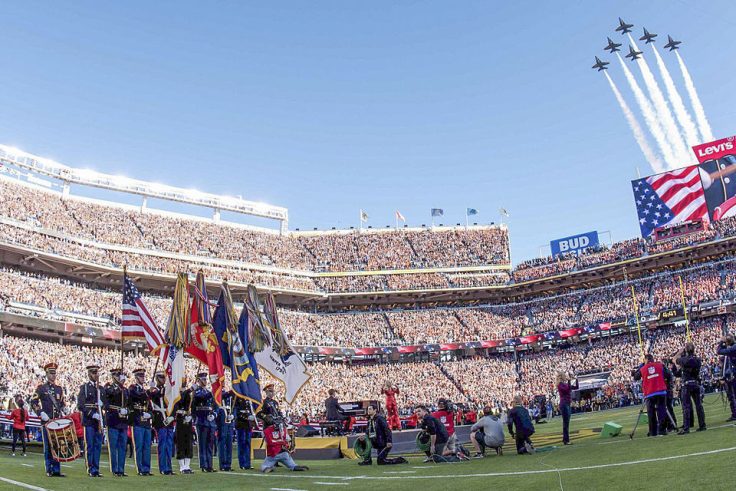
Three weeks ago, my beloved San Francisco 49ers were unceremoniously dispatched from the NFL playoffs by the Seattle Seahawks, who are vying for their second Super Bowl championship today. The result didn’t surprise many; the Niners were hobbled by injuries to many of their best players and, frankly, enjoyed more than a bit of luck in getting as far as they did this past season. But every year, the Grim Reaper comes for all but one team, and my guys could not evade his grip.
More alarmingly, in his new book, the writer Chuck Klosterman predicts the Reaper will soon come for all of football, despite its wild popularity. "Football is doomed," writes Klosterman, a self-described huge fan of the sport, and, in the future, people "are going to misunderstand why it once mattered as much as it did." So as you mash your guacamole, ice your beers, and broil your wings in preparation for the big event, be forewarned: America’s favorite game is in trouble.
"Football is so ingrained in American society that it’s hard to visualize an America without it," Klosterman begins. After all, of the 100 most-watched telecasts in the United States in 2023, no fewer than 93 were NFL games—and three more were college football broadcasts. More Americans watch the Super Bowl than election results. And today’s game will be aired in nearly 200 countries.
Broadcasts play a critical role in Klosterman’s analysis. "What makes football distinctly compelling," he contends, "is that it’s a purely mediated experience, even when there is no media involved." Consider the narrow perspective provided by the typical telecast: The camera focuses tightly on only a small portion of the field despite action taking place across its length and breadth. Yet the line-of-scrimmage view is what fans typically prefer, and Klosterman isn’t wrong to claim that television offers an even better vantage point than attending the game itself.
Football’s popularity also derives from its unique structure, where something like only 11 minutes of action are distributed across a 3-hour-long experience, punctuated by time-outs, commercials, halftime, instant-replay-reviews, and endless huddles. More gameplay would overwhelm our synapses, while less would bore us incurably. "The fact that the game incessantly starts and stops," Klosterman posits, "provides incremental rushes of dopamine, augmented by fleeting bursts of introspection."
The author also assesses the all-time greatest players, ranking the best in each era and ultimately deciding that Jim Thorpe, the iconic early 20th-century running back, is the true GOAT. Surveying the likes of Jim Brown, Joe Montana, Tom Brady, Randy Moss, and others, he employs the (admittedly wordy) yardstick of "measuring the gap between the best player from an era against everyone else who was playing at the same time, with an emphasis on their physical abilities (relative to their peers) and their skill set (relative to how much those skills were dependent on the opportunity to develop them)." Ultimately, he proclaims that Thorpe’s dominance of his era will never be replicated, just as no president will ever surpass Washington or Lincoln and no artist will ever outpaint da Vinci.
Along the way, Klosterman tosses in a chapter devoted to his own beloved Dallas Cowboys and Roger Staubach, their legendary 1970s quarterback. He also touches on how gambling has affected the game ("you can’t understand football if you’re not betting on it"), although he mostly punts on the topic. He tackles the elephant in the room, daring to engage on race and football and urging the Hall of Fame to admit Colin Kaepernick, the 49ers quarterback who famously knelt during the national anthem to protest police misconduct. He even runs with a hilarious analysis of the Canadian Football League, notorious for its three downs, 110-yard field, and points off punts.
But the crux of the matter remains the game’s future, or lack thereof. Klosterman surveys the data on CTE, a degenerative brain disease linked to the micro-concussions football players suffer, and discerns therein the roots of the game’s undoing. "Should strangers be allowed to do very dangerous, very popular things?" he wonders. And while he answers the question in the affirmative, he’s uncertain suburban moms in the future will feel the same when it comes to their own kids. Coupling the withering of Pop Warner and high school football with the rapid deterioration of the college game—the proliferation of name, image, and likeness contracts; the destruction of traditional conferences; a transfer portal undermining team integrity—Klosterman foresees a sport whose future talent pool will soon be circling the drain, sinking the game’s culture along with it. "It will become obvious," he predicts, "that football’s century of supremacy, originally built off the game’s ability to reflect and simulate society, had sustained itself through illusory means."
Much like the game itself, Football isn’t for everyone. Klosterman’s discursive style is extremely idiosyncratic, which makes for lively but occasionally frustrating reading. But his fresh perspectives on the game and its future, delivered with his characteristic wit and verve, provide thoughtful grist alongside your bratwursts and nachos on this glorious day. As Klosterman asserts, "This is an expository obituary, published before the subject has died, delivered by someone who wants to explain why the victim mattered so much to so many." Here’s hoping he’s wrong: As you watch the Seahawks battle the New England Patriots, keep in mind what you love about the game—and how it can be preserved.
Football
by Chuck Klosterman
Penguin Press, 294 pp., $32
Michael M. Rosen is an attorney and writer in Israel, a nonresident senior fellow at the American Enterprise Institute, and the author of Like Silicon From Clay: What Ancient Jewish Wisdom Can Teach Us About AI