


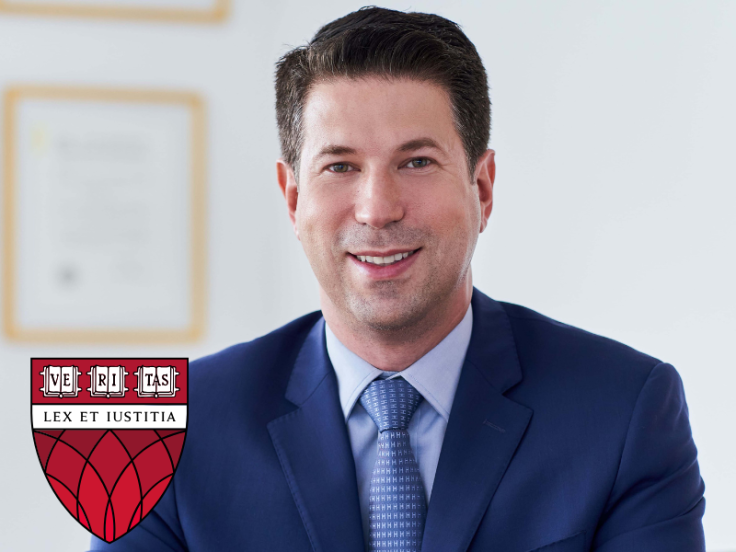
Harvard Law School visiting professor Carlos Portugal Gouvea—who told authorities he fired a pellet rifle outside a synagogue on the eve of Yom Kippur "to hunt rats"—agreed to self-deport after ICE arrested him Wednesday.
Gouvea—who founded a Brazilian think tank that "led the largest anti-violence campaign in the country, resulting in the enactment of the federal Gun Control Act of 2003," according to Harvard—was first arrested on Oct. 2 by the Brookline Police Department immediately following the shooting. Harvard placed Gouvea on administrative leave days later, and on Nov. 13 he pleaded guilty to illegally using the air rifle.
The incident prompted the State Department to revoke his temporary non-immigrant visa on Oct. 16, leading to the ICE arrest. He volunteered to leave the United States rather than risk deportation, ending his stretch of serving at elite American institutions like Yale Law School and the University of Pennsylvania's Wharton School.
"There is no room in the United States for brazen, violent acts of anti-Semitism like this," DHS assistant secretary for public affairs Tricia McLaughlin said in a statement Thursday. "We are under zero obligation to admit foreigners who commit these inexplicably reprehensible acts or to let them stay here."
Gouvea—who came to Harvard from the Law School of the University of São Paulo, where he leads the Diversity and Inclusion Committee—fired his pellet gun on the eve of the holiest holiday of the Jewish year outside of Temple Beth Zion in Brookline, Mass., a short drive from Harvard's Cambridge campus. More than a dozen police officers descended upon the area and arrested Gouvea, but only after he escaped to his home near the synagogue following a "brief physical struggle."
Gouvea was handcuffed on the sidewalk outside of his home and told police he was "using the pellet rifle to hunt rats in the area." Law enforcement officials later found a car with a window shattered from a pellet nearby. They determined that Gouvea was not targeting the temple.
Brookline Police Department spokesman Paul Campbell told the Washington Free Beacon that investigators "did not find evidence that this was a bias-based crime."
Gouvea has been at the forefront of political efforts to ensure that Brazil remains home to strict gun control laws.
He is a founding member of Instituto Sou da Paz, a George Soros-funded Brazilian think tank that played a leading role in pushing the nation’s 2003 gun control act, one of the most restrictive in history. It required Brazilians to register their firearms in a national database and made it illegal to carry weapons outside of their homes.
Although pellet guns like the one Gouvea used aren’t considered firearms under Brazilian law, civilians are nonetheless barred from carrying them in public.
Gouvea also serves as CEO of the Global Law Institute, another Brazilian think tank that focuses on "environmental and social justice in Brazil." Its work particularly focuses on "high impact research on indigenous communities," according to Harvard Law.
Several webpages tied to Gouvea have been removed since his arrest. His Harvard Law biography indicates that he founded PGLaw, which works on anti-corruption and diversity compliance projects, but his bio page on the website has been deleted. His Harvard bibliography, which had displayed several of his reports on racial diversity, has also been scrubbed from the university website.
Much of Gouvea's academic career has been dedicated to advancing left-wing policy goals. He argued in a 2009 paper that democratic political systems are legitimate only if they help the "construction of economic equality." His 2013 study, titled "Social rights against the poor," called for the redistribution of goods in Brazil to reduce economic inequality.
Before his suspension, Gouvea was teaching two fall courses: one called "Sustainable Capitalism," and another on "corruption and inequality." When he started at the Ivy League university in 2022, he taught a corporate ethics class centered on "the social efforts to increase racial and gender diversity in companies, and the progress and backlash in the fight against corruption."
A Harvard spokesman did not provide a comment by press time, and Gouvea did not respond to a request for comment.