





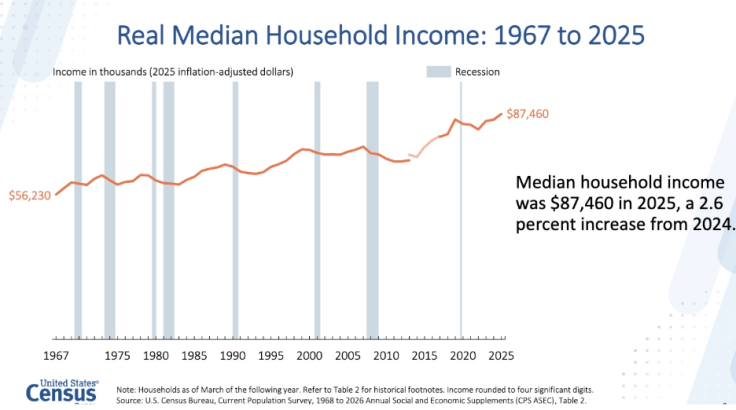
American households are earning more in real terms than they have in more than half a century, according to newly released census data that should help Republicans make the case in the midterm elections that they’ve delivered results on the economy.
"Real median household income was $87,460 in 2025, the highest on record dating back to 1967," the Census reported. "The official poverty rate for children fell to a historic low of 13.4% in 2025." Income inequality did not increase from 2024 to 2025, and the number of people who went without health insurance for all of 2025 was basically unchanged from the year before.
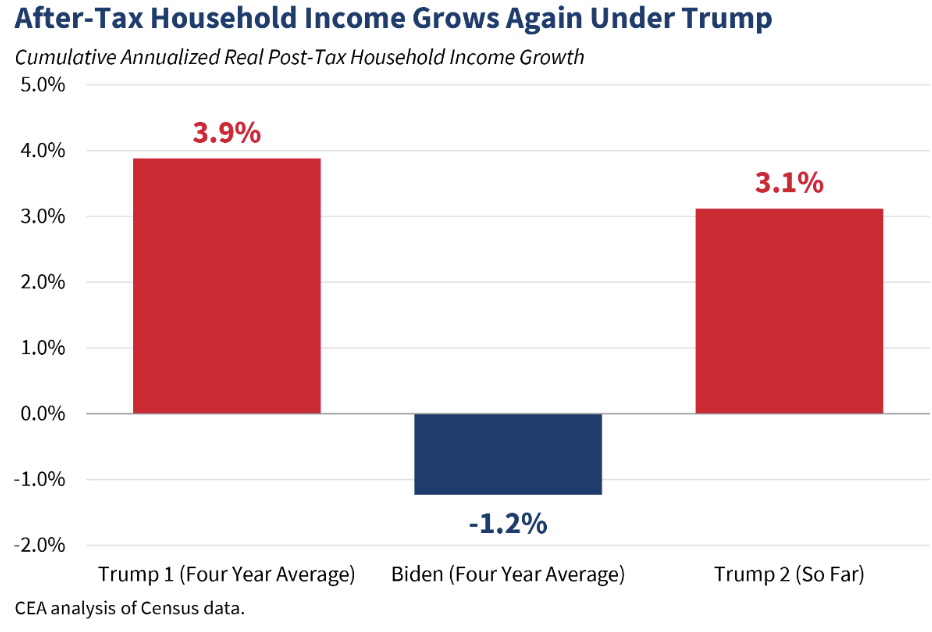
The White House hailed the news. Trump administration social media accounts released graphics with a Council of Economic Advisers analysis parsing the data with red bars showing growth during the Trump administration and blue bars showing reductions during the Biden administration.
"Real household income reached its highest level in history ($87,460) in 2025, surpassing the previous record set in President Trump's first term," is how the White House framed it. "The poverty rate in the U.S. fell to its lowest level in history, falling back to the lowest level of the first Trump administration, also in 2019."
The White House also highlighted a finding that three quarters of a million non-citizens had left government-funded health insurance.
"Under President Trump, the private sector has created over 1 million jobs. Real wages are outpacing inflation. The bottom 25 percent of wage earners are seeing larger wage increases than those at the top. And the Working Families Tax Cuts has delivered the largest share of tax relief directly to millions of low- and middle-income Americans," the Treasury Secretary, Scott Bessent, said in testimony prepared for delivery to the House Committee on Financial Services.
"U.S. manufacturing is roaring back to its fastest pace in years. August marked eight consecutive months of domestic manufacturing growth. Business activity has surged to a 52-month high," Bessent said. "And as companies allocate trillions to building and expanding across the U.S., the Atlanta Fed now projects Q3 GDP growth to surpass 4 percent. A new industrial supercycle is moving from investment into production, and from blueprints into paychecks."
The New York Fed staff Nowcast, a realtime estimate of U.S. economic growth that has been a more accurate predictor of the quarterly GDP numbers, is at 2.26 percent as a GDP forecast. The new Fed chairman, Kevin Warsh, has downplayed GDP in favor of an alternative indicator, private domestic final purchases, or PDFP, which was up 4.2 percent in the second quarter.
Even the chair of the Council of Economic Advisers during the Obama administration, Jared Bernstein, vouched for the veracity of the statistics. "I personally know some of the folks doing this work and they’re of the highest integrity. I’m highly confident they’d blow whistles if the Trump admin was trying to cook the data," Bernstein wrote.
"Median income grew pretty strongly, up 2.6% overall and a strong 4.8% for Black households," Bernstein wrote. He called the reduction in poverty by the official poverty measure "good news," though he said next year’s numbers may show worse results for poverty measures that include post-tax, post-transfer income as Republican policies kick in.
It’s unclear how much attention the numbers will get from the public or the press, but you can bet that if they showed declining real income, rising poverty, rising uninsured rates, or rising income inequality, you’d hear all about them, and endlessly.
The Washington Post headlined the news, "U.S. poverty rate drops slightly, but experts fear worse ahead." Talk about negativity bias. The Wall Street Journal played it more straight with "American Incomes Hit Record Last Year as Women Gained Ground." It’s a reminder to always read more than just one newspaper, because comparing coverage of the same story helps show the spin.
Tuesday afternoon, a New York Times headline over the news was "Poverty Rate Was Stable Before Trump’s Safety Net Cuts Gained Force." That was lower on the homepage than an article about a Times/Siena Poll, which claimed, "opposition to Mr. Trump is intensifying. The survey was the first Times/Siena poll in his second term to find a majority of voters, 52 percent, saying that they ‘strongly’ disapproved of him."
The latest round of the military conflict with Iran that has contributed to higher gasoline prices began in 2026, so it is captured by the Times poll but not by the Census data release. Even so, though, at a certain point you want to commission a poll of the strongly disapproving people and inquire about what, precisely, they disapprove of about Trump. Is it they don’t like how he made their retirement savings go up? He obliterated too much of the Iranian nuclear program? He obtained the release of too many of the kidnapped Israeli hostages? He was too successful at ending the flow of illegal immigration? He was too effective at combating the Ivy League antisemitism so that there are no more Gaza encampments on campus? He cut the taxes on tips and overtime too much? He was too accessible to questions from the press? He looks like he's having too much fun? He made their income go up too much? I guess you could say the economic developments are not attributable to Trump or congressional Republicans but to other factors such as the business cycle or the Federal Reserve or technology trends, but, again, if the trends were in the opposite direction, you can be sure that Trump would be getting blamed.
As it is, he’s getting blamed. The Times poll article included a quote from "Meghan Demetrios, a 40-year-old independent voter in South Carolina," who said, "I actually feel really gaslit because I’m constantly hearing from Republicans, from conservatives just in the media in general, that ‘don’t believe your lying eyes, everything’s great, wages have increased,’ all of these different things." Who is doing the gaslighting now exactly, the U.S. Census Bureau? A median is just a median, and just because the median income rose doesn’t mean that everyone’s did. But the numbers are the numbers. And if you don’t like the numbers, there’s always, "Experts fear worse ahead." As James Taranto used to say, what would we do without experts?