




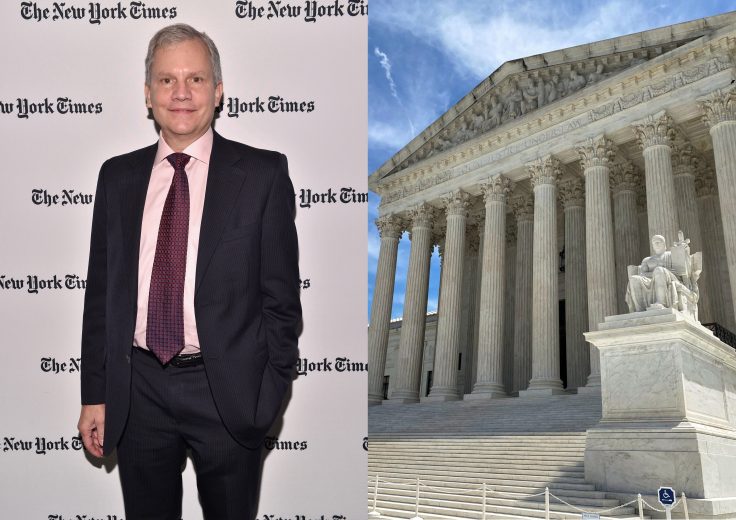
A highly hyped New York Times investigation—touted with the unusual label "Times Exclusive"—appeared this month under the headline "How the Supreme Court Locks Away Its Own History." It complained that "many of the justices have valued confidentiality over transparency and chosen to postpone scrutiny of their work for years to come."
"Some scholars question why papers should be sealed long after a justice has retired," says the Times article, by Jodi Kantor, with research and reporting contributed by Julie Tate, Ann Marimow, and Adam Liptak. It quoted a legal historian at the University of California, Davis, Mary Ziegler, accusing the justices of engaging in "reputation management," and, as Ziegler was paraphrased in the article, "protecting themselves from examination and second-guessing."
Not disclosed in the Times article: that the papers of former Times publishers Arthur Ochs Sulzberger and Arthur Ochs Sulzberger Jr., donated to the New York Public Library in 2007, are closed to public access until 2035 and 2057, respectively, according to the finding aid to the collection.

Arthur Ochs Sulzberger stepped down as publisher of the Times in 1992 and as CEO of the company in 1997. Arthur Ochs Sulzberger Jr. stepped down as publisher in 2017 and retired as chairman in 2020. So their papers, too, are sealed for long after they retired.
It's just the latest example of a New York Times double standard. The paper backs campaign-finance regulation restricting speech for the non-Sulzberger rich, while the Times can print candidate endorsements and limitless unregulated news articles bashing or boosting political candidates. The paper backs higher taxes on the non-Sulzberger rich, but seeks tax breaks—a Sulzberger subsidy—to help with the construction of a new Times headquarters tower. It demands immediate and total transparency from Supreme Court Justices, but grants a pass to reputation management and opacity of the Sulzberger variety–facilitated by the New York Public Library, a government agency that also attracts philanthropic dollars.
Nor are the Sulzberger papers, and the Sulzberger Jr. papers, the sole Times company documents that the newspaper is declining to disclose. The National Center for Public Policy Research, a Times company shareholder, is demanding an inspection of the company's books and records in what a letter from and other lawyers at the National Jewish Advocacy Center say is a "requested inspection … grounded in concrete corporate risk." That letter notes "The books and records sought are therefore necessary to determine whether the Board and senior management have monitored comparable risks arising from the Company's current reporting practices, whether they have evaluated the legal, reputational, financial, and business consequences of those practices, and whether further action is warranted to protect the Company and its shareholders."
The Times hasn't shared its records with the shareholders yet, instead denouncing the request as "a clear attempt to chill First Amendment-protected journalism." By that standard, the Times demand that the Supreme Court disclose its records is a clear attempt to chill Article III-protected judging. It's almost enough to suggest the Times isn't making a principled, consistent case for or against transparency, but that the paper is instead taking an opportunistic or hypocritical approach that holds a conservative-dominated court to one standard, a liberal publisher to another. I guess the Times can claim it's not the government. Yet it is a public company and an important cultural institution, and the New York Public Library is a public library. Many of the tradeoffs when it comes to secrecy or disclosure are not that different in government or nongovernment institutions.
Kantor and a New York Times spokesman did not respond to an email seeking comment.