

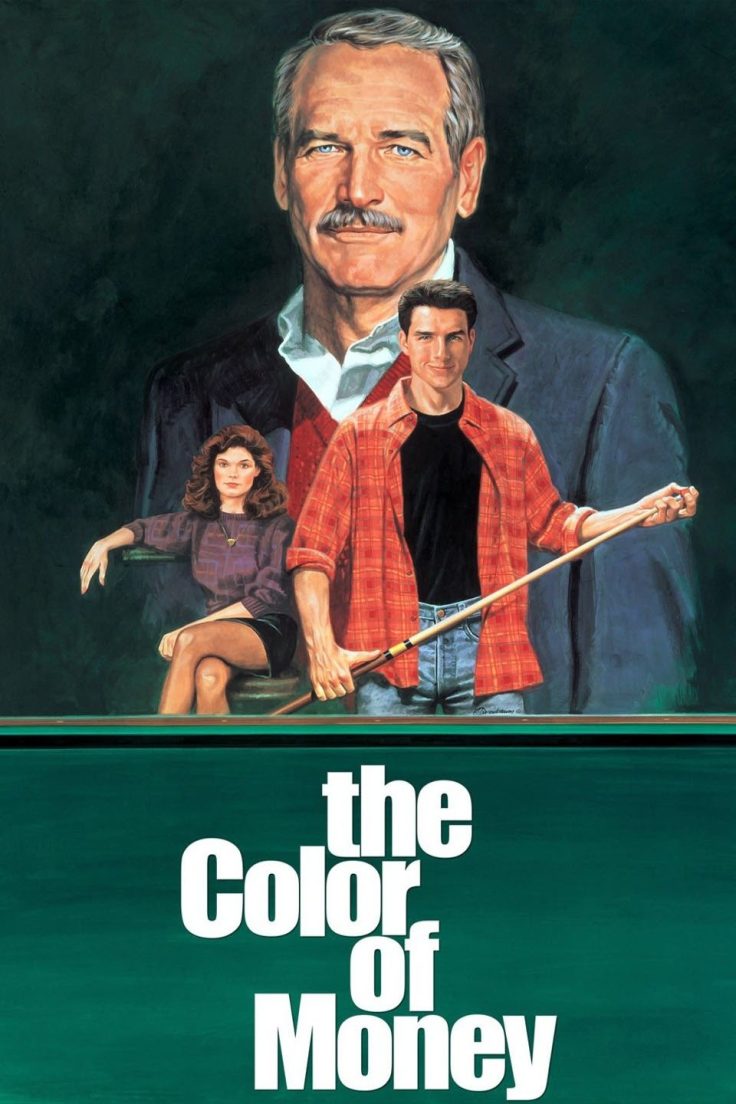
The Color of Money is not the best film in its three leads' bodies of work (meaning costars Paul Newman and Tom Cruise, alongside director Martin Scorsese). That would be—reader objections expected—The Sting for Newman, Collateral for Cruise, and Goodfellas for Scorsese. Nor is it the most impressive entry in each man's catalogue: Newman's alcoholic ambulance chaser in The Verdict and Cruise's pickup artist-slash-motivational speaker in Magnolia represent two actors at the peak of their powers, while Raging Bull is Scorsese's true technical masterpiece. But The Color of Money occupies a genuinely important place in each of their careers.
The movie itself, a sequel to 1961's The Hustler, picks up two decades or so after the original left off. Newman's "Fast Eddie" Felson, a small-time pool player who never made it big, is now a successful liquor wholesaler in Chicago who bankrolls John Turturro to skim money off unsuspecting marks. That is, until Cruise's Vince Lauria appears and dispatches Turturro. Felson, seeing Vince as both an investment and his ticket to the big time, recruits him as his new hustler. He teaches him the art of "dumping," or losing on purpose to drive up one's odds for a later match, and takes him around Chicago and then to Atlantic City to reap the rewards.
Newman was by no means washed up by the time he reprised his role as Fast Eddie. But he had—quite famously—failed to achieve the glory befitting the greatest movie star of his generation. By 1986, Newman had been nominated for the Oscar for Best Actor six times: For Cat on a Hot Tin Roof in 1959, The Hustler in 1962, Hud in 1964, Cool Hand Luke in 1968, Absence of Malice in 1982, and The Verdict in 1983. He won none. In 1986, the Academy gave him an honorary Oscar, to which Newman joked he was grateful it "did not come wrapped as a gift certificate to Forest Lawn," a Los Angeles cemetery. In the years between the 1982 release of The Verdict and his 1986 honorary Oscar, the only movie Newman made was Harry & Son, a critical and commercial failure.
Newman's acting career was on its last legs, it seemed. He was pouring himself into racing and his charitable Newman's Own salad dressing company. But as he said in his acceptance speech for that honorary Oscar, that award gave him "a kind of permission" to take risks. Maybe, he said, his "best work [was] down the pike." It turned out that exact kind of project was in the works. Two years earlier, Newman, running point on a sequel to The Hustler, called another down-on-his-luck Hollywood icon in Scorsese.
In 1984, Scorsese's long-running snub from the Academy had yet to become Hollywood legend. Raging Bull earned him a Best Director nomination, the first and only to that point in his career. After his first two films, 1967's Who's That Knocking at My Door and 1972's Boxcar Bertha, 1973's Mean Streets put Scorsese on the map. He followed that with Alice Doesn't Live Here Anymore in 1974 and Taxi Driver in 1976, establishing himself as a critical darling and a bankable box-office director. What followed was different. New York, New York, released in 1977, failed to win over critics or moviegoers, and though Raging Bull did earn a bevy of Oscar nominations, it was not a financial success. Scorsese's next film, The King of Comedy, made him radioactive. Now widely considered one of his best, it grossed only $2.5 million on a $19 million budget and sank Scorsese's hopes of making his passion project, The Last Temptation of Christ. By the time Newman called him, Scorsese was reduced to working as a gun-for-hire on After Hours, a far cry from the celebrated filmmaker audiences know him as today.
The next move Newman made was finding his Vince. Legend has it that Newman met Cruise after seeing him in 1981's Taps, took a liking to him, and nicknamed him "Killer." When Newman got Cruise for The Color of Money in 1985, though, it wasn't the slam dunk it would seem the next year, when the movie opened five months after another iconic 1986 picture, Top Gun. Cruise had a string of successes after Taps with, among others, Risky Business and All the Right Moves, turning him into one of Hollywood's brightest up-and-comers. He had promise, but he wasn't yet a movie star. Newman made a bet that that's what he'd be.
And boy, was Newman right—not just about Cruise, but about the entire Color of Money project. Again, the movie isn't the best or most impressive in each of their careers, but there's a good case to be made that it's one of the most important. It starts with what we see on screen. For Cruise, it's the making of a movie star. The highlight of the film comes just before its midpoint. Eddie takes Vince to Chalkies, a black billiards bar, where he tries to teach him how to hustle. Vince has none of it, and Cruise lets loose.
Singing along to "Werewolves of London" and performing nunchuk moves with his cue, Cruise gives what may be the biggest performance of his career. It works. Scorsese's camera is as in love with Cruise as any camera has ever been with any actor, and the result is a movie star. Cruise in Top Gun is the coolest guy around; in The Color of Money, he allows himself to get a bit ridiculous. That moment—delivered without any sort of knowing wink to the audience—is enough to make a career. Coming on the heels of Top Gun, it cements him as Hollywood royalty, and he follows this peak with a decade-long run that includes Rain Man, Born on the Fourth of July, A Few Good Men, Jerry Maguire, and the first Mission: Impossible movie.
Newman, too, is in full movie-star mode. When we first see him, we don't see the washed-up drunk from The Verdict. We see him in total command of his surroundings, unleashing those piercing blue eyes and that effortless charisma that made him a legend.
Orchestrating one pivotal scene like a conductor, Newman first tells Vince his girlfriend, Carmen—played by an electric Mary Elizabeth Mastrantonio—may leave him for someone more serious about making money. Cue the next moment, when Eddie tries to entice Vince to join him on the road. Newman's Eddie manages the whole scene from his barstool: He coaches Carmen to go cold on Vince and walk out of the bar, confirming the fears he stirred in Vince. Newman, directing each character's every move without leaving his seat, is in prime form. But his finest moment comes in Atlantic City. Eddie enters the same tournament as Vince, who tanked his own odds by failing to dump enough games. Eddie defeats Vince in a Newman-Cruise showdown, only to learn that Vince bet on Eddie and threw the game. Newman withdraws from the tournament, returns the $8,000 Vince won for him, and challenges his protégé to a real game.
Scorsese follows the two into a backroom with a beautiful Busby Berkeley-style overhead shot into an array of pool tables, where Eddie and Vince break simultaneously. Newman, just before the screen cuts to black, says, "I'm back." And he was. The same Newman who accepted a lifetime achievement Oscar he likened to a funeral won the Academy Award for Best Actor in 1987, his first win on his seventh nomination. Instead of a funeral, it was a lifeline. Newman ended up with two more Oscar noms, in 1995 for Nobody's Fool and in 2003 for his supporting role in Road to Perdition.
If The Color of Money provided a roadmap for Cruise and a comeback for Newman, it did both for Scorsese. The film made about $52 million at the box office, the director's biggest hit to that point. More importantly, it restored his reputation. It got The Last Temptation of Christ made just two years later, and even when films like Kundun bombed at the box office, those failures couldn't land him in director jail ever again. The Color of Money didn't just get Scorsese out of the doghouse, though. It brought him the team and the techniques that would come to define the rest of his career. With Michael Ballhaus as cinematographer, Robbie Robertson putting together a score, and longtime editor Thelma Schoonmaker cutting the film together, Scorsese's crew was set, and it's evident in the finished product.
That Newman scene early in the film, when he directs the action in the bar from his stool, is composed of the sorts of long tracking shots we'd see in Goodfellas. The "Werewolves of London" scene is one of the earliest examples we have of Scorsese mastering the use of music in a film. With Robertson's help, he'd do the same in Casino and The Wolf of Wall Street. One scene in particular, viewed with the benefit of having seen the rest of Scorsese's filmography, is like watching a master impressionist first discover his brushstroke. Vince's last match before Atlantic City sees him face off against Grady Seasons, by Eddie's light the best money player in the game. The game plan is for Vince to lose and drive his odds up. As we know, that isn't how it went.
Seasons taunts Vince, and Vince turns it on. As our hero once again lets his ego get the better of him, Scorsese unleashes his camera. It zips around the table, becoming almost hostile, with sharp, quick cuts seemingly aimed at disorienting the viewer, all while Scorsese-style barroom blues plays in the background. It isn't a stylistic peak for Scorsese, but any viewer can trace the throughline from the Grady Seasons scene to the cocaine-fueled paranoia of the last act in Goodfellas or the hellish chaos of the Stratton Oakmont office in The Wolf of Wall Street.
Newman said in his honorary Oscar acceptance speech that he hoped his best work was ahead of him. That may not have been true for Fast Eddie, but Newman sank the nine ball, and both Cruise and Scorsese were in position to run the table for decades.
Editor's note: This retrospective review is one in a series celebrating 1986, arguably the greatest year in movies—inarguably if you're Gen X.
Zach Kessel is the politics editor of the Washington Free Beacon.